My phone rang at 11:43 p.m.
I remember the time because the clock above the kitchen doorway had been stuck three minutes fast for almost a year, and I had been meaning to fix it since February.
Retirement does strange things to a man who spent forty years measuring time in blood pressure drops, incision windows, medication schedules, and the narrow margins between intervention and loss.
You think you will enjoy silence.
Then silence becomes a room too large for one person.
That night, my kitchen was quiet except for the dishwasher humming behind me.
A half-cold mug of coffee sat beside the sink.
Outside, the porch flag barely moved in the damp night air.
The whole house had that tired, empty stillness that settles after midnight when there is no one else breathing under your roof.
Then I heard Dr. Alan Mercer’s voice.
“Richard, get to St. Mary’s now.”
He did not say hello.
He did not soften his tone.
That was the first sign.
I had worked beside Alan for twenty years.
We had stood shoulder to shoulder in operating rooms, emergency bays, and family consultation rooms where every sentence had to be chosen with mercy and precision.
I had watched him tell parents their children did not survive.
I had watched him keep his voice steady while a young resident vomited into a trash can after a trauma case.
I had watched him handle pileups, shootings, farm accidents, collapsed lungs, severed fingers, and one awful summer night when three teenagers came in from the same wreck and only one left alive.
Alan did not scare easily.
That was what scared me.
“It’s Emily,” he said.
I was already reaching for my keys.
“What happened?”
“She came into the ER forty minutes ago. Severe trauma to her back. Possible assault.”
His breath caught.
Only slightly.
Most people would have missed it.
I did not.
“You need to see this yourself.”
There are phone calls that divide a life cleanly.
Before.
After.
I remember knocking my coffee mug with my elbow and not stopping to wipe up the spill.
I remember trying to put my right shoe on the wrong foot.
I remember grabbing my coat, missing the sleeve, and cursing in a voice that sounded younger and more frightened than mine had in years.
My daughter was thirty-four years old.
A grown woman.
A teacher.
A wife.
Still, in that moment, she was six again, asleep in the backseat after a county fair, clutching a stuffed rabbit with one dirty ear.
She was seventeen, standing in our driveway with her college acceptance letter, trying not to cry because she wanted to look brave.
She was a bride in white lace, smiling at me through tears while Daniel Carter Miller stood beside her and promised to take care of her.
Ten minutes after Alan’s call, I came through the ambulance entrance at St. Mary’s.
I was still wearing the gray sweater I had fallen asleep in.
My shoes were untied.
My hands were cold from gripping the steering wheel.
The ER smelled like antiseptic, rainwater tracked in from the parking lot, and coffee burned too long.
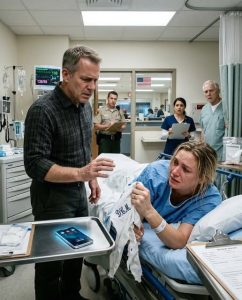
A sheriff’s deputy stood near the intake desk with a clipboard.
A nurse I did not know looked up from a hospital intake form, recognized my face from years of surgical rounds, and looked away too quickly.
That look went through me.
Medical staff learn to hide pity.
When they fail, the news is usually worse than words.
Alan met me outside Trauma Two.
His face was pale.
Not tired.
Not professional.
Pale.
“Where’s Emily?” I asked.
He did not answer at first.
He only put one hand on the curtain.
It was the same hand I had seen steady a scalpel through a twelve-hour surgery.
For one second, it trembled.
“She’s sedated,” he said. “She was conscious when she arrived. She asked for you.”
“Did she say who did this?”
Alan’s jaw tightened.
“Richard. Look first.”
A lifetime in medicine teaches a man to enter rooms prepared.
That is a lie we tell ourselves.
Nothing prepares a father to enter the room where his child has been hurt by someone who knew where she slept.
Alan opened the curtain.
Emily was lying face down on the hospital bed.
Her blond hair was damp and tangled against her cheek.
Her fingers twitched against the sheet as if some part of her was still trying to hold on to the world.
A blue hospital wristband circled her wrist.
The monitor beside her blinked a steady green line, ordinary and obscene in its calmness.
The back of her gown had been cut away.
At first, my mind tried to protect me.
I thought the marks across her back were bruises.
Then I stepped closer.
They were not bruises.
They were words.
Not rage.
Not panic.
Not one wild moment that had gone too far.
This was control.
This was someone taking time.
A message had been cut into her skin in shallow, deliberate lines.
The trauma nurse had placed gauze around the edges but left the pattern visible for documentation.
I saw the camera tag on the counter.
I saw the plastic evidence bag.
I saw the INCIDENT REPORT form clipped beside her chart, the top line stamped 11:08 p.m.
I had spent forty years keeping my hands steady over other people’s children.
That night, I could barely keep them at my sides.
The letters stretched from one shoulder blade to the other.
HE LIED TO YOU TOO.
For one second, the room disappeared.
No monitor.
No nurse.
No rain against the ambulance bay doors.
Only my daughter’s back, my daughter’s breath, and those five words sitting there like they had been waiting for me.
Alan said my name quietly.
“Richard.”
I could not answer.
I was reading the message again.
HE LIED TO YOU TOO.
The words did not belong to a random attacker.
They had direction.
Purpose.
A target beyond Emily.
Someone had wanted me to see them.
That realization made the floor feel unstable.
I thought of Daniel.
Of course I did.
Daniel Carter Miller had been in our family for nine years.
He was the sort of man who looked good beside a grill at summer gatherings and better beside a Christmas tree.
He knew how to make eye contact with older men.
He knew when to say “sir.”
He knew exactly how much humility to perform without seeming weak.
He had eaten at my table.
Borrowed my ladder.
Called me for advice when their water heater burst.
He had stood in my garage with grease on his hands and told me he had never had a father figure like me.
That is how men like Daniel get close.
Not by forcing the lock.
By asking for a spare key.
I gave him one.
Literally.
After the wedding, I gave him the emergency key to my house because Emily had always misplaced hers.
I gave him trust.
I gave him access.
I gave him my daughter’s life because decent men are supposed to recognize other decent men.
Trust is not stolen all at once.
It is invited in, cup by cup, favor by favor, until one day you realize the door was never locked.
“Richard,” Alan said again.
This time I followed his eyes.
Something was tucked under Emily’s trembling right hand.
A torn strip of fabric.
The nurse had not pulled it free.
Alan told me whoever brought Emily in said she had been clutching it when she collapsed near the ER doors.
The fabric was white.
Men’s dress-shirt cotton.
Ripped rough at one edge.
Stained dark at the other.
On the corner, stitched in navy thread, were three initials.
D.C.M.
Daniel Carter Miller.
My son-in-law.
My mouth went dry.
Alan did not say what we were both thinking.
He did not have to.
The deputy near the hallway stepped closer, careful not to crowd me.
“Dr. Hayes, we’ll need that bagged once the attending clears it.”
I heard myself answer like I was standing outside my own body.
“Photograph it first. Under her hand. Then remove it. Chain of custody starts before anyone touches anything.”
The deputy nodded immediately.
Professional recognition passed between us.
Not comfort.
Not hope.
Procedure.
When the world becomes unbearable, procedure is a railing.
The trauma nurse lifted the camera.
A flash reflected off the metal tray.
The deputy marked the time.
11:57 p.m.
Alan watched me with the strained expression of a friend who wanted to stand between me and what I had seen but knew there was no place to stand.
For one ugly heartbeat, I wanted violence.
Not justice.
Violence.
I wanted to pick up the nearest metal tray and throw it through the glass cabinet.
I wanted Daniel in front of me.
I wanted his collar in my hands.
I wanted every calm thing I had ever taught young surgeons to leave my body at once.
Then Emily’s fingers moved.
Barely.
Her eyes opened.
The room snapped back into focus so hard it hurt.
“Emily?”
I bent low, close enough that she would not have to turn her head.
“Baby, I’m here.”
Her lashes fluttered.
Her eyes were glassy from pain medicine, red at the edges, terrified in a way no child should ever look at her father.
Her lips moved.
I leaned closer.
“Dad…”
“I’m here.”
Her hand tightened around the torn fabric.
The monitor ticked faster.
“Don’t let him know…”
Alan stepped forward, but I lifted one hand to stop him.
Emily swallowed.
Her voice was so thin it almost disappeared beneath the oxygen line.
“Don’t let him know I’m still alive.”
The deputy stopped writing.
Alan’s face changed.
Before I could ask who she meant, my phone buzzed in my coat pocket.
Daniel’s name lit up the screen.
For three seconds, nobody in Trauma Two breathed.
The phone buzzed again against my palm.
Emily saw the screen.
Her eyes widened, not with confusion, but recognition.
Alan lowered his voice.
“Richard, do not answer that unless the deputy is recording.”
The deputy was already reaching toward his body camera.
I stared at the caller ID.
Daniel Carter Miller.
The man whose monogram was stitched into the torn cloth under my daughter’s hand.
The man who had stood in my kitchen and eaten my food.
The man Emily had just begged me not to alert.
My thumb hovered over the screen.
Then Alan noticed something beneath Emily’s hospital wristband.
A thin black mark.
At first I thought it was smudged makeup or marker from triage.
The trauma nurse gently lifted the edge of the tape without moving Emily’s arm.
Four numbers were written there in shaky ink.
2-1-7-9.
Emily’s lips trembled.
“Locker,” she whispered. “Bus station.”
The deputy looked up.
“What locker?”
Emily fought the medication.
I could see the effort in the tiny muscles around her eyes.
“Proof,” she breathed.
My phone stopped buzzing.
Then a text appeared.
Daniel: Richard, I heard Emily had an accident. I’m coming to the hospital now. Don’t let anyone talk to her until I get there.
Alan’s expression went cold in a way I had only seen during surgery when something had gone catastrophically wrong and emotion had to be buried beneath action.
The deputy stepped toward the door and spoke into his radio.
I looked at my daughter.
Then at the four numbers on her wrist.
Then at Daniel’s text.
Come through the ambulance entrance, I wrote.
My hands were steady when I sent it.
That steadiness frightened me.
Alan read the message over my shoulder.
“You’re sure?”
“No,” I said. “But he is.”
The deputy requested additional units and instructed security to lock down the side exits.
Another nurse closed the trauma curtain.
Alan ordered Emily moved under a protected patient protocol.
The room began to operate like a body responding to injury.
Each person had a role.
Each role mattered.
That saved me from becoming only a father with rage in his chest.
The torn fabric was photographed under Emily’s hand.
Then removed with forceps and sealed in an evidence bag.
The time was marked.
The attending physician documented the wounds.
The nurse photographed the numbers on Emily’s wrist.
Alan dictated a note for the medical record using a voice so controlled it made me want to weep.
Adult female, severe back trauma, deliberate incised lettering, patient fearful of known person, possible ongoing threat.
Known person.
Those words landed hard.
Daniel was not a monster in an alley.
He was a known person.
That is where danger often hides best.
At 12:09 a.m., the deputy’s radio crackled.
A black pickup had turned into the ambulance bay.
Daniel had arrived.
I had imagined him looking wild.
He did not.
He wore dark jeans, a navy jacket, and a white dress shirt missing part of one cuff.
The remaining cuff was monogrammed.
D.C.M.
Security camera footage later showed him stepping out of the truck and smoothing his hair in the reflection of the driver’s window before walking toward the doors.
That small gesture haunted me for months.