Vanity, even then.
Performance, even there.
The deputy met him before he reached the second set of doors.
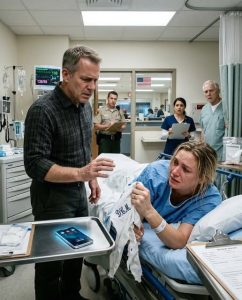
I stood far enough back that Daniel could see me through the glass but not reach me.
His face shifted when he saw me.
Concern first.
Then calculation.
Then anger, hidden so quickly another man might have missed it.
“Richard,” he called. “Where’s Emily?”
I did not answer.
The deputy asked him to step inside and keep his hands visible.
Daniel laughed.
“What is this?”
“Routine questions,” the deputy said.
Daniel looked past him toward me.
“Is she awake?”
I said nothing.
That was when he knew.
Not the whole thing.
But enough.
His eyes flicked once toward the trauma corridor, once toward the exit, once toward the deputy’s hand near his belt.
A guilty man does not always run.
Sometimes he starts narrating.
“I don’t know what she told you,” Daniel said, voice rising, “but she’s been unstable. She’s been paranoid. We argued earlier, and she left. I’ve been looking everywhere for her.”
The deputy asked, “Why did you tell Dr. Hayes not to let anyone talk to her?”
Daniel’s mouth tightened.
“I was worried she’d be confused.”
“About what?”
“About the accident.”
“What accident?”
Daniel blinked.
It was tiny.
It was enough.
The deputy saw it.
So did I.
Before Daniel could answer, Alan stepped beside me.
“Emily did not have an accident,” he said.
Daniel’s face went blank.
A blank face is not innocence.
Sometimes it is a curtain dropping.
The deputy asked Daniel to come to a private room.
Daniel refused.
Then security moved closer.
Then he said he wanted a lawyer.
That was the smartest thing he said all night.
At 12:31 a.m., Daniel Carter Miller was detained for questioning.
At 12:44 a.m., another deputy left for the bus station with the locker number written on Emily’s wrist.
I stayed with my daughter.
Alan told me I should sit.
I did not.
The human body can stand far longer than the heart believes it can.
Emily drifted in and out beneath medication.
Once, she whispered, “Did he come?”
“Yes.”
“Did you tell him?”
“No.”
Her face loosened by one degree.
That degree was worth everything.
At 1:26 a.m., the deputy at the bus station called.
Locker 2179 existed.
Inside was a small canvas bag.
Inside the bag were a burner phone, a flash drive, Emily’s missing house keys, and a folded copy of a bank statement with highlighted withdrawals from a joint account.
There were also photos.
Not many.
Enough.
Photos of Daniel with another woman outside a motel near the interstate.
Photos of Emily’s car parked behind the bus station.
A screenshot printed on cheap paper from a message thread in which Daniel wrote, She knows too much. I can handle it.
No one spoke for several seconds after the deputy read that line over the phone.
I looked at Alan.
He looked at the floor.
There are sentences that do not need interpretation.
They only need evidence tape.
The flash drive came later.
That was the worst of it.
Not because it showed the attack.
It did not.
Emily had been careful enough to record audio before things turned violent, not because she expected mercy from the law, but because she no longer expected truth from her husband.
The recording captured Daniel’s voice.
Calm.
Dismissive.
Almost bored.
You should have stayed out of my accounts.
Then Emily, frightened but steady.
You used Dad’s investment money.
Then Daniel.
Your father trusted me because he wanted a son.
That line made the message on her back make sense.
HE LIED TO YOU TOO.
Daniel had not only betrayed Emily.
He had used me.
Years earlier, after my retirement, Daniel had approached me about a small medical office development.
He said he wanted to diversify.
He said he respected my judgment.
He said he hoped to build something that would make Emily proud.
I invested.
Not everything.
Enough to hurt.
Enough to feel ashamed.
The quarterly reports came by email.
Clean formatting.
Professional language.
Fake confidence.
Emily had found irregularities.
Emily had followed the money.
Emily had discovered Daniel was moving funds through accounts tied to the woman in the motel photos.
When she confronted him, he tried to make her sound unstable.
When that failed, he tried to make her silent.
That was the shape of it.
Not passion.
Not rage.
Exposure.
Daniel was not afraid of losing Emily.
He was afraid of being seen.
By dawn, Emily was in a protected hospital room.
Two deputies were posted nearby.
Daniel had an attorney.
The woman from the motel had been identified.
The district attorney had been notified.
I had not slept.
Alan brought me coffee at 6:15 a.m.
It tasted terrible.
I drank all of it.
“You need to call someone,” he said.
“I did.”
“Who?”
“You.”
He sat beside me then.
For a while, neither of us spoke.
In medicine, silence can be a kindness.
In family, silence had nearly killed my daughter.
That difference stayed with me.
Emily woke more fully just after eight.
Her voice was raw.
She asked whether Daniel had been arrested.
I told her he had been detained and would not reach her.
She asked whether I hated her for not telling me sooner.
That question broke something in me that the sight of her injuries had not.
I took her hand carefully, avoiding the IV.
“Emily,” I said, “there is nothing you could tell me that would make me hate you.”
Tears slipped sideways into her hair.
“He said you would think I was stupid.”
I closed my eyes.
Daniel had known exactly where to cut long before that night.
Not her back.
Her trust.
Her belief that I would stand beside her.
“He was wrong,” I said.
She swallowed.
“I found the accounts by accident. Then I kept looking. He said if I told you, he’d make sure everyone knew I helped him. I didn’t. I swear I didn’t.”
“I know.”
She looked at me.
“You don’t know everything.”
“I know you.”
That was not enough to undo what had happened.
But it was a place to begin.
The legal case moved with the slow cruelty of systems that require injured people to repeat themselves.
Statements.
Photographs.
Medical records.
Evidence logs.
Financial audits.
The INCIDENT REPORT stamped 11:08 p.m. became part of a larger file.
So did the torn fabric with D.C.M.
So did the locker contents.
So did the burner phone.
So did the bank records.
I gave a statement about the investment.
Then another.
Then records from my own accounts.
I sat across from investigators and explained how a retired surgeon could be foolish enough to trust a charming man in a clean shirt.
One detective corrected me.
“Trusting family is not foolish, Dr. Hayes.”
I nodded, but did not believe him for a long time.
Daniel’s defense tried everything.
Emily was unstable.
Emily had injured herself.
Emily had staged evidence.
Emily had misread financial documents.
Emily had been medicated.
Emily had been emotional.
Emily had been jealous.
There are old scripts for women who survive.
His attorney used several.
Then the audio played.
Not in public at first.
In a hearing.
Daniel’s voice filled the room.
Your father trusted me because he wanted a son.
I watched the judge’s face.
I watched Daniel look down.
I watched Emily sit straighter beside the victim advocate.
And I felt something settle in me.
Not peace.
Certainty.
The plea came six months later.
Assault.
Financial exploitation.
Evidence tampering.
Additional charges tied to the investment fraud.
The sentence was not enough.
No sentence would have been enough.
Prison can measure years.
It cannot measure the moment a father sees his child lying face down in a trauma bed with a message carved into pain.
But it was something.
It was a door locked from the correct side.
Emily healed slowly.
Skin heals with its own stubborn intelligence.
The mind is less obedient.
There were dressings.
Follow-up appointments.
Physical therapy.
Nightmares.
Days when she could not stand fabric touching her back.
Days when the phone rang and she froze.
Days when she apologized for needing help and I had to leave the room because the apology made me angrier than any scream.
Not at her.
Never at her.
At the man who taught her survival should sound like inconvenience.
She moved into my house for eight months.
The kitchen stopped feeling empty.
There were mugs in the sink that were not mine.
A sweater over the back of a chair.
Prescription bottles lined up beside the coffee can.
On difficult nights, we sat without speaking while the dishwasher hummed and the porch flag barely moved in the dark.
Sometimes silence is not abandonment.
Sometimes silence is two people breathing in the same room because words would be too small.
One afternoon, almost a year after the attack, Emily asked me to drive her to the county fair.
I thought she was joking.
She was not.
We walked past the rides, the food stands, the livestock barns, the same places she had loved as a child.
She bought a cheap stuffed rabbit from a game booth.
One ear was slightly dirty from falling against the gravel.
She held it up and smiled.
“Full circle?”
I could not speak for a moment.
Then I said, “Something like that.”
She laughed.
It was not the laugh she had before Daniel.
It was quieter.
More careful.
But it was real.
That was when I understood healing does not mean returning to the person you were before.
Sometimes it means becoming someone who can carry the proof and still walk forward.
I still keep copies of the documents.
The incident report.
The evidence receipt.
The investment records.
The printed text Daniel sent me outside Trauma Two.
Richard, I heard Emily had an accident.
He had called it an accident before anyone told him what happened.
That sentence sits in the folder like a nail.
I do not look at it often.
I do not need to.
Paper tells the truth better than people do.
Ink does not flatter.
A signature does not pretend it was misunderstood.
And a message sent too early can reveal the lie a man thought he was smart enough to control.
Emily lives three towns away now.
She teaches again.
She has a dog that sheds on everything.
She keeps the bus station locker key on a chain in a small box, not because she wants to remember terror, but because she wants to remember herself.
The woman who wrote four numbers on her wrist while bleeding.
The woman who made it to the ER doors.
The woman who held on to proof with one hand and life with the other.
As for me, I am still a retired surgeon.
My hands are not as steady as they once were.
But when Emily calls, I answer.
Every time.
Not because I think danger is always coming.
Because once, late at night, my phone rang at 11:43 p.m., and my daughter was alive on the other end of someone else’s courage.
A father reads smaller things.
The stillness of a child’s hand.
The angle of her shoulder.
The way a room goes quiet because grief has just walked in.
And sometimes, if he is lucky, he also gets to read something else.
A breath.
A second chance.
A daughter who survived long enough to say, “Dad, I’m here.”
END!