Part 2/1
The cathedral fell so silent I could hear the tiny electric hum of the microphones near the altar.
Rebecca’s fingers tightened around Grant’s hand. Not in fear exactly. In possession.
My father’s coffin gleamed beneath the flowers, polished mahogany under blue delphiniums, and for one dizzy second I thought about how much he would have hated this.
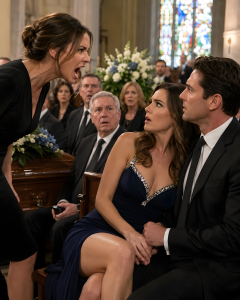
Not the scandal. My father, Charles Whitmore, had survived scandal like other men survived weather. He would have hated the carelessness.
The cheap theater of it. The insult disguised as confidence.
A mistress in the family pew.
My dress on her body.
My husband whispering, “Not here,” as though my grief had inconvenienced his affair.
Aunt Helen moved first.
She crossed the aisle with the deadly calm of a woman who had once made a boardroom of oil executives apologize to her in alphabetical order.
“Rebecca,” she said, her voice smooth as a knife drawn from velvet. “You are sitting in my sister’s seat.”
Rebecca blinked. “I’m sorry?”
“My late sister. Natalie’s mother. That seat is reserved for family.”
Grant stood quickly, color climbing his neck. “Helen, please—”
“No,” Aunt Helen said. “I have been saying please all morning. Please sign the guest book. Please turn off your phones. Please do not put your coffee on the antique sideboard. I am finished with please.”
People were watching now. Cousins, business partners, my father’s old golf friends, women from charity boards who could smell disgrace through walls.
Rebecca looked at Grant, expecting rescue.
Grant looked at me.
That was his mistake.
Because until that moment, some broken, exhausted part of me had still been waiting for him to become the man I married. The man who held my hand through my mother’s hospice. The man who danced barefoot with me in our kitchen the night we signed the papers on our first house. The man who promised my father, under a white tent in June, that he would spend his life protecting me from pain.
But he did not move toward me.
He moved toward Rebecca.
“Come on,” he murmured to her, helping her stand.
My dress whispered against her thighs as she rose.
Something inside me went cold and clean.
“Leave the dress,” I said.
Rebecca froze.
Grant’s head snapped toward me. “Natalie.”
“It’s mine,” I said. “My father bought it. You stole it from my closet and gave it to your girlfriend. So she can leave the church, but the dress stays.”
A gasp fluttered somewhere behind me.
Rebecca’s mouth opened, then closed.
She was not prepared for that. Women like Rebecca practiced softness because softness made men underestimate the damage they caused on her behalf. But she had not practiced being publicly named.
Her eyes sharpened. “I didn’t steal anything.”
“No,” I said. “You only wore stolen property to a funeral.”
Grant leaned in, voice low. “You’re making a scene.”
I laughed once.
It was not a pretty sound.
“My father is dead,” I said. “My husband brought his mistress to the funeral, seated her in the family row, and dressed her in my missing birthday gift. Grant, darling, the scene made itself.”
Aunt Helen’s mouth twitched.
Then Mr. Blackwood stepped forward.
He was nearly seventy, narrow and dignified, with silver hair combed back from a severe face. In all my life, I had never seen him raise his voice. He did not have to. Authority lived in him like bone.
“Mrs. Thornton,” he said to Rebecca, “you may wait outside.”
Rebecca flinched at the use of her name.
Mrs.
My eyes moved to her left hand.
There was no ring.
Mr. Blackwood noticed me noticing. Something unreadable crossed his face.
Grant swallowed. “Edward, this is inappropriate.”
“Yes,” Mr. Blackwood said. “It is.”
Then he turned away from them as though they were furniture placed badly in a room and touched my elbow.
“Natalie,” he said gently, “your father asked me, specifically, to continue today no matter what occurred.”
“What does that mean?” I whispered.
His gaze flicked to the cream envelope in his hand.
“It means he knew.”
The words did not strike like thunder. They sank like a blade between ribs.
He knew.
Yesterday, the lawyer had said. In my father’s will: To my daughter Natalie, who called me yesterday about her husband’s affair…
But I had not called him yesterday.
I had not called my father at all the day before he died.
I opened my mouth to say so.
Before I could, Rebecca spoke behind me.
“This is ridiculous,” she said, louder now, trying to recover. “I came to pay my respects.”
Mr. Blackwood turned.
“To whom?”
The question was so simple that it stripped the room bare.
Rebecca’s lips parted.
She had no answer. She had never met my father.
Grant touched her arm. “Let’s go.”
But as they moved toward the aisle, Father Martinez gently stepped aside, revealing two security guards from the back of the cathedral. My father’s security guards. I had thought they were there for crowd control, an old habit from years of Dad attending events with politicians and judges.
Now one of them stepped into the aisle.
Rebecca stopped.
The guard said, “Ma’am, Mr. Blackwood requested you remain on the premises until after the reading.”
Rebecca’s face drained.
Grant stiffened. “You can’t detain her.”
“No,” Mr. Blackwood said. “But I can inform her that leaving before the reading will trigger a provision in Mr. Whitmore’s estate documents. One that concerns both of you.”
Grant looked as if the marble beneath him had opened.
Aunt Helen whispered, “Charles, you magnificent bastard.”
The funeral service continued.
That was the strangest part.
Father Martinez began speaking about dust, mercy, memory, the valley of shadow. People dabbed their eyes and pretended they had not just witnessed a woman being socially executed in couture. Rebecca sat at the far end of the second row, away from Grant now, hands folded tightly in her lap, my crystals burning at her throat.
Grant sat beside me because, by ceremony and law, he was still my husband.
His shoulder did not touch mine.
Once, during the hymn, he whispered, “Nat, I can explain.”
I kept my eyes on my father’s coffin.
“No,” I whispered back. “You can try.”
He said nothing after that.
When the service ended, I followed the casket out under a hard white sky. The cemetery grass was wet from morning rain. Mud clung to the heels of women who had dressed for marble, not earth. My father was lowered beside my mother while the wind lifted the priest’s black robe and sent a shiver through the roses.
I did not cry until the first shovel of dirt hit the casket.
The sound was small. Dull. Final.
Aunt Helen put an arm around me, and for a moment I let myself fold.
Grant stood a few feet away, performing grief with his hands clasped in front of him.
Rebecca remained near a black car, guarded by silence and two men who did not smile.
The will was read at Whitmore House an hour later.
My childhood home sat on six acres overlooking the river, all gray stone, ivy, and windows tall enough to reflect the sky in pieces. It had never felt warm after my mother died. My father tried, God help him. He filled rooms with books, dogs, flowers, music. But grief had a way of becoming architecture if it stayed too long.
That afternoon, the house felt like a courtroom.
Family gathered in the library. Heavy curtains. Leather chairs. Decanters no one touched. My father’s portrait above the fireplace, painted ten years before his death, stared down with amused severity.
Mr. Blackwood stood at the desk with two sealed folders.
One cream.
One black.
Rebecca had been escorted in and placed near the door. She had put on a beige trench coat, but the blue hem of my dress still showed beneath it.
Grant stood beside the window, jaw clenched.
I sat in my father’s chair.
No one objected.
Mr. Blackwood cleared his throat.
“Charles Henry Whitmore executed his final will and testament twelve days ago,” he said. “At the same time, he recorded a supplemental statement to be read aloud in the event that certain named individuals were present.”
My skin prickled.
Grant said, “This is absurd. A funeral is not the place for games.”
Mr. Blackwood did not look up. “Charles anticipated you would say that.”
Aunt Helen murmured, “Of course he did.”
Mr. Blackwood opened the cream envelope.
“My dear Natalie,” he began.
The room changed.
It was still his voice, Mr. Blackwood’s careful legal voice, but the words were my father’s. I knew them instantly. The rhythm. The dry elegance. The restraint that always made tenderness more devastating.
“My dear Natalie, if Edward is reading this in front of Grant, then I failed to protect you quietly. Forgive me. I had hoped to hand you truth in private, with a glass of wine, two aspirin, and the name of a vicious divorce attorney. Circumstances, however, appear to have developed a flair for theater.”
A shaky sound escaped me. Half sob, half laugh.
Grant went pale.
Mr. Blackwood continued.
“You called me yesterday, though perhaps not in the way the room assumes. Your phone number appeared on my screen at 9:42 p.m. I answered. You did not speak. Instead, I heard Grant. I heard a woman. I heard enough.”
My heart stopped.
My phone.
Yesterday evening, I had searched for my father’s number but never called. I remembered standing in my bedroom, the house too quiet, suspicion gnawing at me. Grant had said he was working late. I had found one of Rebecca’s earrings under the guest bed two days earlier.
I had picked up my phone.
I had almost called Dad.
Then I had lost my nerve.
Had I called accidentally?
Mr. Blackwood’s voice went on.
“I stayed on the line for four minutes and thirty-eight seconds. Long enough to hear Grant tell Rebecca that once I was dead, Natalie would be manageable. Long enough to hear Rebecca ask whether the old man had changed the trust yet. Long enough to hear Grant say, and I quote, ‘He signs whatever Natalie puts in front of him when she cries.’”
The room erupted.
Aunt Helen stood so quickly her chair hit the rug.
Grant shouted, “That is a lie.”
Rebecca whispered, “Grant.”
He turned on her. “Shut up.”
There he was.
Not my husband, not the polished partner, not the grieving son-in-law.
The man beneath.
My father’s letter continued.
“I was disappointed, but not surprised. Men who confuse kindness with weakness usually reveal themselves near money. What did surprise me was the mention of the blue dress. Rebecca seemed very pleased with it. Natalie, darling, I am sorry. I chose it for you because you were luminous in blue. Not because it was expensive, although I admit the receipt offended even me.”
A tear slid down my face.
I wiped it away with the heel of my hand.
“After that call,” Mr. Blackwood read, “I contacted Edward. We revised everything necessary by morning. I also made calls to people who owe me favors and several who fear me enough to pretend they do. If I died naturally, these precautions would be unnecessary. If I died suddenly, they would become useful.”
My stomach turned.
Died suddenly.
My father had died at 2:13 a.m. of a heart attack, according to the hospital.
He had been seventy-two. He had a pacemaker. He had a cardiologist, a diet plan, a trainer, and the stubborn vanity of a man who intended to live to ninety just to annoy his enemies.
A heart attack had seemed possible.
Now it felt convenient.
Grant’s voice cracked. “Are you accusing me of something?”
Mr. Blackwood looked at him at last.
“I am reading.”
The letter went on.
“To Grant: I once believed you loved my daughter. That belief has been revised. You will receive nothing from my estate. No shares, no property, no advisory seat, no forgiveness disguised as civility. Any attempt to contest this will release to Natalie and law enforcement the audio recording referenced above, along with additional materials.”
Grant stared at the floor.
“To Rebecca Thornton,” Mr. Blackwood continued.
Rebecca flinched.
“Yes,” my father had written, “I know your name. I also know about the consultancy payments routed through Mercer Bloom, the apartment on Waverly Place, and the emerald earrings Grant purchased with funds drawn from an account containing marital assets. You may keep the earrings. They are vulgar and therefore suited to you.”
Aunt Helen pressed a hand to her mouth.
No one could tell whether she was horrified or delighted.
Rebecca’s eyes filled, but the tears were angry.
“And the dress?” Mr. Blackwood read. “The dress is to be returned to Natalie immediately. If altered, damaged, sold, hidden, or removed from these premises, Miss Thornton will find herself named in a civil claim before sunset.”
Rebecca’s face hardened. “This is humiliation.”
“No,” I said quietly. “Humiliation is wearing a dead man’s gift to his daughter while sitting beside her husband at his funeral.”
She looked at me then, really looked.
For the first time, I saw not glamour, not youth, not triumph.
Fear.
Mr. Blackwood placed the cream letter down.
Then he picked up the black folder.