Part 2/2
“My father’s remaining estate,” he said, shifting back into legal formality, “including Whitmore House, the river property, the charitable foundation, and controlling interest in Whitmore Holdings, passes to Natalie Elise Whitmore-Hale, held independently and beyond the reach of any spouse.”
Grant’s head lifted.
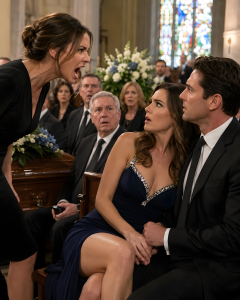
There it was. The money.
I watched grief leave his face and calculation enter.
“But there is one condition,” Mr. Blackwood said.
The room held its breath.
I almost laughed. Of course there was. My father loved conditions. He believed unconditional gifts produced lazy heirs and badly behaved spaniels.
Mr. Blackwood looked at me.
“Natalie must reside at Whitmore House for thirty consecutive days, beginning tonight, and review the contents of the private archive before full transfer of control.”
“The private archive?” I asked.
Aunt Helen went still.
Grant noticed.
So did I.
“What archive?” I said.
Mr. Blackwood closed the folder.
“The one your mother found before she died.”
The room became colder than the cathedral.
My mother, Elise, had died eighteen years earlier of an aneurysm while alone in the greenhouse. That was the family story. Sudden. Tragic. Unpreventable.
My father never spoke of that day.
Neither did Aunt Helen.
Now she had one hand on the back of a chair, knuckles white.
“Helen?” I whispered.
She did not answer.
Grant laughed sharply. “This is insane. Natalie, listen to me. Your father was grieving, paranoid. People get strange at the end.”
I turned toward him.
“At the end?” I said. “He was alive yesterday.”
Grant’s mouth shut.
A phone rang.
Everyone flinched.
It was Mr. Blackwood’s.
He checked the screen, and his expression changed in a way that made my pulse kick.
“Yes?” he answered.
He listened.
His eyes moved to Grant.
Then to Rebecca.
Then to me.
“I understand,” he said. “Send it to me now.”
He hung up slowly.
“What is it?” Aunt Helen asked.
Mr. Blackwood slipped the phone into his pocket.
“The medical examiner has requested a hold on cremation.”
I stood.
“Why?”
“Because your father’s pacemaker transmitted irregular activity shortly before his death.”
Grant’s face emptied.
Mr. Blackwood’s voice remained calm.
“There may have been external interference.”
For a moment, no one spoke.
Then Rebecca said, “I want a lawyer.”
Grant turned on her again. “Stop talking.”
But panic had loosened her tongue.
“No, you stop talking. You said he was old. You said nothing could be traced. You said—”
Grant moved so fast I barely saw him.
He grabbed her wrist.
The room exploded.
Security stepped in. Aunt Helen shouted. Rebecca cried out. My cousin Daniel knocked over a lamp. Mr. Blackwood barked Grant’s name with a force I had never heard from him.
And me?
I sat back down in my father’s chair.
Because the world had tilted too far, too quickly, and I was suddenly aware of something strange.
I was not surprised.
Horrified, yes.
Shattered, yes.
But not surprised.
Somewhere deep inside, a part of me had known. Maybe not about pacemakers or wills or secret archives. But I had known there was rot under the polished floors of my life.
Grant was escorted from the library, shouting that this was a misunderstanding, that my father hated him, that Rebecca was unstable, that I was hysterical. He reached for every old weapon. Charm. Blame. Rage. Pity.
None of them worked.
Rebecca was taken to another room to wait for her attorney. Before she left, she looked back at me.
The dress glittered beneath her coat like stolen moonlight.
“I didn’t know everything,” she said.
“No,” I said. “You knew enough.”
Her mouth trembled.
Then she was gone.
That evening, Whitmore House emptied slowly.
Relatives drifted away in stunned clusters. Cars pulled down the long drive beneath bare trees. Rain began again, soft and persistent, needling the windows.
By dusk, only Aunt Helen, Mr. Blackwood, and I remained.
And my father, everywhere.
His pipe on the desk though he had not smoked in twenty years. His chessboard near the fire with an unfinished game. His reading glasses folded on a book about Roman law. His handwriting on a yellow legal pad: Call Natalie.
I touched the words.
My chest broke open all over again.
Mr. Blackwood stood near the fireplace, looking older now that duty had paused.
“There is more,” he said.
I almost told him no. Not tonight. Not after burying my father and losing my marriage and learning that death might not have come for him naturally.
But my father had made the condition thirty days.
He had wanted me here tonight.
“Show me,” I said.
Aunt Helen closed her eyes.
“Natalie,” she said softly, “once you enter that archive, you cannot unknow what’s inside.”
I looked at her.
“Did Mom know?”
Her silence was answer enough.
Mr. Blackwood led us through the library to a panel behind my father’s portrait. He pressed two carved leaves in the wooden frame, and something clicked inside the wall.
The portrait swung open.
Behind it was a steel door.
I stared.
“Has that always been there?”
“Since your grandfather’s time,” Aunt Helen said.
“You knew?”
“I knew there was a room. I did not know everything in it.”
Mr. Blackwood entered a code.
The lock released with a deep mechanical sigh.
Cold air drifted out, carrying the smell of paper, dust, and metal.
Inside was not a room.
It was a vault.
Rows of filing cabinets lined the walls. Shelves held boxes labeled by year. There were photographs, ledgers, old reel tapes, hard drives, passports, sealed envelopes, and a long table beneath a green banker’s lamp.
At the center of the table sat a blue folder with my name on it.
Natalie.
My knees weakened.
Mr. Blackwood did not enter behind me.
“This first folder was left by your father,” he said. “For you alone.”
Aunt Helen touched my arm once, then stepped back.
I opened the folder.
On top was a photograph of my mother.
Not the mother from framed family portraits, elegant and distant in pearls.
This woman looked frightened.
She stood beside the greenhouse, hair windblown, one hand raised as if warning whoever held the camera not to come closer.
Behind the photograph was a handwritten note.
Natalie, if you are reading this, then your father finally told you there are two kinds of inheritance: what people leave you, and what they leave inside you.
The handwriting was not my father’s.
It was my mother’s.
I forgot how to breathe.
Beneath the note was a birth certificate.
Mine.
Except the father’s name was not Charles Henry Whitmore.
It was blank.
A sound came out of me, small and wounded.
Aunt Helen stepped toward me.
I backed away.
“No,” I said. “No. Don’t touch me.”
Mr. Blackwood’s face folded with pity.
I hated him for it.
I looked again, harder, hoping grief had rearranged the letters.
Mother: Elise Marguerite Whitmore.
Father: Unknown.
Unknown.
The word was a pit.
All my life, I had been Charles Whitmore’s daughter. His only child. His heir. His stubborn girl. His Sunday chess opponent. His emergency contact. His pride.
Had that been a lie?
My hands shook as I lifted the next page.
It was another letter from my father.
My darling girl,
Biology is a crude little clerk. It records facts without understanding truth. You are mine because I chose you before I knew whether I was allowed to keep you. You are mine because I held you through fever, taught you how to argue, watched you become brave enough to disappoint me. You are mine because love did what blood could not.
But your mother was right. You deserve the whole story.
The next page held one sentence.
Your biological father is alive.
Rain struck the windows behind me.
Somewhere in the house, a door slammed.
We all turned.
Mr. Blackwood stiffened.
Aunt Helen whispered, “No.”
From the hallway came the slow, deliberate sound of footsteps.
Not Grant’s. Not security.
A man appeared in the open vault doorway.
He was tall, silver-haired, dressed in a dark coat beaded with rain. He held my father’s old signet ring in one gloved hand.
And he had my eyes.
“Hello, Natalie,” he said.
“I believe your father kept something that belongs to me.”
END!