He paid three dollars for the virgin bride, and the first thing he did after the auctioneer took the coins was kneel.
For one stunned second the whole barn stopped breathing.
Men who had been grinning over whiskey went silent.
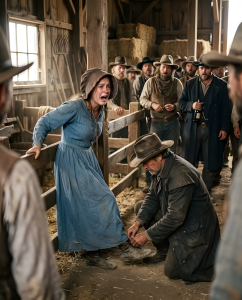
The auctioneer’s hand hung in midair.
Annabeth, nineteen years old and trembling inside a borrowed dress that smelled of someone else’s soap, felt the sound rip out of her before she understood it was hers.
She screamed because the stranger had lowered himself instead of reaching up to claim her, and after years of men towering over her, that small act of gentleness hit like a blow.
Annabeth had been brought to the sale at dawn by Harlan Bell, the man she had called father since childhood because calling him anything else brought the back of his hand across her mouth.
He had told the men at the barn that she was unclaimed now, old enough to be useful, pure enough to fetch a fair price if the buyers had any taste left in them.
Debt had dragged him there, but greed had brought him sooner or later; she knew that now.
Harlan had never looked at her as a daughter.
He looked at fields, horses, tools, and Annabeth with the same measuring eye.
The only thing in Annabeth’s possession that had not passed through Harlan’s fists was the faded bonnet on her head.
Her mother had worn it in the one blurred memory Annabeth still trusted: a soft voice humming near a window, fingers smelling of flour and lavender, and the bonnet strings brushing Annabeth’s cheek as she was lifted.
Harlan always said her mother had died weak and foolish.
He said softness killed women.
By the time Annabeth was twelve, he had beaten that lesson into her so often she stopped asking whether he was right.
The auctioneer had tipped her face up and shouted to the crowd that she was untouched.
Laughter answered him from every rail and feed sack.
Annabeth had stared at the floorboards and counted splinters to stay upright.
She had discovered long ago that fear had no bottom.
Every time she thought she had found the deepest part, some man found a way to dig lower.
Then came the voice from the back of the barn.
Three.
Not loud.
Not eager.
Certain.
The man who stepped forward wore a dark coat dusted by road miles and a hat brim low over serious eyes.
He moved like he belonged to no one and asked nothing of anyone.
He paid without bargaining.
Then he knelt, loosened the laces of her cracked shoes, and said in a voice meant only for her that she did not belong to him.
He had only paid so no one else could hurt her.
He draped his coat over her shoulders and walked away without touching her again.
That, more than the coins, convinced the barn he meant what he had said.
There was no boast in him, no performance of heroism, no claim.
When Annabeth followed him out into the pale afternoon, the men watched as if the world had slipped sideways in front of them and they did not know how to right it.
The stranger drove an old wagon west without forcing conversation.
Once, when Annabeth flinched.
that she had agreed to marry him.
She had not.
By the time Silas found the first trail, she was already carrying a child.
Harlan met Silas once outside a freight office and smiled while telling him to forget her if he valued his life.
Silas bloodied him for it, but Harlan vanished before the law could be made to care.
Months later a traveling midwife slipped Silas a letter Sarah had hidden in a basket of linens.
In it she wrote that the child was his.
If the baby was a girl, she planned to call her Annabeth after Silas’s mother, Anna Beth, who had once fed her when she was hungry and treated her like kin long before any promise of marriage.
Silas bought a pair of little shoes the same week he received that letter.
He told himself he would place them on his daughter’s feet when he found them.
He never got the chance.
The second letter never reached him in time.
It had been hidden beneath the hearthstone by his Aunt Mae, who lived in the cabin then and kept house when Silas rode the range.
Sarah had come there on a storm-heavy night carrying a feverish toddler, bonnet soaked through, lip split, one eye bruised yellow at the edges.
The child on her hip had stared at the fire with huge solemn eyes while Aunt Mae dried her clothes and put the very shoes Silas had bought onto her cold little feet.
Sarah planned to wait for dawn and then ride farther west with help from a wagon master loyal to Silas.
She never made it to dawn.
Near midnight Harlan and a man named Rusk, the same auctioneer now running the bride sale, rode up asking questions.
Aunt Mae sent Sarah and the child out through the back with a blanket and a mule.
In the rush, the little shoes were left by the hearth.
Sarah hid the second letter under the loose stone and fled into the rain.
Silas returned two days later to find the cabin empty, the shoes by the fire, and Aunt Mae crying so hard she could barely speak.
A week after that, Sarah’s body was pulled from a creek bank thirty miles south.
The death was called an accident by men who had no interest in looking harder.
Annabeth listened with both hands flat on the table, as if the boards might tip under her.
The room seemed to tilt anyway.
She had always known Harlan’s temper.
She had even known, in the buried animal part of herself, that his eyes never carried any trace of family.
But she had built her life around what he said because children build with whatever wood they are given, even when the boards are rotten.
Fragments rose now against her will: the scent of wet wool, a woman’s heartbeat against her ear, rain, a door slamming, boots on a porch.
Memory was not gone after all.
It had only been frightened into silence.
She could read only a little, enough for Bible verses and account marks, so Silas asked permission before touching the letter.
When she nodded, he opened it with hands less steady than they had been in the barn.
Sarah’s words were plain and urgent.
If Harlan found.
this, he would kill her.
If Silas ever found the child, he was to tell Annabeth that none of what Harlan called sacrifice had been love.
Love did not bruise.
Love did not lock doors.
Love did not sell a girl to settle a card debt.
By the last line Silas’s voice had dropped rough and low.
Annabeth did not realize she was crying until a tear fell onto the back of her hand.
Hoofbeats shattered the moment.
A wagon rolled hard across the yard, and then came the unmistakable crash of a boot on Silas’s porch.
Harlan Bell’s voice cut through the cabin wall like an ax.
He wanted his girl back.
Rusk was with him, talking louder than a brave man needed to.
Silas stood, reached for the rifle above the hearth, and kept the barrel pointed toward the floor.
You stay behind me if they come through, he said.
Annabeth rose too fast, chair legs scraping.
She was done staying behind men who bargained over her while pretending to protect her.
Silas opened the door but not the screen.
Harlan stood in the yard with a lantern hanging from one fist, his beard damp with night mist, his eyes already narrowed in that familiar way that promised pain.
Rusk smirked beside him.
Harlan claimed Silas had stolen private property.