Part 2
had been the midwife who delivered Sarah’s baby.
She remembered the storm, the bruises on Sarah’s throat, and the way Sarah clutched her hand afterward and whispered that if anything happened, the child’s father was Silas Reed.
Mrs.Carrow even remembered the bonnet.
She had sewn fresh ties onto it herself because Sarah’s fingers shook too badly.
Harlan’s face lost color by the breath.
He called the old woman a liar.
He called Sarah a whore.
Then anger outran caution, as it always did with cruel men who mistook dominance for control.
He struck the desk with both palms and spat that Sarah had owed him for years, that he had fed the girl, clothed her, and earned the right to get something back before she bled him dry like her mother had.
The room went silent.
There it was at last, not fatherhood, not guardianship, only ownership spoken plain.
Rusk tried to edge toward the door, but Sheriff Calder caught the movement and had a deputy block it.
Under the threat of a cell and a hanging charge if Sarah’s death turned uglier, Rusk turned on Harlan with the speed of a rat leaving a flood.
He admitted the auction had been running for years in bits and pieces, always under different names, always with girls made vulnerable first by debt or death or isolation.
He admitted Harlan had paid him to say Sarah drowned drunk and to keep quiet when she came through the barn looking for work and asking about trains west.
He admitted, with sweating shame, that he had taken Annabeth to the platform himself because Harlan said three dollars was better than feeding her through another winter.
Sheriff Calder ordered both men jailed before noon and sent deputies to the barn.
By evening they had returned with a ledger, forged guardianship papers, and a lockbox full of women’s keepsakes taken as payment or leverage.
Among them was a silver brooch that matched the mark on Annabeth’s bonnet ribbon.
Mrs.Carrow recognized it immediately as Sarah’s.
Three months later, on the strength of the letters, the ledger, Mrs.
Carrow’s testimony, and Rusk’s confession, Harlan Bell was convicted for Sarah’s murder, fraud, and trafficking the women he had tried to reduce to ledger marks.
Rusk took a lesser sentence for cooperating, and the barn was shuttered for good.
Before the trial ended, Annabeth asked to see Harlan once more.
Silas did not like it, but he stood close and let her choose.
Harlan looked smaller behind iron bars, though the ugliness in him had not shrunk at all.
He told her she would have starved without him.
He told her the world was cruel and he had only done what men did.
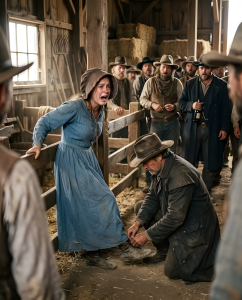
Annabeth thought of the kneeling in the barn, of hands untying her shoes as if even fear deserved gentleness.
No, she said quietly.
You did what you did.
Do not put that on the whole world.
Then she turned her back and left him with the first truth he had never been able to beat out of her.
In the weeks that followed, Annabeth stayed at Silas’s cabin not because she had nowhere else to go, but because each morning he asked what she wanted and waited for the answer.
It bewildered her at first.
He gave her the back room and slept by the hearth.
He taught her how to tend the mare’s sore hoof, how to draw water without bruising her palms, how to read the letters Sarah had left behind one slow line at a time.
The flowers beneath the window had been Aunt Mae’s; after Mae died, Silas kept them because the sight of something living returning each year was the only argument against despair he trusted.
By October, Annabeth had added marigolds of her own.
When the ground hardened enough for travel, Silas took her south to the creek where Sarah had been buried under a marker too plain for the love she deserved.
They set a better stone there together.
Annabeth read her mother’s name aloud, then the line from the first letter she had asked Silas to carve beneath it: She was never yours to bury in silence.
On the ride home she finally asked the question he had never once demanded she consider.
Did you know, in the barn?
Silas kept his eyes on the road.
Not at first, he said.
Then I heard your name.
Then I saw the bonnet.
By the time I counted out the third coin, I was praying I was wrong because if I wasn’t, I had already failed you once.
Annabeth sat with that for a long while before reaching across the wagon seat and resting her hand over his.
He broke then, not loudly, just enough.
She did not call him Father that day.
Healing did not happen because a letter proved blood or because a cruel man was led away in chains.
It happened slowly, in bowls of stew left warming on the stove, in doors never locked against her, in the patient way Silas waited whenever fear stopped her mid-step.
The first time she called him Pa was months later, half asleep by the fire, and the startled look on his face made them both laugh and cry at once.
Years afterward, what Annabeth remembered most was not the price, though three silver dollars had nearly been the measure of her life.
It was the kneeling.
The first man who ever lowered himself before her had been the one who understood that rescue meant returning a person to herself, not claiming her.
And if one question lingered after the bruises faded, it was not whether Harlan deserved forgiveness.
It was how many people had watched cruelty for years and called it ordinary until one tired cowboy refused to.