The radio on the paramedic’s shoulder cracked once, sharp and dry, and the sound cut through the bedroom harder than any shouting could have.
Lucy’s fingers slipped from mine when they lifted the stretcher. Her skin felt cold and damp, and my coat hung around her shoulders like it belonged to someone much larger.
The cracked phone lay faceup on the floor, still glowing beside the blood pressure cuff, my mother’s name bright enough to make the whole room feel lit by accusation.
The paramedic looked at me again.
“Bring that phone,” he said.
Not asked.
Told.
I picked it up with two fingers, like it had been pulled from dirty water.
In the ambulance, Lucy kept blinking at the ceiling. The lights flashed red across her face, then white, then red again. The air smelled like rubber gloves, cold metal, and the sour coffee in my own breath. Every bump in the road made her mouth tighten. Every time the monitor beeped, the paramedic looked down faster.
I sat on the bench, knees jammed against the cabinet, Lucy’s cracked phone in my hand and my own phone lighting up at last with missed calls I had not earned the right to miss.
At 1:31 a.m., my mother called me.
The screen showed Mom.
The paramedic saw it.
“Answer on speaker,” he said.
My thumb hovered.
Lucy’s eyes moved toward me. Not begging. Not angry. Just tired enough that I could see the tiny red lines around the whites of her eyes.
I answered.
Before I said a word, my mother’s voice came through clean and calm.
“Adrian, do not let them turn this into some dramatic hospital scene. Lucy gets attention when you’re gone, and you know it.”
The paramedic’s jaw shifted.
I stared at the silver latch on the ambulance cabinet until it blurred.
My mother kept going.
“I already told her. If she goes in making claims, I’ll explain that she’s been unstable all week.”
Lucy closed her eyes.
The paramedic reached for the phone.
“Ma’am,” he said, “this is Chicago Fire Department. This call is being documented.”
Silence.
Then my mother laughed once, softly.
“Well, then document that my daughter-in-law is hysterical.”
The paramedic ended the call without asking me.
At Northwestern Memorial, the sliding doors opened into cold fluorescent light and the smell of antiseptic. Wheels rattled over the floor. A nurse with a blue badge moved beside Lucy and asked questions in a voice that did not waste air.
“How many weeks?”
“Thirty-five,” I said.
“Headache? Vision changes? Upper right pain?”
Lucy tried to answer. Her lips moved, but only one word came out.
“Pressure.”
The nurse looked at the blood pressure number the paramedic read from his chart.
Her face changed by half an inch.
Not panic.
Procedure.
That was worse.
They took Lucy through a set of double doors. I followed until a nurse put one hand up, palm flat against my chest.
“Sir, wait here.”
“I’m her husband.”
“I know. Wait here.”
The waiting area had gray chairs bolted together and a vending machine humming in the corner. A man in a Cubs hoodie slept with his chin on his chest. Somewhere behind the wall, a woman cried out once and then the sound vanished into machines.
My mother called again at 1:46 a.m.
I did not answer.
She texted.
Do not sign anything they give you.
Then another.
Tell them she refused rest and worked herself up.
Then another.
I warned her this would happen if she kept using pregnancy as leverage.
I read that one three times.
The letters did not move. My hand did.
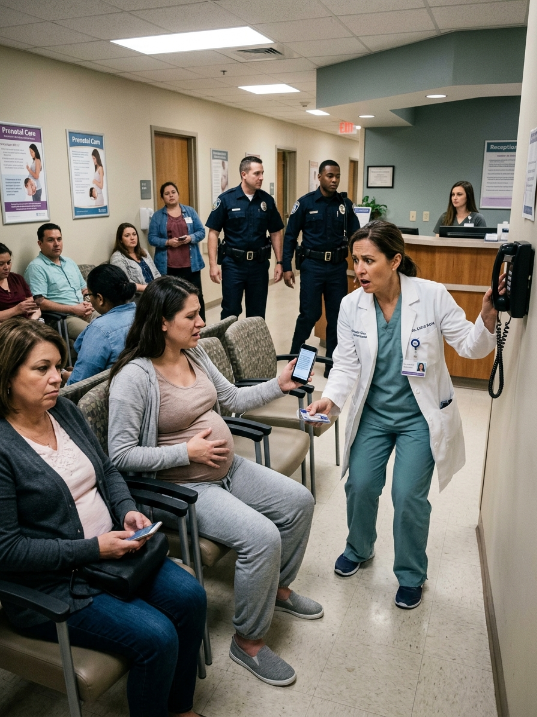
A doctor came out at 2:03 a.m. Her hair was pulled into a tight bun, and her white coat swung open over navy scrubs. She held a tablet in one hand and Lucy’s cracked phone in the other.
“Mr. Miller?”
I stood too fast. The chair scraped the floor.
“Is she okay?”
The doctor did not answer that first.
“I’m Dr. Han. Your wife is very sick. We are treating this as a hypertensive emergency in pregnancy. We’re moving quickly.”
My mouth went dry.
“The baby?”
“We are monitoring both of them.”
Both of them.
Those three words pressed down on my ribs.
Then Dr. Han held up Lucy’s phone.
“Your wife gave permission for us to document these messages. Is the sender your mother?”
I looked at the screen.
The thread was open now, scrolled higher than what I had seen in the bedroom.
At 11:08 p.m., Lucy had written:
I can’t see clearly. My head hurts. I think something is wrong.
My mother had replied:
You are not the first woman to be pregnant. Stop performing.
At 11:26 p.m., Lucy wrote:
Please call Adrian. He’s in the air. I’m scared.
My mother replied:
No. You wanted to be his wife. Act like one.
The doctor’s thumb moved once.
At 12:12 a.m., Lucy had sent a photo of the blood pressure cuff.
168/112.
My mother’s answer sat under it.
Delete that before Adrian sees it.
Dr. Han looked at me over the phone.
The vending machine hummed behind me. My shoes stuck faintly to the polished floor. Somewhere in the hallway, a printer spat paper in short angry bursts.
“I need you to understand something,” the doctor said. “This is no longer a family disagreement.”
My throat worked once.
“She came to our apartment,” I said. “Lucy told me.”
Dr. Han’s eyes stayed on mine.
“Did your mother remove or move any medication, paperwork, or medical equipment?”
I saw the towel again. The bracelet. The cuff. The folder on the floor.
“I don’t know.”
“Think.”
That word landed clean.
My mind went to the nursery. The white dresser. The Target bag with the prenatal vitamins. The folder from our last appointment. The discharge sheet with warning signs printed in red.
My mother had laughed at it last Sunday.
Hospitals print fear so they can bill you twice.
I covered my mouth with my hand.
Dr. Han turned to the nurse beside her.
“Call security. No visitors except husband until further notice.”
My head snapped up.
“Security?”
Before the doctor could answer, the automatic doors opened behind me.
My mother walked in wearing a beige trench coat over her church dress, hair sprayed smooth, lipstick perfect at 2:07 in the morning.
She carried her black leather purse in the crook of her arm like she had arrived for brunch and not the wreckage of a woman she had told to stay home.