Part 2
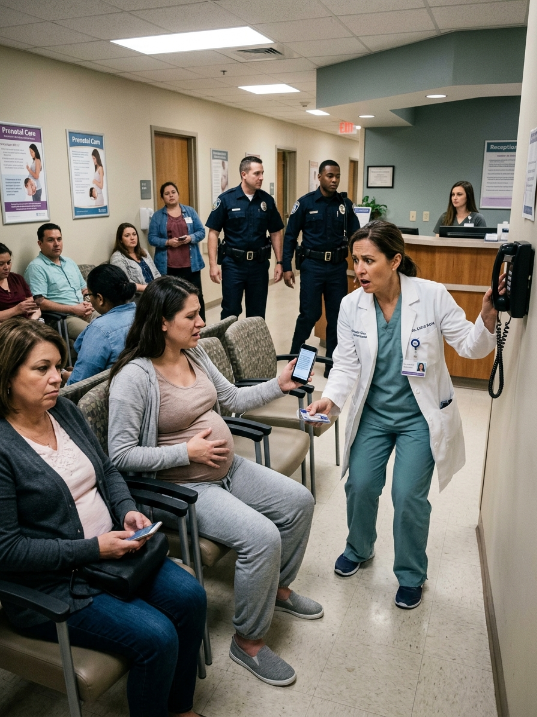
“Adrian,” she said quietly. “Come here.”
Not please.
Not are they okay.
Come here.
Dr. Han did not move.
My mother’s eyes flicked to the phone in the doctor’s hand.
Then to me.
Then, for the first time since I could remember, the corner of her mouth failed to hold its shape.
“This is private,” my mother said.
Dr. Han’s voice stayed level.
“Mrs. Miller, you are not authorized to be in this care area.”
“I’m his mother.”
“You are not my patient’s support person.”
My mother smiled with only her teeth.
“My daughter-in-law gets confused when she’s emotional. She has always been fragile.”
A security officer stepped out from the side hallway before she finished the sentence. Tall, gray-haired, hands folded in front of him. He did not touch her. He did not need to.
“Ma’am,” he said, “you’ll need to wait outside.”
My mother looked at me then.
That was the look I knew.
The one from report cards that had one B. The one from college when I changed majors. The one from our wedding when Lucy wore her grandmother’s small pearl earrings instead of the diamonds my mother offered.
Soft disappointment sharpened into ownership.
“Adrian,” she said, “tell them.”
My phone buzzed in my palm.
A new text from her, sent while she was standing ten feet away.
Do not let that woman turn you against your family.
I showed the screen to Dr. Han.
My mother saw me do it.
Her face emptied.
Security moved one step closer.
I finally spoke.
“You’re not coming near my wife.”
The words came out rough, small, and complete.
My mother’s hand tightened around her purse strap until the leather creased.
“You’ll regret this when she costs you everything.”
The security officer opened his hand toward the exit.
“She already almost did,” I said.
My mother’s mouth opened, but no sound came fast enough. The officer guided her backward through the sliding doors. She kept staring at me until the glass closed between us and split her reflection into two pale versions of the same woman.
At 2:41 a.m., they let me into Lucy’s room.
The machines were louder in there. A cuff squeezed her arm every few minutes. Clear tubing ran into her hand. Her nightgown was gone, replaced by a hospital gown with blue diamonds printed across it. Her hair looked smaller against the pillow.
I sat beside her and put my hand where hers rested over the baby.
She did not open her eyes.
“Your mom?” she whispered.
“Gone.”
Her fingers twitched under mine.
“Mad?”
I looked at the monitor. At the IV pole. At the folded blanket warming over her feet.
“Documented,” I said.
A tear slipped sideways into her hairline.
Not dramatic. Not loud. Just one thin line disappearing into the pillow.
At 3:18 a.m., Dr. Han returned with another doctor and a nurse who introduced herself as a patient advocate. They explained things in short pieces. Medication. Monitoring. Possible early delivery. Consent forms. Risks. Choices.
Every time they asked Lucy a question, they waited for Lucy.
Not me.
Not my mother.
Lucy.
Her voice was weak, but it was hers.
“Yes.”
“No.”
“Call my sister.”
“Keep her out.”
The patient advocate wrote my mother’s full name on a clipboard and asked if Lucy wanted the hospital to restrict information.
Lucy looked at me.
I nodded once.
She looked back at the advocate.
“Yes.”
That one word changed the room.
By sunrise, my mother had called thirteen times. She left five voicemails. I did not play them beside Lucy. I walked to the end of the hall near the vending machines and listened with the phone pressed to my ear until each message carved another clean line through what I had been pretending was loyalty.
At 6:22 a.m., she said Lucy had “always wanted control.”
At 6:37 a.m., she said I was “too emotional to make decisions.”
At 6:51 a.m., she said the hospital would “exaggerate anything for money.”
At 7:04 a.m., she said if I kept humiliating her, she would tell everyone Lucy had endangered the baby by refusing help.
I saved every voicemail.
Then I called Lucy’s sister, Mara.
Mara arrived at 8:19 a.m. in sweatpants, with wet hair and two coffees she forgot she was holding. She took one look at Lucy through the glass and pressed both cups into my chest so hard hot coffee spilled over my knuckles.
“What happened?” she asked.
I handed her the phone.
She read in silence.
Her face did not crumble. It hardened from the mouth outward.
“Lucy told me your mom was taking her appointment papers,” she said.
The back of my neck prickled.
“What?”
“She said she was ‘organizing’ them. Lucy thought she was trying to help.”
Mara dug through her tote bag and pulled out a folded sheet, creased twice, soft at the edges.
“Lucy sent me a picture of this last week in case it disappeared.”
It was the hospital warning sheet. Headache. vision changes. swelling. high blood pressure. Call immediately.
Across the bottom, in my mother’s neat blue handwriting, were four words.
Overreacting makes men leave.
I stopped feeling my burned knuckles.
Mara looked through the glass at her sister.
“She kept it because she was scared no one would believe her.”
At 9:30 a.m., the patient advocate copied the paper. At 10:05 a.m., hospital security updated the file. At 11:12 a.m., Dr. Han told me Lucy’s numbers were responding, but they were not taking chances. At 12:46 p.m., Lucy’s hand tightened around mine when the baby’s heartbeat filled the room, fast and steady and alive.
I bent forward until my forehead touched the edge of her blanket.
The blanket smelled like bleach and warm cotton. Lucy’s fingers moved into my hair, weak but deliberate.
“You came home,” she whispered.
I could not tell her the first thing I had thought when I saw the bed.
Not then.
So I told her the truer thing.
“I’m staying.”
Three days later, our daughter was born small, loud, and furious at the room.
Lucy laughed when she heard that first cry. It cracked in the middle, but it was a laugh. The nurse placed our daughter against her chest, and Lucy held her with both hands, hospital bracelet against newborn blanket, the whole world reduced to one damp forehead and one tiny open mouth.
My mother found out from my aunt.
She sent flowers to the hospital.
White lilies.
The card read:
For my granddaughter. I hope her mother chooses peace.
The nurse at the front desk did not bring them into Lucy’s room. She called me out, showed me the card, and waited.
I took the flowers downstairs and dropped them in the trash outside the lobby.
The cold March air hit my face. Cars moved along the curb. A man in a gray hoodie smoked near the ambulance bay. Somewhere above me, on the fourth floor, my wife was learning the weight of our daughter against her chest.
My phone buzzed once.
Mom.
I let it ring until the screen went dark.
Then I walked back inside with empty hands.