The heat in San Diego had a way of making even beautiful places feel cruel.
By midafternoon, La Jolla Shores shimmered under a hard white sun, the kind that flattened color and made the sand too bright to stare at for long.
The ocean kept moving, patient and blue, but its breeze carried no mercy that day.
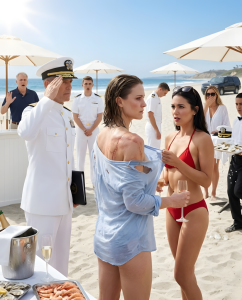
It rolled over the private section of beach smelling of salt, sunscreen, chilled champagne, and expensive seafood sweating on silver trays.
Commander Evelyn Reed stood at the edge of the shade in a long-sleeved shirt while everyone else dressed for summer.
The fabric was thin, pale blue, and already damp against her back.
She had chosen it carefully that morning because it covered her wrists, collarbone, shoulders, and most of what people looked at when they thought they were being discreet.
She knew what curiosity looked like.
She knew what pity looked like.
She knew the uglier expression people made when they decided pity was too much work and disgust was easier.
For five years, Evelyn had built a life around not giving anyone access to the parts of her they had not earned.
That discipline had begun in a hospital room at Naval Medical Center San Diego, where fluorescent lights buzzed above her bed and nurses changed the dressings on her back without asking questions they were not cleared to ask.
It had continued through physical therapy, closed-door evaluations, sealed briefings, and the quiet destruction of the career she had nearly died serving.
It followed her home too.
Her father, Colonel Harrison Reed, retired Marine, did not ask what happened.
He asked whether she had signed everything properly.
He asked whether the discharge paperwork was final.
He asked whether she had considered how this would look to people who knew the family.
That was Harrison Reed’s gift and his curse.
He knew how to stand straight in a room full of officers.
He did not know how to sit beside his wounded daughter and say he was sorry.
Evelyn’s younger sister Vanessa had learned a different language from the same household.
Vanessa did not avoid discomfort.
She weaponized it.
She was beautiful in a way that made strangers forgive her before she spoke, and for years she had treated that forgiveness as proof that she was right.
When they were children, she had borrowed Evelyn’s jackets without asking, taken her makeup, read her letters, and laughed when Evelyn complained.
Their father called it harmless.
Their mother, before she died, called it rivalry.
Evelyn had called it practice.
Vanessa had practiced touching what was not hers until the whole family treated Evelyn’s boundaries like a personality flaw.
The beach gathering was supposed to be a celebration for one of Harrison’s old military contacts, a polished afternoon of donors, officers, family friends, and people who understood the value of being seen in the right crowd.
Evelyn had nearly declined.
Then her father had said, “It would look strange if you weren’t there.”
Not painful.
Not difficult.
Strange.
So she came.
She stood near the umbrellas, drank water from a plastic bottle, and listened to Vanessa perform charm for young officers who did not know they were being auditioned.
Vanessa wore a red designer bikini and gold sunglasses.
Her laugh carried over the sand.
Attention had always loved her.
Cruelty did too.
“Seriously?” Vanessa called, loud enough for nearby people to hear. “Are you allergic to sunlight now?”
A few people laughed because the safest laugh at any party is the one that pretends not to understand what it is laughing at.
Evelyn took a slow drink of water.
She had learned overseas that a reaction could be used as a map.
Give an enemy anger, and they knew where to push.
Give a bully embarrassment, and they knew where to dig.
Silence was not weakness.
Sometimes it was armor.
“You know this is a beach, right?” Vanessa continued, walking closer. “Not witness protection.”
Harrison glanced over from the catered bar where he had been speaking with two junior officers.
For one second, Evelyn saw the old calculation in his face.
He saw Vanessa closing in.
He saw Evelyn’s sleeves.
He saw the audience forming without admitting it was an audience.
Then he looked away.
That hurt more than Vanessa’s voice ever could.
Strangers could be cowards by accident.
Family made cowardice a choice.
Vanessa reached her with a smile that looked sweet from ten feet away.
Up close, it was sharpened glass.
“You could at least try not to look miserable,” she whispered.
“I’m fine,” Evelyn said.
“Oh honey,” Vanessa said softly, “that’s exactly the problem.”
Evelyn saw the movement a heartbeat before it happened.
Vanessa’s hand lifted.
Her fingers slipped under the collar of Evelyn’s shirt.
Evelyn’s shoulder locked.
Her hand started to rise.
She could have stopped her.
Five years of restraint held her still for half a second too long.
Vanessa yanked hard.
The shirt tore down over Evelyn’s shoulder.
The sun hit her skin.
The beach went silent.
Burn scars crossed her back and shoulder in pale raised maps.
Surgical seams ran near her ribs where doctors had opened her body and closed it again with the brutal efficiency of people trying to beat a clock.
Small round scars marked the path of shrapnel.
Some scars had faded.
Some never would.
A champagne flute stopped halfway to a woman’s mouth.
One of the Navy officers stiffened so sharply his shoes sank deeper into the sand.
A server holding oysters froze while melted ice dripped from the tray.
Vanessa’s friends went still behind their sunglasses.
One lieutenant looked directly at Evelyn’s back, then away toward the ocean, ashamed of his own eyes only after they had already taken what they wanted.
Nobody moved.
Vanessa stared.
For a moment, Evelyn thought even her sister might understand the line she had crossed.
Then Vanessa laughed.
“Oh my God,” she said loudly. “I forgot how horrible it looks.”
The words landed harder because they were not shouted.
They were casual.
That was Vanessa’s real talent.
She could make violence sound like commentary.
“She always acts mysterious about leaving the Navy early,” Vanessa announced, turning slightly so the officers could hear her better. “Everyone thought it was classified or heroic or something.”
Her finger lifted toward Evelyn’s exposed shoulder.
“Turns out she’s just a disaster magnet.”
A few weak chuckles broke out.
Not real laughter.
Compliance.
The cheap social sound people make when they want the cruel person to know they are not the target.
Evelyn looked at her father.
Harrison Reed did not speak.
He stood there with a drink in his hand and silence on his face.
That silence had followed Evelyn for five years.
It sat at family dinners when old friends asked why she had left the Navy.
It sat in holiday photographs where Vanessa joked that Evelyn had “flamed out.”
It sat in every room where Harrison could have said, “My daughter served honorably,” and chose not to.
The records had existed the entire time.
A casualty notification dated August 17.
A burn unit transfer from Naval Medical Center San Diego.
A sealed operational reference stamped OPERATION NIGHTFALL.
A witness designation that had disappeared from every conversation the moment military attorneys told her the investigation was sensitive.
Evelyn had not left in shame.
She had been buried in procedure.
There are families who love the truth only when it flatters them.
When it arrives burned, limping, and classified, they call it drama.
Evelyn pulled the shirt back over her shoulder.
Her fingers were steady.
Inside, something old and furious pressed against her ribs, but she kept her hand flat against the fabric.