Part==>>2
She would not strike Vanessa.
She would not beg Harrison.
She would not explain herself to a beach full of people who had mistaken their curiosity for judgment.
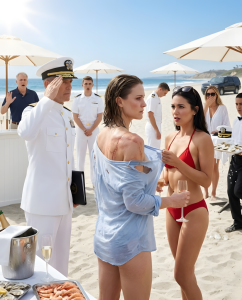
Then tires crunched on the private access road.
A black government SUV rolled past the low dunes and stopped near the sand.
The change in the officers was immediate.
Spines straightened.
Conversations died.
Even people who did not know why the air had shifted understood that rank had entered the beach.
The driver opened the rear door.
An older man stepped out in a crisp white Navy dress uniform.
Admiral Thomas Hale looked almost unreal under the brutal sun, all clean lines, polished shoes, and a face built by decades of command.
Evelyn had seen his photograph in secure facilities across the country.
She had heard his name spoken in briefing rooms where people did not joke.
The moment he saw her, he stopped.
Completely.
For one suspended second, the only sound was the ocean breaking behind them.
Then Admiral Hale walked toward her.
Two officers followed quickly, but he did not look at them.
He did not look at Vanessa.
He did not look at Harrison until he had already reached Evelyn.
His gaze moved once to the torn collar, once to the visible edge of scar tissue, and then returned to her face.
He stopped in front of her.
Then he saluted.
A full formal salute.
The kind of salute that did not belong at a family beach party.
The kind of salute that turned rumor into evidence.
“I’ve been looking for you for five years, Commander Reed,” he said.
The title moved through the crowd like a detonation.
Commander.
Not failure.
Not disgrace.
Not disaster magnet.
Vanessa’s hand slipped on her champagne glass.
Harrison looked as if someone had reached inside his chest and squeezed.
Evelyn returned the salute because her body remembered what her family had tried to erase.
Only then did Hale lower his hand.
His voice dropped, but not enough to hide.
“We finally confirmed who gave the unauthorized strike order during Operation Nightfall.”
The words pulled the beach away from Evelyn.
For a second, she was not in La Jolla anymore.
She was back in smoke.
Back under orange light and screaming metal.
Back with the taste of copper in her mouth and a radio transmission cutting in and out while someone ordered a strike that should never have been authorized.
Six people died that night.
Evelyn had survived because another officer dragged her behind a concrete barrier while burning debris fell around them.
By the time she woke in the hospital, the mission record had already begun to change shape.
Names disappeared.
Timelines blurred.
Responsibility dissolved into passive language.
Mistakes were made.
Coordinates were misread.
A field team was compromised.
No one wrote that someone with authority had pushed the order through after being warned civilians and friendlies were still in range.
No one wrote Evelyn’s objection into the official summary.
No one wrote her name where it belonged.
Admiral Hale held out a classified black folder.
The black cover seemed to absorb the sunlight.
Evelyn looked at it, then at him.
“Commander,” he said, “are you ready to testify?”
Before Evelyn could answer, Vanessa whispered, “Testify?”
The word came out small.
Stripped of performance.
Hale opened the folder just enough for Evelyn to see the first page.
Her name was there.
Commander Evelyn Reed.
Operation Nightfall.
Recovery witness designation.
A redacted casualty chain.
A document she had been told she might never see again.
Harrison stepped forward.
“Admiral, there must be some mistake.”
Hale turned toward him slowly.
“Colonel Reed,” he said, “I would choose your next sentence very carefully.”
That was when one of the officers behind Hale removed a sealed evidence sleeve from a hard case.
Inside was a water-damaged field recorder.
A strip of white tape marked the side.
The faded timestamp read 02:14, August 17.
Evelyn felt the breath leave her body.
She remembered that recorder.
She remembered shoving it into a pocket because the official comms channel had gone chaotic and she needed proof of what had been said.
She remembered waking up later and being told no such recorder had been recovered.
Vanessa stared at the sleeve as if it had become a weapon.
Harrison’s expression changed.
Not confusion.
Recognition.
For five years, Evelyn had wondered whether her father had simply believed the rumors because they were easier.
Now she saw something worse in his face.
He had known enough to be afraid.
Admiral Hale placed the evidence sleeve on top of the folder.
“The voice on this recording gave an illegal order that killed six service members and nearly erased Commander Reed from the record,” he said.
A woman behind Vanessa covered her mouth.
The young lieutenant who had laughed earlier stared at the sand.
The server set down the oyster tray with shaking hands.
The whole beach had become a courtroom without walls.
Harrison whispered, “Evelyn.”
She looked at him.
For five years, she had imagined that moment.
She had imagined anger.
She had imagined satisfaction.
She had imagined asking why he did not defend her when defending her would have cost him nothing but pride.
But standing there under the San Diego sun, with her scars burning beneath a torn shirt and the truth finally breathing in the open, she felt something colder.
Clarity.
“You let them call me a disgrace,” she said.
Harrison swallowed.
“I didn’t know everything.”
“No,” Evelyn said. “You knew enough.”
Vanessa made a sound, half protest and half panic.
“Evelyn, I was joking.”
Evelyn turned to her sister.
The red bikini, the perfect makeup, the champagne, the audience she had gathered like kindling, all of it looked suddenly small.
“No,” Evelyn said. “You were counting on everyone staying silent.”
Vanessa had no answer.
Bullies often mistake silence for agreement.
They never expect silence to be evidence waiting for the right room.
Admiral Hale asked Evelyn to come with him to the secure command office at Naval Base San Diego that afternoon.
She did.
Not because she was ready.
Because readiness had nothing to do with it anymore.
The testimony took three days.
The first day was procedural.
Names, dates, ranks, assignments.
The second day was worse.
They played the field recorder.
The room heard Evelyn’s voice warning that the coordinates were unsafe.
They heard another voice override her.
They heard the strike order given anyway.
They heard the blast.
They heard twenty-seven seconds of screaming before the recorder cut out.
No one in the room asked why she had scars after that.
No one asked why she left early.
No one asked whether she had been dramatic.
By the third day, the buried chain of authorization had a name.
The officer who gave the order had used influence, friendships, and missing paperwork to protect himself for five years.
Harrison had not given the order.
But he had been warned, privately, that Evelyn’s record was complicated and that speaking too loudly in her defense might pull the family into a classified inquiry.
So he chose reputation.
He chose ease.
He chose the photograph.
When the findings finally became public in limited form, the Navy corrected Evelyn’s service record.
Her commendation was restored.
The disgrace people had whispered about evaporated, but its damage did not.
Truth can clear a record faster than it can heal a daughter.
Harrison came to her apartment two weeks later.
He stood outside her door holding a folder of printed articles, as if proof could be offered back to the person from whom it had been stolen.
“I should have protected you,” he said.
Evelyn looked at him for a long time.
“Yes,” she said.
He cried then.
Quietly.
Too late.
She did not slam the door.
She did not forgive him either.
Some wounds are not repaired by confession.
They are repaired by years of changed behavior, if they are repaired at all.
Vanessa sent one message.
It said, “I didn’t know.”
Evelyn deleted it.
Because the problem had never been that Vanessa knew too little.
The problem was that she had known exactly where to hurt someone and called it humor.
Months later, Evelyn returned to La Jolla Shores alone.
The day was cooler.
The beach was public again, ordinary again, full of children running toward waves and couples shaking sand from towels.
She wore short sleeves.
Not because the scars had become beautiful.
Not because strangers had earned the right to see them.
Because the scars were hers, and hiding them had started to feel too much like helping the lie.
A little girl building a sandcastle nearby looked at Evelyn’s arm and asked, “Did that hurt?”
Her mother gasped and apologized.
Evelyn smiled faintly.
“Yes,” she said. “But I lived.”
The child nodded with solemn acceptance and went back to packing wet sand into a purple bucket.
That was all.
No pity.
No judgment.
Just a fact received and released.
For five years, Evelyn’s family had treated her like a broken thing because broken things are easier to dismiss than betrayed people.
But she had never been broken.
She had been burned.
She had been silenced.
She had been waiting for the truth to find daylight.
And when it finally did, an entire beach learned what her father and sister should have known from the beginning.
Scars are not proof of shame.
Sometimes they are the receipt for courage no one bothered to honor.