I stopped calling my son three years ago.
Even now, writing those words in my mind feels like admitting to a wound that never healed right.
People talk about estrangement in tidy little phrases, as if family distance is just a disagreement stretched across time.
But when it is your child, silence does not feel tidy.
It feels alive.
It sits in the house with you.
It follows you into the grocery store, into church, into the chair across from you at supper.
It turns ordinary hours into questions.
For the first six months after my son, Daniel, cut me off, I did what most parents do when they still believe effort can fix everything.
I called.
I texted.
I left voicemails trying to sound calm even when my throat was tight.
I would rehearse what I wanted to say before dialing, determined not to sound accusing or desperate, and then the second the phone rang, all that resolve would dissolve into the same plea.
Daniel, just give me five minutes.
Tell me what happened.
Tell me what I did.
Sometimes the messages showed as read.
That was almost worse than being blocked.
It meant he had seen my words and chosen silence anyway.
I would sit at my kitchen table long after dark, my old flip-top phone charging beside the sugar bowl, and replay his whole life in my head.
I blamed things I had said when he was thirteen and impossible.
I blamed the years I worked too much.
I blamed the times I had been stern because I thought the world would be harsher than I ever could be.
I blamed my own pride.
My own tiredness.
My own blind spots.
There is no cruelty quite like a father trying to inventory his failures and wondering which one finally cost him his son.
I live in a quiet suburb outside Dayton, in the same house Daniel grew up in.
My wife passed eleven years ago, so by the time Daniel pulled away, it was just me and the echo of a life that used to be louder.
The house held memories in every room.
Pencil marks on the laundry room doorframe from measuring his height.
A cracked baseball trophy in the den.
The hallway where he once ran full speed in sock feet and crashed into the coat rack so hard we both laughed until we cried.
After his silence began, those memories turned sharp.
They stopped feeling warm and started feeling like evidence in a trial I was losing.
For months, I kept chasing.
Then one Thursday afternoon, while waiting for a haircut at the barbershop downtown, I picked up a thin devotional booklet from the side table.
I almost put it back.
I was not looking for wisdom.
I was looking for distraction.
But one line caught me and would not let go.
Real love does not force the door.
It remains true, and it waits without surrendering its dignity.
I must have read that sentence ten times.
I took the booklet home, set it on the kitchen counter, and stared at it through supper.
By bedtime I knew something I did not want to know: my chasing was not healing anything.
It was only teaching Daniel that I would accept any version of the
relationship, even one in which I was reduced to begging for scraps of acknowledgment.
The next morning, I stopped.
I did not make a speech.
I did not announce some dramatic boundary.
I simply woke up and chose not to call.
I did not block his number.
I did not post cryptic things online.
I did not talk badly about him to neighbors.
Mrs.
Hargrove from next door would sometimes ask, in that gentle-but-curious way people do, whether Daniel had visited lately, and I would smile and say, “Not lately, but I hope he’s well.”
That was all.
At first, the silence felt like withdrawal.
Around noon my body would remember I had not checked my phone.
Around supper I would fight the urge to text him a photo of something small and ordinary, like the first tomato on the vine or the dogwood tree blooming in front.
Every instinct in me wanted to reach.
But I held still.
It was not anger.
That is what many people misunderstand.
Stepping back was not punishment.
It was grief with posture.
It was love refusing to humiliate itself.
It was me finally accepting that fatherhood has seasons.
There is a season for carrying, a season for correcting, a season for providing, and eventually a season for letting a grown child walk far enough to hear his own footsteps.
So I built myself a life that was not organized around waiting.
The porch had needed repair for years, and my wife used to say I would never get around to it until a board snapped under a guest.
I replaced every bad plank, sanded the railings, painted them white, and hung a fern basket by the front steps.
I started volunteering Tuesdays and Fridays at the local food bank, sorting canned goods and helping load trunks for older folks who had trouble lifting.
I planted tomatoes, basil, and cucumbers in the side yard.
I joined the early service again at church instead of staying home out of embarrassment over questions people might ask.
Peace did not arrive in one dramatic wave.
It came in small layers.
The first Christmas without Daniel nearly broke me.
I still set out his favorite plate by habit before putting it away.
The second Christmas, I left the chair empty on purpose and did not apologize for it.
By the third, I could look at that empty place and feel something gentler than pain.
Not relief.
Never relief.
Just acceptance.
Life has a way of instructing us after pride has run out of noise.
I learned that the greatest lesson you can teach from a distance is steadiness.
If Daniel ever looked back, I wanted him to see that his absence had wounded me, yes, but it had not destroyed me.
I wanted him to know he had been loved by a father who could stand upright even in sorrow.
Then, on a gray Tuesday in October, a car pulled into my driveway.
I remember the exact sound of gravel under tires because it interrupted the weather report I had playing low in the kitchen.
I looked through the window expecting a delivery driver.
Instead, I saw Daniel.
For a moment I truly thought I was mistaken.
He seemed both familiar and changed, like one of those old
family photos restored so clearly it startles you.
He was thinner than I remembered.
The confidence he had worn in his twenties was gone, replaced by the tiredness of someone who had been carrying too much without sleep.
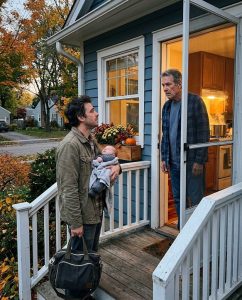
In one hand he held a baby carrier.
In the other, a diaper bag.
He stood beside the car for several seconds looking at the house.
Not knocking.
Just looking.
At the porch.
The new paint.
The flower box under the window.
The life that had continued.
Then he climbed the steps.
When I opened the front door, he looked almost younger for an instant.
Not because his face had softened, but because uncertainty had stripped something off him.
He glanced past me into the house as if he expected to find anger waiting there, polished and loaded.
Instead, there was soup on the stove and the old grandfather clock ticking in the hall.
“I didn’t know if you’d want to see me,” he said.
His voice cracked on the last word.
I stepped back from the doorway.
“Come in,” I said.
He did, carefully, as if he were entering a place made of memory and glass.
He set the diaper bag by the chair and lifted the carrier onto the rug.
Inside was a little boy maybe three months old, asleep with one fist tucked under his chin.
I stared at that child and felt time do something strange inside me.
Grief, tenderness, disbelief, and an ache so old it had its own roots all rose together.
“His name is Owen,” Daniel said.
I nodded because my throat had gone tight.
He kept standing.
I could see he didn’t think he had earned a seat yet.
“Sit down,” I told him.
He lowered himself to the sofa but stayed on the edge of it.
I took the chair across from him.
For a few seconds, neither of us spoke.
Then he looked at the baby, swallowed hard, and said, “The first time I held him, I understood something about you that I was too selfish to understand before.”
I stayed quiet.
“I didn’t know,” he said.
“I didn’t know how constant it was.
How being a parent means worrying even when nothing is wrong.
Planning even when you’re tired.
Showing up even when nobody thanks you.
I didn’t know how much love can cost until they put him in my arms.
And all I could think about was everything you did that I acted like was normal.”
His face folded then.
Not dramatically.
Just enough to show he had been holding himself together all the way up my driveway.
“I was angry at you,” he said.
“For years.
Some of it was real.
Some of it wasn’t.
But most of it got mixed up with other things, and I let that become an excuse to disappear.”
I could have demanded specifics.
I could have asked where he had been and why he let me suffer in the dark.
But one thing silence had taught me was that confessions forced too early turn into defenses.
So I let him continue in his own order.
He told me he had fallen in love fast with a woman named Kara.
She was bright, impulsive, and charming in the exact ways that make some people