seem like rescue when they are really only momentum.
Their relationship had burned hot and fast.
When she got pregnant, Daniel convinced himself it was a sign to commit harder, work more, and shut out anyone who questioned the pace of it.
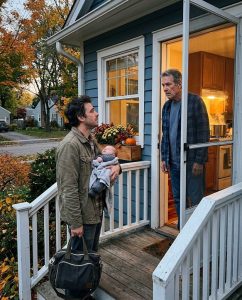
That included me.
We had argued one night on the phone before the silence began.
I had told him he was moving too fast, taking on responsibilities with a woman he barely knew, spending money he didn’t have to keep up a life that looked secure from the outside.
He heard judgment.
I intended concern.
Neither of us knew how to bridge the difference.
“Kara said you never believed in me,” he said, staring at his hands.
“And once she said that enough times, I started hearing everything through that filter.
Every old argument.
Every piece of advice.
It all sounded controlling.”
He paused.
“I let her talk me into cutting you off.
At first I told myself it was temporary.
Then too much time passed, and I was ashamed to come back.”
The room stayed very still.
He went on.
Kara had left six weeks after Owen was born.
Not in a dramatic midnight scene.
Not with a screaming fight.
She packed two suitcases while Daniel was at work, left the baby with a neighbor for two hours, and texted him a paragraph about needing freedom, not domestic pressure.
By the time he got home, she was gone.
Two weeks later, he learned she had moved in with someone else in Nashville.
“I kept thinking she’d calm down and come back,” he admitted.
“Then I stopped thinking that.”
He had been trying to manage everything alone in a one-bedroom apartment.
No sleep.
Too much formula on a credit card.
Rent behind.
Work performance slipping.
The sort of slow collapse that happens one unpaid bill, one missed hour of sleep, one panicked grocery trip at a time.
“Last night Owen had a fever,” he said.
“Nothing serious, the doctor said.
But I sat there holding him at three in the morning, and I suddenly remembered every night you sat by my bed with a washcloth when I was sick.
And then I remembered all the games, all the rides, all the things I treated like background noise because I thought parents were supposed to give and give and somehow never be hurt by what they received back.”
He laughed once, bitterly at himself.
“I think becoming a father stripped the arrogance right out of me.”
By then, my own eyes were wet.
I did not want them to be.
I did not want sentiment to rush ahead of truth.
But grief and love are neighbors.
Once one opens the door, the other is never far behind.
“Why didn’t you answer me?” I asked quietly.
He exhaled for a long time before replying.
“At first because I was angry.
Then because Kara kept saying talking to you would ruin us.
Then because the longer it went on, the worse it felt.
After a year, I didn’t know how to come back without admitting what I had done.
After Owen was born, I told myself I’d reach out after things settled down.
But they only got worse.”
His voice dropped.
“And I was ashamed.”
That word did more in the
room than any apology could have.
Shame is costly.
Cheap regret blames circumstances.
Shame names the self.
I nodded slowly.
“Did you come here because you need help?” I asked.
He met my eyes then.
“Yes,” he said.
“But not just money or babysitting or a place to crash.
I came because I don’t want my son growing up thinking disappearing is normal.
I came because I need to tell you the truth and accept whatever you decide to do with it.”
That mattered.
Parents know when a child, no matter how grown, is asking for rescue without repentance.
This was not that.
Daniel looked like a man who had finally run out of excuses.
I stood and walked to the carrier.
Owen was awake now, blinking solemnly up at the ceiling.
I lifted him carefully.
He was lighter than memory said babies should be, warm and soft and impossibly trusting.
Daniel watched me as if this moment held some final verdict.
I remembered all at once the first day I held him as a baby in the hospital.
The terror.
The awe.
The sudden understanding that from then on, your heart would have a body walking outside your own.
“There has always been a plate for you here,” I said.
Daniel covered his eyes with one hand.
Not because those words erased the past.
They didn’t.
They simply gave him a place to set it down.
I made soup, warmed a bottle, and found the old rocking chair in the den still worked as well as ever.
Daniel ate like a man who had been surviving on protein bars and worry.
Halfway through his second bowl, he started crying in earnest, the kind that comes when someone has been holding themselves upright too long.
I let him cry.
Over the next few weeks, we did not pretend everything was repaired because one hard conversation had happened in my living room.
That is not how trust returns.
Trust returns the way a porch is rebuilt: one board, then another, then another.
Daniel began coming by every Tuesday evening.
Then Saturdays too.
Sometimes with Owen.
Sometimes alone after the baby was asleep at a neighbor’s apartment across the hall.
We talked about practical things first: feeding schedules, rent, child support paperwork, legal custody, work.
Then gradually the deeper things surfaced.
He told me about his resentment after his mother died and how he felt I had hidden my own grief inside work.
He told me how lonely his twenties had felt in ways he didn’t know how to describe then.
I told him I should have talked more honestly about my own fear and sorrow instead of assuming stoicism was strength.
We found, buried under years of silence, not a villain and a victim but two stubborn men who had loved each other poorly for a while.
That does not excuse what he did.
It explains it.
There is a difference.
By December, Daniel and Owen were coming for Sunday dinner.
I bought a second high chair for my kitchen because the first one I found at a yard sale was missing a tray, and fixing it became its own little project.
Owen learned my beard was funny.
Daniel learned where I kept the spare diapers.
Some evenings we sat on
the rebuilt porch after the baby fell asleep and watched the neighborhood lights come on one by one.
One night Daniel said, “I thought if you ever saw me again, you’d make me pay for everything.”
I looked out at the yard.
“Life already did some of that for me,” I said.
“I didn’t need to add to the bill.”
He laughed softly, then got quiet.
“Do you forgive me?”
I answered honestly.
“Yes.
But forgiveness and trust are cousins, not twins.
One can arrive before the other.”
He nodded, accepting that.
That might have been the most grown-up moment of our relationship.
The next Christmas, his chair at my table was no longer empty.
Owen smeared sweet potatoes across his face.
Daniel carved the ham badly, and I criticized him on principle, which made him grin for the first time in years like the boy who used to steal biscuits before supper.
The house sounded alive again.
Not the same as before.
It can never be the same.
But alive.
I think that is all grace really is sometimes: not restoring the old picture exactly, but creating room for a new one after the frame has cracked.
People often want stories like mine to end with a moral tidy enough for a greeting card.
Something about never giving up, or always fighting for family, or love conquering all.
What I learned is less polished.
You cannot demand a relationship, even from your child.
Love that chases too hard can become a form of control wearing holy clothes.
Sometimes the most loving thing a parent can do is step back, keep the door unlocked, and let life finish a lesson your voice can no longer teach.
And when they return, if they return, you get to choose whether the house they enter is built on ego or grace.
I am glad mine was built on grace.
But I still think about the lost years.
I think about birthdays missed, ordinary Tuesdays vanished, and all the quiet meals eaten in separate rooms because pride and hurt were sitting between us.
I think about how easily people let new loyalties rewrite old love.
I think about how many parents never get the knock on the door that I did.
So no, I do not romanticize estrangement.
I do not recommend silence as a trick to bring someone back.
It is not a strategy.
It is surrender to what you cannot force.
What changed my son was not my silence by itself.
It was fatherhood.
Exhaustion.
Consequences.
Reality.
Time.
In the end, life taught him what my pleading never could.
And if I am honest, that still leaves me wondering one thing.
Was the biggest red flag his distance from me in the beginning, or the fact that I almost kept shrinking myself just to stay within reach of it?
END!