After Richard Whitmore died, people looked at me differently.
Some looked at me with pity.
Some looked at me with discomfort, the way people do when your grief reminds them that their own comfortable life can change before dinner.
Vanessa looked at me like I was an opening.
The morning of Richard’s funeral, Boston was all wet pavement and gray sky, the kind of rain that makes every black coat look heavier.
Outside the church, umbrellas bumped and folded as people hurried through the doors.
Inside, the air smelled of lilies, raincoats, polished pews, and old wood.
Every hug left cold wool pressed against my cheek.
Every whispered apology sounded rehearsed by the time it reached me.
Vanessa performed beautifully.
She stood beside my son Daniel in pearls and a black dress that looked expensive without looking inappropriate.
She held his sleeve with one hand and a silk handkerchief with the other.
Her eyes were damp, but never red.
She thanked Richard’s old business friends.
She touched elbows with women from charity boards.
She told people, “Margaret is devastated. We’re doing everything we can for her.”
I stood close enough to hear every word.
I said nothing.
Three days before that funeral, I had been sitting in Mr. Harlan’s office on State Street while rain tapped against the windows behind him.
He was Richard’s attorney, though Richard always called him “Harlan” like they were two men comparing hardware-store receipts instead of managing millions of dollars.
Mr. Harlan had opened a blue folder and slid one document toward me.
His office smelled faintly of coffee, paper, and the leather chairs Richard used to complain were too low.
“Mrs. Whitmore,” he said, “your husband transferred the bulk of his estate into a private trust for you alone.”
I watched his mouth move, but for a moment, the words had no shape.
“Liquid assets, investment accounts, commercial property shares, and life insurance payouts,” he continued. “The current value is approximately twenty-eight million dollars.”
Twenty-eight million.
I stared at the number typed on the page.
It looked too large to belong to my life.
Richard and I had lived well, but never loudly.
He drove the same dark green Volvo for eleven years.
He clipped coupons for coffee.
He kept a jar of spare change near the back door and acted personally insulted when the grocery store stopped doubling paper coupons on Tuesdays.
He could afford the best of almost anything, but he preferred the familiar.
A good chair.
A clean shirt.
A quiet house.
A wife who knew how he took his tea when his hands were too tired to make it himself.
“Does Daniel know?” I asked.
Mr. Harlan folded his hands over the folder.
“No,” he said. “Your husband was specific. Disclosure is entirely your decision.”
That was Richard.
Careful even after death.
He had always believed money changed the room before anyone admitted it.
“Let people show you who they are before they know what you have,” he told me once, years ago, after a distant cousin suddenly became friendly when Richard’s business started growing.
I thought he had been talking about strangers.
I did not yet know he had been talking about family, too.
I left Mr. Harlan’s office with a folder in my purse and rainwater soaking the cuffs of my pants.
I went home to the colonial house Richard and I had shared for thirty-six years.
The kitchen was quiet when I walked in.
Too quiet.
The refrigerator hummed.
The clock above the back door clicked over to 8:14 p.m.
Richard’s chair sat across from mine, empty in a way that made the whole room feel lopsided.
That kitchen had held our marriage in ordinary pieces.
Daniel doing homework with pencil smudges on his fingers.
Richard paying bills with a calculator older than the microwave.
Me setting out two mugs every morning, even on days when we were annoyed with each other.
Vanessa had eaten Thanksgiving pie at that table.
She had accepted my wedding china there.
She had borrowed my pearl earrings once for a fundraiser because, as she put it, mine looked more established.
At the time, I had laughed.
I had even helped her fasten the clasp.
That is the thing about trust.
It almost never disappears in one dramatic moment.
You hand it over in small useful pieces, and later you realize someone has been counting them.
I decided not to tell anyone about the trust.
Not Daniel.
Not Vanessa.
Not even my sister in Oregon, who would have packed a bag and driven across half the country until I promised her I was eating.
I told myself I needed time.
That was true.
But somewhere under that truth was another one.
I wanted to see what people did when they thought Richard had left me with nothing but memories and utility bills.
For two weeks after the funeral, Daniel called twice.
Both conversations were short.
He asked whether I was sleeping.
He asked whether I had eaten.
He did not ask whether I needed him to come over and sit in his father’s chair for a while so the room would stop feeling so empty.
Vanessa texted once.
Thinking of you.
No period.
No visit.
Then, on a Thursday afternoon, she arrived with a clipboard.
She did not knock.
I heard the front door open and her heels clicking across the hardwood like she had already decided the house belonged to someone more practical.
Daniel followed her into the hallway.
He looked pale and tired, his hands shoved into his coat pockets.
He did not meet my eyes.
That should have warned me.
“Margaret,” Vanessa said, glancing around my living room, “we need to discuss reality.”
She set papers on my kitchen table.
Utility estimates.
Property tax printouts.
Insurance projections.
A maintenance list copied from the internet and highlighted in yellow.
She had turned my life into a packet.
“This house is too much for you,” she said.
I looked at the papers, then at the chair where Richard used to sit.
“It has been my home for thirty-six years.”
“That isn’t the point. Taxes, upkeep, insurance, utilities. Daniel and I have talked. You should sell it.”
Daniel stared at the floor.
I waited for him to speak.
He did not.
“I’m not ready,” I said.
Vanessa’s mouth tightened.
“Ready doesn’t matter. You’re seventy-one. You have no income besides whatever little pension Richard left. You can’t expect us to carry you.”
There are sentences that hurt because they are cruel.
There are others that hurt because of who lets them stand.
I looked at my son.
“Daniel?”
He swallowed.
His eyes stayed down.
That silence did something to me that Vanessa’s words could not.
She leaned closer, and her perfume cut through the smell of cooling tea.
“Honestly, Margaret, if you refuse to be practical, you may have to learn what it feels like to live on the streets,” she said. “Sentiment doesn’t pay bills.”
The house went quiet.
Not peaceful quiet.
The kind of quiet that comes after someone says the thing they have been polishing in private.
Live on the streets.
She said it in my kitchen.
Beside my husband’s empty chair.
For one ugly second, I wanted to tell her everything.
I wanted to say Richard had left me more money than she had probably imagined touching in her lifetime.
I wanted to say twenty-eight million dollars out loud and watch her face rearrange itself.
I wanted Daniel to finally look up.
Instead, I placed both hands flat on the table.
My fingers were shaking.
I kept them there until they stopped.
“Thank you for your concern,” I said.
Vanessa smiled.
It was small.
Almost polite.
But it carried the satisfaction of a woman who believed she had just frightened an old widow into obedience.
They left ten minutes later.
Daniel paused at the door like he wanted to say something.
Vanessa was already halfway to the driveway.
He looked back at me once, then followed her.
At 9:06 that night, I called Mr. Harlan.
He answered on the third ring.
“Mrs. Whitmore?”
“Begin the transfer review,” I said. “Every property connected to Whitmore Holdings. Current ownership records, occupancy agreements, insurance files, and any residential property Richard held through the trust.”
There was a pause.
In that pause, my dishwasher switched cycles.
“Mrs. Whitmore,” he said carefully, “that includes Daniel and Vanessa’s house.”
“I know.”
“Do you want to proceed with a full review?”
I looked at Richard’s chair.
“Yes.”
Competence does not always look like revenge.
Sometimes it looks like a widow in a quiet kitchen writing down document names while her tea goes cold.
By 11:30 the next morning, Mr. Harlan’s paralegal had emailed the property ledger.
By Friday, a copy of the deed history was waiting in my locked mailbox.
I opened the envelope at the kitchen table.
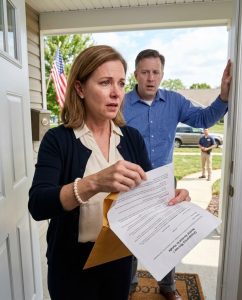
The house Vanessa bragged about at brunches, the one with the white front door and the small porch flag, had never belonged to her.
It belonged to Richard’s trust.
The arrangement was legal, clean, and old enough that Vanessa had probably never thought to question it.
Richard had helped Daniel and Vanessa live there when Daniel’s business had been unstable.
He had not transferred ownership.
He had not forgotten the paperwork.
He had simply never announced the truth at dinner.
That was Richard, too.
Quiet help.
Quiet boundaries.
Quiet records.
For three months, I said nothing.
I signed where Mr. Harlan told me to sign.
I requested the occupancy review.
I confirmed insurance files.
I reviewed the trust letter.
I asked for every notice to be drafted properly and delivered properly.
I did not call Vanessa.
I did not warn Daniel.
That was the part that hurt.
The story continues — don’t miss what happens next