Daniel had been my little boy before he became her husband.
I remembered him at seven, asleep at the kitchen table with a math worksheet under his cheek.
I remembered Richard carrying him upstairs and whispering that one day the boy would be taller than both of us.
I remembered Vanessa at their wedding, holding my hands and saying she was lucky to have another mother.
I had believed her.
I had wanted to believe her.
For three months, Daniel left voicemails that sounded like apologies but never became one.
“Mom, call me when you can.”
“Mom, I know things got tense.”
“Mom, Vanessa was just worried.”
That last one sat in my phone for two days before I deleted it.
Worried people bring soup.
They do not bring highlighted maintenance lists and tell widows to imagine the sidewalk.
On the morning the notice was delivered, the sky was bright in that sharp spring way Boston gets after days of rain.
Mr. Harlan’s office had arranged certified delivery.
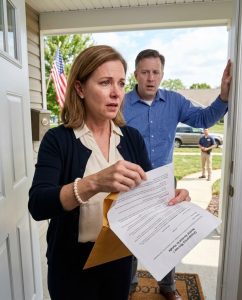
At 10:17 a.m., the official envelope reached Vanessa’s front door.
There was a delivery photo.
Her hand was in the frame, pearl bracelet shining at her wrist.
Daniel stood behind her in a wrinkled blue shirt.
Vanessa looked annoyed at first.
Then she tore the envelope open.
The first page unfolded.
Occupancy Review and Notice to Vacate.
Her smile disappeared.
The driver was already stepping back toward the walkway.
The small porch flag stirred beside the white door.
Daniel leaned closer, reading over her shoulder.
“This has to be a mistake,” Vanessa said.
But her voice had changed.
She turned the page.
Behind the notice was the occupancy file, the revocable residential use language, the trust name, the dates, and the authorization for review.
Daniel grabbed the doorframe.
“Mom knew?” he whispered.
Vanessa turned on him.
“What do you mean, she knew?”
Daniel did not answer.
He was staring at the final page.
Richard’s instructions were attached to the trust review.
I know because Mr. Harlan sent me a scanned copy after delivery confirmation.
Richard had written that the home could remain available to Daniel as long as the arrangement did not become abusive, coercive, or financially exploitative toward me.
My husband had been dead for three months.
He was still protecting me from a room he could no longer enter.
Vanessa saw the signature.
Then she saw mine beneath the review authorization.
That was when she looked straight toward the delivery camera.
Her mouth opened.
For the first time since Richard’s funeral, she did not look polished.
She looked caught.
My phone rang seven minutes later.
Daniel.
I let it ring.
He called again.
Then Vanessa called.
Then Daniel again.
At 10:31 a.m., a voicemail appeared.
“Mom,” Daniel said, and his voice cracked on the word. “Please call me. I didn’t know. I swear I didn’t know about the house.”
I listened once.
Then I set the phone facedown on the table.
Mr. Harlan called at 10:46.
“They have received the notice,” he said.
“I know.”
“You should prepare for contact.”
I looked at Richard’s empty chair.
“I already am.”
By noon, Daniel was on my porch.
He looked smaller than I remembered.
Not physically.
He was still tall like his father.
But shame has a way of bending a person without touching their shoulders.
I opened the door.
He stood there with both hands empty.
No flowers.
No Vanessa.
No clipboard.
Just my son.
“Mom,” he said.
I waited.
He looked past me into the house where he had grown up.
His eyes landed on the hallway wall, on the family photos, on the tiny scratch near the baseboard from the year he dragged a hockey bag inside without lifting it.
“I should have said something,” he whispered.
“Yes,” I said. “You should have.”
His face crumpled.
Not dramatically.
Just enough that I saw the boy at the kitchen table again.
“Vanessa told me she was trying to help,” he said. “She said you were going to lose the house if we didn’t step in.”
“And when she told me I might have to live on the streets?”
He closed his eyes.
The silence answered before he did.
“I froze,” he said.
“No,” I said softly. “You chose silence. There is a difference.”
That landed.
He nodded once, as if he deserved it.
Then he said the thing I had needed him to say three months earlier.
“I’m sorry.”
I did not forgive him in that doorway.
Forgiveness given too quickly can become another chore expected of women who have already carried enough.
But I let him come inside.
I made coffee.
He sat at the kitchen table, not in Richard’s chair, but beside it.
That mattered.
He told me Vanessa had been furious.
She had called Mr. Harlan’s office twice.
She had demanded an explanation.
She had said the notice was cruel.
I almost laughed at that, but I did not.
Cruelty sounds different when it comes back addressed to you.
Mr. Harlan handled the legal part.
He explained the trust.
He explained the occupancy arrangement.
He explained that Vanessa and Daniel were not being thrown into the street overnight, because I had refused to become the thing Vanessa accused me of being.
They had a lawful notice period.
They had options.
They had resources.
What they no longer had was my silence to live inside.
Vanessa did not come to see me for eleven days.
When she finally did, she arrived without pearls.
She stood on my porch in a plain coat, her hair pulled back, her face stiff from the effort of appearing calm.
“Margaret,” she said, “I said things I shouldn’t have.”
It was not an apology.
It was a sentence built to stand near one.
I opened the door only halfway.
“You told me to imagine living on the streets.”
Her mouth tightened.
“I was under pressure.”
“So was I. My husband had died.”
She looked away.
For once, there was no graceful answer ready.
Behind her, Daniel sat in the car, staring straight ahead.
He had come because she asked him to.
He had not come to protect her from consequence.
That, too, mattered.
“We need more time,” Vanessa said.
“Mr. Harlan has your timeline.”
“This will ruin us socially.”
There it was.
Not homelessness.
Not grief.
Not family.
Socially.
I thought of her in the church, her handkerchief lifted to dry eyes, telling everyone she was doing everything she could for me.
I thought of my kitchen, the highlighted pages, Daniel’s lowered eyes.
I thought of Richard’s handwriting in the trust letter.
“Vanessa,” I said, “you were willing to discuss my future as if I were furniture that had become inconvenient. Do not ask me to protect your reputation from your own words.”
She flinched.
Only a little.
Enough.
The move happened six weeks later.
Quietly.
No police.
No screaming on the lawn.
No dramatic scene for the neighbors.
Just boxes, a moving truck, and Vanessa standing in the driveway while the small porch flag flicked in the wind beside a door she had never owned.
Daniel came to my house that evening.
He brought two paper bags of groceries.
Milk.
Bread.
Soup.
Tea.
The ordinary things people bring when they are trying to learn care from the beginning again.
He set them on the counter and said, “I don’t expect you to trust me yet.”
“Good,” I said.
Then I put the kettle on.
We are still working on it.
Some weeks are better than others.
He comes by on Sundays now.
He fixes little things without making a speech about it.
A loose cabinet handle.
The porch light.
A sticky window in the breakfast room.
He does not sit in Richard’s chair.
Not yet.
Maybe someday.
Vanessa and I are not close.
I do not hate her.
Hate is too heavy to carry at seventy-one when you have already carried grief.
But I no longer lend her pearls.
I no longer accept polished sentences in place of character.
And I no longer confuse silence with peace.
Richard’s trust did not give me my dignity.
Money cannot do that.
What it gave me was room.
Room to see clearly.
Room to act carefully.
Room to stop begging people to remember I was a person before they treated me like an expense.
That kitchen still feels empty some nights.
The refrigerator hums.
The clock ticks.
Richard’s chair waits across from mine.
But now, when I sit there with my tea cooling in my hands, I remember the day Vanessa stood in that same room and told me sentiment did not pay bills.
She was right about one thing.
Sentiment does not pay bills.
But neither does entitlement.
And three months after she told me to go live on the streets, the notice arrived at her own front door.
END!