The doctor’s words seemed to drain all the air from the examination room.
“We need additional imaging immediately.”
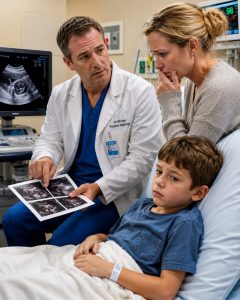
I looked from his face to the blurry ultrasound images on the screen, trying to force my mind to understand what my eyes could not.
Ethan sat beside me on the narrow hospital bed, small and pale in the blue paper gown they had given him. His sneakers dangled over the edge. One hand rested protectively over his stomach.
“Mom?” he whispered. “Am I in trouble?”
That question broke something in me.
I took his hand and squeezed it gently.
“No, sweetheart,” I said, forcing my voice to stay calm. “You’re not in trouble.”
But I was terrified.
The doctor, whose badge read Dr. Leonard Hayes, softened when he looked at my son.
“Ethan, we just need to take some clearer pictures inside your belly,” he said. “It won’t hurt. You’ll just have to lie still for a little while.”
Ethan nodded, but his eyes stayed on me.
Children always know when adults are pretending not to be scared.
A nurse came in a few minutes later and explained that Ethan needed a CT scan first, then possibly an MRI. She spoke gently, carefully, but every word sounded like it was coming from far away.
Clearer images.
Abnormal structure.
Possible mass.
Further evaluation.
Mass.
That was the word that stayed.
I tried not to think of tumors. I tried not to think of cancer. I tried not to imagine anything sharp, dark, or impossible growing inside my little boy.
But fear is cruel.
It fills in blanks before truth arrives.
As they wheeled Ethan down the corridor, I walked beside him, holding his hand. The hospital lights passed overhead in bright white squares. Somewhere nearby, a baby cried. A monitor beeped steadily behind a curtain. Nurses moved quickly through the halls, calm in the way only people who see emergencies every day can be calm.
I felt like I was walking underwater.
When we reached the imaging department, they let me stay until Ethan was settled on the scanner table. He looked so small beneath the large machine.
“Don’t move, okay?” the technician said kindly.
Ethan swallowed. “Will Mom stay?”
“I’ll be right outside,” I promised.
He nodded, but his lower lip trembled.
Before they moved me behind the glass, I leaned close and kissed his forehead.
“You’re brave,” I whispered.
He looked up at me.
“I don’t feel brave.”
“That still counts.”
The CT scan took only minutes, but it felt endless.
Behind the glass, I watched my son disappear slowly into the machine. My palms were damp. My heart beat so hard it hurt.
Dr. Hayes stood nearby with another physician, a woman with silver-rimmed glasses and a serious expression. They spoke quietly while the images appeared on the screen.
At first, I tried not to look.
Then I couldn’t stop myself.
The pictures were strange, shadowed layers of gray and white. I could make out bones, organs, outlines. Nothing made sense to me.
But it made sense to them.
Or worse, it didn’t.
The woman in glasses leaned closer to the monitor.
Dr. Hayes crossed his arms.
The technician stopped typing.
Nobody said a word.
That silence was worse than screaming.
Finally, Dr. Hayes turned to me.
“Mrs. Mitchell, after this, we’re going to move Ethan upstairs and admit him overnight.”
My knees nearly buckled.
“Admit him?”
“Yes. We need specialists to review these images.”
“What specialists?”
He hesitated.
“A pediatric surgeon. A radiologist. Possibly genetics.”
“Genetics?” I repeated.
The word felt completely disconnected from a stomachache.
Dr. Hayes took a breath.
“I know this is frightening. But we need to understand exactly what this structure is and where it came from.”
“Where it came from?” I stared at him. “What does that mean?”
Before he could answer, Ethan’s scan finished. The technician opened the door and helped him sit up.
The conversation ended immediately.
Adults are good at hiding horror from children.
Not always from each other.
They moved us to a private room on the pediatric floor. There were cheerful animal paintings on the walls, a small television mounted high in the corner, and a recliner beside the bed where parents were meant to spend sleepless nights.
I called my husband, Mark, from the hallway.
He answered on the second ring.
“Sarah? Everything okay?”
I closed my eyes.
“No.”
The word came out broken.
He was silent for half a second.
“What happened?”
“We’re at the hospital. Ethan’s being admitted.”
“What? Why?”
“They found something on the ultrasound. Then on the CT.”
“What do you mean something?”
“I don’t know, Mark.” My voice cracked. “They won’t tell me clearly yet. They asked if you were here.”
“If I was there?” His confusion sharpened. “Why?”
“I don’t know.”
“I’m leaving now.”
He hung up before I could say anything else.
I stood in the hallway clutching my phone, watching nurses pass with medication carts and clipboards. On the other side of the glass window, Ethan was sitting in bed, staring at the TV without really watching it.
He looked exhausted.
Too exhausted for ten years old.
A memory hit me suddenly.
Ethan at five, racing through a sprinkler in the backyard, laughing so hard he fell into the grass.
Ethan at seven, missing his two front teeth and proudly declaring that he was going to become an astronaut-paleontologist.
Ethan last Christmas, asleep under the tree after insisting he could stay up to catch Santa.
And now Ethan here.
Small.
Silent.
Sick.
I pressed a hand over my mouth to stop myself from crying.
Mark arrived forty minutes later, still wearing his work shirt, his hair damp from the rain outside. He looked frantic.
The moment Ethan saw him, he sat up.
“Dad.”
Mark crossed the room in three strides and wrapped him in his arms.
“Hey, buddy,” he said, but his voice shook. “You scared us.”
“I didn’t mean to.”
“I know.” Mark kissed the top of his head. “I know.”
For a moment, watching them together nearly undid me.
Mark had been there when Ethan took his first steps.
He had taught him to ride a bike.
He had spent entire Saturdays building Lego cities on the living room floor.
Whatever the doctors wanted from him, whatever strange question they needed answered, Mark was Ethan’s father in every way that mattered.
Dr. Hayes returned just after nine o’clock with two other doctors.
The woman from imaging introduced herself as Dr. Priya Nair, pediatric radiologist. The older man beside her was Dr. Samuel Ortiz, pediatric surgeon.
They asked if we wanted to speak outside Ethan’s room.
That alone told me enough to make my hands go cold.
Mark looked at me.
I nodded.
We stepped into a small consultation room down the hall. It had soft lighting, a box of tissues on the table, and two chairs positioned across from the doctors.
I hated that room immediately.
Rooms like that exist for bad news.
Dr. Hayes sat forward.
“Mr. and Mrs. Mitchell, we’ve reviewed Ethan’s ultrasound and CT scan. We still need MRI confirmation, but we have a clearer idea of what we may be seeing.”
Mark reached for my hand under the table.
“What is it?” he asked.
Dr. Ortiz folded his hands.
“There is a mass in Ethan’s abdomen. It appears to be located near the retroperitoneal space, close to several important blood vessels.”
My throat tightened.
“A tumor?”
Dr. Ortiz paused.
“It may not be a typical tumor.”
I stared at him.
Dr. Nair turned a tablet toward us. The scan appeared on the screen, marked with arrows.
She spoke carefully.
“The structure has organized tissue. We see calcifications that resemble bone formation. There are areas that appear similar to soft tissue. And there is something that looks like a rudimentary spinal column.”
The room went silent.
I thought I had misheard.
“A what?” Mark said.
“A spinal column,” Dr. Nair repeated gently.
My hand slipped from Mark’s.
“That’s impossible.”
“It’s rare,” Dr. Hayes said. “Extremely rare. But there is a condition called fetus in fetu.”
The words meant nothing to me.
Dr. Ortiz explained.
“During early pregnancy, in very rare cases involving twins, one twin may become enclosed within the body of the other twin. The enclosed twin does not develop normally and cannot survive independently. Sometimes it remains undetected for years.”
I stared at him, unable to speak.
Mark leaned back in his chair.
“You’re saying there’s a twin inside our son?”
“Possibly,” Dr. Ortiz said. “An undeveloped twin-like mass. We need more imaging and testing before we can be certain.”
My mind rejected it.
Ethan had never had a twin.
No doctor had ever mentioned a twin.
Every ultrasound during my pregnancy had shown one baby.
One heartbeat.
One tiny body curled inside me.
“No,” I whispered. “That can’t be right. I carried him. I had scans. There was only Ethan.”
Dr. Hayes nodded.
“That is often the case. If this occurred very early, before the first ultrasound, there may have been no visible second fetus by the time you were examined.”
Mark stood suddenly and walked to the wall.
He placed both hands on the back of his neck.
“Is it dangerous?”
Dr. Ortiz’s expression grew serious.
“It can be. The mass may be pressing on organs or blood vessels. That could explain Ethan’s pain, nausea, weight loss, and fatigue. We need to remove it surgically.”
Surgically.
The word hit like thunder.
“You want to operate on my son?” I asked.
“We believe surgery may be necessary,” he said. “But first we need the MRI to map its exact position.”
I couldn’t stop staring at the image.
Bone.
Soft tissue.
Spinal column.
Inside my child.
A twin who had never become a child at all.
A twin who had stayed hidden for ten years.
“Why did you ask for his father?” Mark said suddenly.
The doctors exchanged a glance.
Dr. Hayes answered.
“When we see unusual findings like this, we need a complete family history. Twin pregnancies, genetic conditions, anything that may help us understand what we’re dealing with.”
Mark looked relieved.
But only for a second.
Because Dr. Nair looked down at the file.
“There is another reason,” she said.
My heartbeat changed.
Dr. Hayes gave her a brief look, then turned back to us.
“The mass has features that are unusual even for this condition. We may need genetic testing from both parents and Ethan to determine whether the tissue is related to him in the expected way.”
“In the expected way?” I repeated.
“To confirm whether it is genetically his twin,” Dr. Hayes said.
Mark sat down slowly.
“And if it isn’t?”
Nobody answered right away.
The silence became unbearable.
“If it isn’t,” Dr. Ortiz said at last, “then we would need to consider other explanations.”
“What other explanations?” I demanded.
“Mrs. Mitchell, let’s not get ahead of the evidence.”
But it was too late.
My mind had already started racing into places I did not want to go.
A mass with bone.
A hidden twin.
Genetic tests.
The father.
Mark looked at me, his face pale and tense.
“Sarah.”
I knew what he was asking without words.
Had there been something he didn’t know?
Someone he didn’t know?
The answer was no.
Absolutely no.
But fear has a way of making even the innocent feel accused.
I turned back to the doctors.
“Do whatever tests you need. But save my son.”
Dr. Ortiz nodded.
“That is our priority.”
That night, neither Mark nor I slept.
Ethan dozed fitfully in the hospital bed while machines hummed softly around him. Every so often, he woke and asked for water, or reached for my hand, or whispered that his stomach hurt.
At two in the morning, Mark stepped out to call his mother.
When he came back, his face looked different.
Harder.
Not angry exactly.
Guarded.
“You okay?” I asked.
He nodded too quickly.
“Yeah.”
But he didn’t sit beside me.
He stood near the window, staring out at the dark parking lot below.
“Mark.”
He turned.
“Did you know twins run in my family?” he asked.
I blinked.
“What?”
“My grandmother had a twin who died at birth. Mom just reminded me.”
I stared at him, too exhausted to understand why his tone felt strange.
“That could explain it, right?”
“Maybe.”
He looked at Ethan.
“Then why do they need genetic testing?”
“Because doctors test things.”
“That’s not an answer.”
I stood slowly.
“Are you asking me something?”
His jaw tightened.
“I’m trying not to.”
The words hurt more than I expected.
After everything—after ten years of diapers, birthdays, fevers, school concerts, and bedtime stories—one strange scan had put doubt in his eyes.
I lowered my voice.
“Ethan is your son.”
“I know.”
“Do you?”
His face twisted.
“I’m scared, Sarah.”
“So am I.”
“I watched those doctors look at each other like something was wrong beyond the mass.”
“Something is wrong. Our child needs surgery.”
He flinched at the sharpness in my voice.
For a moment, neither of us spoke.
Then Ethan stirred.
“Mom?”
I went to him instantly.
Mark stayed by the window.
The MRI happened the next morning.
They gave Ethan medication to help him stay still. I sat beside him until his eyes grew heavy, stroking his hair while he tried to make jokes.
“If I have an alien in my stomach,” he murmured, “can I name it?”
My throat tightened.
“It’s not an alien.”
“Can I still name it?”
I smiled because he needed me to.
“What would you name it?”
He thought for a moment.
“Bob.”
I laughed softly, even as tears blurred my vision.
“Bob?”
“Bob the stomach monster.”
The nurse chuckled.
Then Ethan’s eyes fluttered closed.
When they took him away for the MRI, I sat in the waiting room with Mark. There was a fish tank against one wall. Bright orange fish drifted through blue water, peaceful and oblivious.
Mark stared at them for nearly twenty minutes.
Then he said, “I’m sorry.”
I didn’t look at him.
“For what?”
“For last night.”
I folded my hands in my lap.
“I need you to be his father right now. Not a man looking for betrayal in a hospital scan.”
He closed his eyes.
“I know.”
“Do you?”
“Yes.” His voice broke. “I’m terrified that we’ll lose him.”
That softened me.
Not completely.
But enough.
I reached for his hand.
This time, he held on.
Hours later, Dr. Ortiz met us in the same consultation room.
The tissue box still sat in the center of the table.
I hated it even more now.
“The MRI confirms a complex mass,” he said. “Its structure is consistent with fetus in fetu, though unusually developed in some areas.”
“How soon does he need surgery?” I asked.
“Soon. The mass is pressing against part of the intestine and may be affecting blood flow. I recommend surgery tomorrow morning.”
Tomorrow.
My stomach dropped.
Mark squeezed my hand.
“What are the risks?” he asked.
Dr. Ortiz did not hide from the question.
“Bleeding, infection, damage to nearby organs or vessels. But leaving it there carries increasing risk. Ethan is symptomatic. It needs to come out.”
I nodded because there was no other choice.
“Do it.”
They drew blood from all three of us that afternoon.
Ethan complained more about the needle than the idea of surgery, which somehow made him seem more like himself.
The rest of the day passed in a blur of consent forms, anesthesiologists, nurses, questions, and signatures.
By evening, news had reached our family.
My mother arrived crying.
Mark’s mother brought a stuffed bear, though Ethan insisted he was too old for stuffed animals before tucking it under his arm.
Everyone said the same things.
He’s strong.
Doctors are amazing.
Everything will be okay.
I nodded.
I thanked them.
I wanted to believe them.
But when the room finally emptied and Ethan fell asleep, I sat beside him and watched the rise and fall of his chest.
I thought about the thing inside him.
The lost twin.
Had it once had a heartbeat?
Had it been part of him from the beginning?
Had some hidden fragment of another life been waiting all these years to announce itself through pain?
At midnight, I went to the hospital chapel.
I had not prayed seriously in years.
Not because I didn’t believe in anything.
But because life had been busy, ordinary, full of lunches to pack and bills to pay and laundry that never ended.
Now ordinary life felt like a country I had been exiled from.
The chapel was empty except for one woman asleep in the back pew.
I sat in the front and folded my hands.
No grand words came.
Only one sentence.
Please don’t take my son.
I repeated it until my throat hurt.
When I returned to the room, Mark was sitting beside Ethan, holding his hand.
He looked up at me.
“I told him about the summer we went to Door County,” he whispered.
“He was asleep.”
“I know.”
“He likes that story.”
Mark nodded.
“The part where he dropped my phone in the lake.”
Despite everything, I smiled.
“He said the fish needed GPS.”
Mark laughed quietly, then covered his face with one hand.
His shoulders shook.
I went to him.
For a while, we held each other beside our sleeping child.
Fear did not disappear.
But it became something we carried together.
The next morning came too fast.
Ethan woke groggy and nervous.
“Will it hurt?” he asked.
“Not during,” I said. “They’ll give you medicine so you sleep.”
“What about after?”
I hesitated.
“A little. But they’ll help.”
He nodded, trying to be brave.
Then he looked at Mark.
“Dad?”
“Yeah, buddy?”
“If Bob is real, can I see a picture?”
Mark’s face changed.
He glanced at me.
Then he forced a smile.
“We’ll ask the doctor.”
The surgical team came at seven.
They let us walk with Ethan until the double doors.
That was where we had to stop.
No parent should ever have to let go of a child at hospital doors.
Ethan looked suddenly very small again.
“Mom?”
I bent down.
“I’m right here.”
“You’ll be here when I wake up?”
“The second you open your eyes.”
He turned to Mark.
“Promise?”
Mark kissed his forehead.
“Promise.”
Then the doors opened.
The nurse wheeled him through.
And my son disappeared.
The surgery lasted four hours.
Then five.
Then six.
Every minute carved something out of me.
Mark paced.
I sat.
Then I paced.
The story continues — don’t miss what happens next