Then we both sat in silence, staring at the doors every time they opened for someone else’s family.
At hour seven, Dr. Ortiz finally appeared.
He wore surgical scrubs and a cap. His face was tired.
But he was not running.
That mattered.
I stood so quickly the chair scraped backward.
“Is he alive?”
The question came out before I could stop it.
Dr. Ortiz nodded.
“Ethan is alive. He’s stable.”
My knees gave way.
Mark caught me.
“He did well,” the surgeon continued. “The mass was more complex than expected, but we removed it completely.”
“Completely?” Mark asked.
“Yes.”
“Will he be okay?”
“He’ll need recovery time and monitoring, but right now, I’m optimistic.”
I started crying then.
Not graceful tears.
Not quiet tears.
The kind that come from the body when terror finally loosens its grip.
Dr. Ortiz waited.
Then his expression shifted.
“There is something else we need to discuss.”
The crying stopped.
“What?” I whispered.
He looked between us.
“The mass was consistent with fetus in fetu. However, there were unexpected findings.”
Mark went still.
“What kind of findings?”
Dr. Ortiz hesitated.
“It contained organized bone, soft tissue, and partial limb-like structures, which we anticipated. But there was also a small object embedded within dense fibrous tissue.”
I frowned.
“Object?”
“It was not biological.”
The world narrowed.
“What do you mean not biological?”
“A small metallic capsule.”
Mark stared at him.
“That’s impossible.”
“I understand how it sounds,” Dr. Ortiz said. “It has been secured and sent for analysis. We don’t know what it is yet.”
My skin went cold.
A metallic capsule.
Inside a mass that had been inside my son for ten years.
“How could that happen?” I asked.
“We don’t know.”
“Was it from surgery? From a tool?”
“No. It was fully enclosed within the tissue.”
Mark’s face had lost all color.
“Could it have been there since birth?”
Dr. Ortiz’s silence answered before he did.
“Possibly.”
The hallway seemed to tilt.
I reached for the wall.
The doctor continued carefully.
“We’ll wait for pathology and genetic testing before making conclusions. Right now, Ethan is stable. That is what matters most.”
Yes.
That was what mattered.
But the word capsule had already lodged itself in my mind like a splinter.
We saw Ethan in recovery an hour later.
He was pale, swollen from fluids, and half-asleep. Tubes and wires surrounded him. A large bandage covered his abdomen beneath the blanket.
But he opened his eyes.
Barely.
“Mom?”
I took his hand and kissed it.
“I’m here.”
“Did they get Bob?”
I laughed and cried at the same time.
“Yes, sweetheart. They got Bob.”
He looked at Mark.
“Was he ugly?”
Mark’s eyes filled.
“Very ugly.”
Ethan gave the smallest smile.
“Good.”
Then he drifted back to sleep.
For the next two days, recovery became our world.
Pain medicine.
Ice chips.
Nurses checking vitals.
Ethan learning to sit up.
Ethan complaining about hospital soup.
Ethan asking when he could go home.
Every ordinary complaint felt like a miracle.
But beneath that miracle, unease grew.
Doctors came and went.
They were kind.
Too kind.
Careful.
Too careful.
On the third day, Dr. Hayes returned with Dr. Ortiz and a woman we had not met before.
She introduced herself as Dr. Elena Graves, a geneticist.
The consultation room waited again.
This time, when we sat down, I did not look at the tissue box.
I looked straight at the doctors.
“Tell us.”
Dr. Graves opened a folder.
“The genetic analysis confirms that the removed mass was closely related to Ethan. It is consistent with a parasitic twin.”
I exhaled shakily.
A strange relief.
Horrible, but at least understandable.
Then she continued.
“However, the metallic capsule is still under investigation.”
Mark leaned forward.
“What is it?”
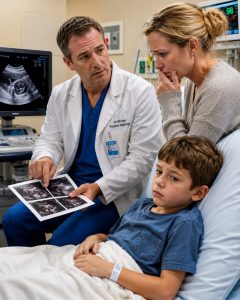
Dr. Ortiz placed a photograph on the table.
It showed a tiny silver cylinder, no longer than a fingernail, darkened in places by tissue and time.
My stomach turned.
“That was inside him?”
“Yes,” Dr. Ortiz said.
Dr. Graves added, “There are markings on it.”
She placed another photograph beside the first.
A magnified image.
Tiny engraved letters appeared along the side of the capsule.
M-17.
My breath caught.
Not because I knew what it meant.
But because Mark did.
I saw recognition flash across his face before he could hide it.
“Mark?” I whispered.
He shook his head too quickly.
“I don’t know.”
But he did.
A wife knows.
I turned fully toward him.
“What is M-17?”
He stood.
“I need air.”
I grabbed his wrist.
“No. You don’t get to walk away.”
The doctors looked uncomfortable.
Mark’s eyes darted toward them.
“Sarah, not here.”
“Yes. Here.”
His face tightened.
“I don’t know what it is.”
“You’re lying.”
He flinched.
Dr. Hayes cleared his throat.
“We can give you a moment.”
“No,” I said. “Please stay.”
Because suddenly I did not want to be alone with my husband.
That thought frightened me.
Mark sank back into the chair.
For ten years, he had been the safe place in our family.
The calm one.
The one who checked locks at night, packed snacks for road trips, and carried Ethan on his shoulders through crowded festivals.
Now he looked like a man standing in front of a door he had spent a decade keeping closed.
Dr. Graves spoke gently.
“Mr. Mitchell, does M-17 mean something to you?”
He stared at the photograph.
His voice came out hoarse.
“My father worked for a medical research contractor years ago.”
I stared at him.
“What?”
“He didn’t talk about it much.”
“What contractor?”
Mark rubbed both hands over his face.
“Mercer Biomedical.”
Dr. Graves went very still.
Dr. Hayes looked at her.
The name meant something to them too.
I felt the room shift.
“What is Mercer Biomedical?” I asked.
No one answered quickly enough.
Mark swallowed.
“They shut down before Ethan was born.”
“Why?”
“I don’t know.”
“Mark.”
“I was told it was funding problems.”
Dr. Graves closed the folder halfway.
“Mercer Biomedical was investigated fifteen years ago for unauthorized embryonic tissue research.”
My heart stopped.
The words came slowly, each one heavier than the last.
Unauthorized.
Embryonic.
Research.
I turned to Mark.
“What does that have to do with our son?”
He looked broken.
“I don’t know.”
But again, I heard the lie.
Or maybe not a lie.
Maybe something worse.
A truth he had never allowed himself to examine.
Dr. Graves said, “We need to review Ethan’s birth records.”
“They’re at home,” I said.
“And any prenatal records. Ultrasounds. Fertility treatments, if applicable.”
“We didn’t have fertility treatments,” I said quickly. “I got pregnant naturally.”
Mark did not look at me.
The silence after that was so strange that I turned toward him slowly.
“Mark?”
He closed his eyes.
I felt my pulse in my throat.
“What did you do?”
His eyes opened, red-rimmed.
“I didn’t do anything to hurt him.”
“That is not what I asked.”
He looked at the doctors, then at me.
“When we were trying to get pregnant, you remember how long it took.”
“Yes.”
Eighteen months.
Eighteen months of negative tests and forced smiles and pretending not to cry at baby showers.
“You were devastated,” he said.
“So were you.”
He nodded.
“My father offered to help.”
The room seemed to lose gravity.
“Help how?”
“He said he knew a specialist. Someone who could run tests quietly, speed things up. I thought he meant vitamins, hormone panels, something simple.”
My voice became very soft.
“Did you take me to someone?”
“No. Not exactly.”
“What does that mean?”
Mark’s face crumpled.
“The weekend we visited my parents in Milwaukee. You got sick. You thought it was food poisoning.”
I remembered.
Nausea.
Fever.
Sleeping almost an entire day in their guest room while Mark and his mother brought me soup.
A coldness spread through me.
“No.”
“Sarah—”
“No.”
“I didn’t know what he did.”
“What did he do?”
Mark was crying now.
“I think he gave you something.”
I stood so fast the chair fell backward.
The sound cracked through the room.
Dr. Hayes rose too.
“Mrs. Mitchell—”
I backed away from the table.
My husband reached for me.
I stepped out of reach.
“You think your father drugged me?”
“I didn’t know then.”
“But you suspected later.”
He said nothing.
That was answer enough.
“When?” I whispered. “When did you suspect?”
He covered his mouth.
“When you got pregnant two weeks later.”
The room blurred.
For ten years, I had told the story of Ethan’s beginning as a miracle.
After months of disappointment, suddenly he was there.
Our joy.
Our answered prayer.
Our beautiful surprise.
Now that memory cracked open, and something monstrous looked back.
“You never told me,” I said.
“I wanted to believe it was coincidence.”
“You never told me.”
“I was afraid.”
“Of what?”
His voice broke.
“Of losing you both.”
I stared at him as if he were a stranger.
And maybe he was.
Dr. Graves spoke carefully.
“Mr. Mitchell, is your father still alive?”
Mark shook his head.
“He died three years ago.”
“Did he leave any documents? Files? Storage units?”
“I don’t know.”
“Think carefully.”
Mark looked at the photograph again.
M-17.
Then his expression changed.
Not recognition this time.
Memory.
“There’s a safe,” he whispered.
I turned.
“What safe?”
“At my mother’s house. In the basement. My father kept old work papers there. Mom never opened it after he died.”
Dr. Graves exchanged a glance with Dr. Hayes.
“We may need those records.”
I could barely hear them.
All I could think was that Ethan was lying in a hospital bed recovering from surgery, while the truth of his life unspooled into something darker than illness.
My son had not simply been born.
He had been interfered with.
Maybe before birth.
Maybe before conception.
Maybe by people who saw life as material.
I walked out of the consultation room without another word.
Mark followed me into the hallway.
“Sarah, please.”
I turned on him.
“Do not come near me right now.”
His face collapsed.
“I love him.”
“I know you do.”
“I love you.”
I shook my head.
“Love without truth is just another kind of betrayal.”
He had no answer.
When I returned to Ethan’s room, he was awake, watching cartoons with the volume low.
He smiled when he saw me.
“Mom, can I have real food yet?”
I went to his bedside and touched his hair.
Soon, I told him.
Soon, sweetheart.
But my voice sounded far away.
He studied my face.
“Are you mad?”
I forced a smile.
“No.”
“At Dad?”
Children always know.
I sat beside him.
“I’m scared.”
He nodded like he understood more than he should.
“Me too.”
I took his hand.
His small fingers curled around mine.
Whatever secrets surrounded his beginning, this was true:
He was my child.
My heart.
My Ethan.
No one could take that from me.
Not Mark.
Not his father.
Not Mercer Biomedical.
Not whatever M-17 meant.
That evening, Mark went to his mother’s house.
I did not go with him.
I stayed with Ethan, helped him take three slow steps with a nurse, and celebrated when he ate half a bowl of applesauce.
At 9:14 p.m., my phone rang.
Mark.
I almost ignored it.
But something made me answer.
For several seconds, all I heard was his breathing.
Then he said, “Sarah.”
His voice was wrong.
“What happened?”
“I opened the safe.”
I stood slowly.
“What did you find?”
“Files.”
“What kind of files?”
He swallowed audibly.
“Medical files. Photos. Names.”
My hand tightened around the phone.
“Ethan’s name?”
A long silence.
“No.”
I closed my eyes.
Relief almost came.
Then Mark spoke again.
“Yours.”
The room seemed to vanish.
“My name?”
“Yes.”
“What does it say?”
He did not answer.
“Mark.”
“There’s a file labeled Mitchell Subject M-17.”
My blood turned to ice.
Subject.
M-17.
Not Ethan.
Me.
Through the phone, I heard papers shifting. Then Mark made a sound I had never heard from him before, something between a sob and a gasp.
“What?” I demanded.
“What is it?”
His voice dropped to a whisper.
“There’s a photograph in here.”
“Of what?”
“You. In the hospital. Holding Ethan.”
“That’s impossible. Your father wasn’t there when Ethan was born.”
“I know.”
My body went cold.
“Mark, what are you saying?”
He breathed shakily.
“On the back, there’s a note.”
“What note?”
He was crying now.
Not softly.
Not quietly.
Like a man whose entire world had split open beneath him.
“It says, ‘Implantation successful. Twin carrier viable. Monitor until activation.’”
I gripped the bed rail to stay upright.
Activation.
The word did not belong to medicine.
It did not belong to motherhood.
It belonged to something planned.
Something waiting.
Behind me, Ethan stirred in his sleep.
At that exact moment, the monitor beside his bed began to beep faster.
I turned.
His eyes were open.
Wide.
Unfocused.
“Mom?” he whispered.
I rushed to him.
“What is it?”
He stared past me toward the dark hospital window.
Then he said in a voice that did not sound like my son’s at all:
“He’s awake now.”
My phone slipped from my hand and hit the floor.
On the other end, Mark was still shouting my name.
But I could not answer.
Because beneath Ethan’s bandage, something small and silver began to glow.
END!