The first thing I remember from that night is not my father’s hand.
It is the refrigerator humming behind him.
That is what fear does sometimes.
It makes the ordinary things louder.
The kitchen light was yellow, the kind that made old cabinets look warm and tired, and the coffee in the pot had burned down to something bitter.
My mother had brewed it before I arrived, even though she knew I could barely keep anything down after treatment.
Maybe she thought coffee made it feel less like an ambush.
Maybe she simply liked having something to pour while she asked me to give up the money that was supposed to keep me alive.
I was twenty-nine years old, bald from treatment, eighty-eight pounds, and cold all the time.
Cold in my hands.
Cold in my knees.
Cold somewhere behind my ribs where hope used to sit.
The envelope was on the table when I walked in.
It was not an invitation.
It was a trap with a flap.
Inside were copies of my medical savings account, the hospital intake estimate, and the wire transfer form my mother had printed before anyone had asked my permission.
The amount was the same number everyone had been saying in different tones for three days.
$65,000.
For my father, it was a resource.
For my mother, it was a solution.
For Evan, it was a way out of whatever hole he had dug at a card table or online betting site or back room I never wanted to imagine.
For me, it was surgery.
It was medication.
It was rent for the months when I would be too weak to work full hours.
It was groceries I could tolerate, rides to appointments, and the thin line between recovery and sleeping in my car with an immune system that could not afford the flu.
My mother tapped the envelope with one red fingernail.
“Your brother made a mistake,” she said.
She always said mistake when she meant choice.
Evan sat across from me with both elbows on his knees and his head down.
His eyes were swollen.
His face had that gray morning-after color he got when he had been drinking, gambling, lying, or all three.
On his left wrist was the $900 watch he had bought six months earlier after promising me he had finally learned his lesson.
I had seen that watch when I was in the infusion chair and he stopped by for fourteen minutes with vending machine pretzels.
He told me then that family was everything.
Then he asked if I could cover his car insurance until Friday.
My father stood near the sink with his arms folded.
He had not hugged me when I came in.
He had looked at my head, looked away, and said, “You look tired.”
That was as close as he usually got to tenderness.
My mother had set four plates on the table even though nobody was eating.
It was one of her little performances.
A family meeting should look like dinner, and dinner should look normal, and normal should keep everyone from naming the thing happening in plain sight.
“I can’t give him the money,” I said.
Nobody answered right away.
The microwave clock glowed 7:31.
The kitchen smelled like burnt coffee, dish soap, and the lemon candle Mom lit whenever she wanted the house to seem cleaner than it was.
“My oncologist moved the surgery up,” I said. “The hospital intake desk already has the deposit schedule.”
Evan rubbed both hands over his face.
“I said I’ll pay you back.”
“You also said that when you used my credit card,” I told him.
He looked up then.
The shame left his face so quickly it was almost impressive.
“Don’t be dramatic.”
That sentence was a family heirloom.
My brother could empty accounts, wreck cars, vanish for weekends, and come back with a story that had holes big enough to drive through.
If I pointed at the holes, I was dramatic.
If I cried, I was selfish.
If I asked where the money went, I was cruel.
That was our family rhythm.
Evan destroyed, Mom excused, Dad enforced, and I learned to make myself small enough not to cost anyone anything.
The first time I learned it, I was twelve.
Evan broke the sliding glass door throwing a baseball in the living room after Dad told him three times not to.
When Dad came home, Evan cried before I could speak.
Mom said I had been teasing him.
Dad grounded me for two weeks and made me help sweep the glass.
The second time, I was seventeen.
Evan took my car to a party, backed it into a mailbox, and left it three blocks away.
Mom said boys panic.
Dad said I should not have left my keys on the hook.
The third time was not a single memory.
It was years.
It was birthdays where Evan’s emergencies swallowed my cake.
It was college forms my parents forgot to sign because Evan had court that morning for a speeding ticket.
It was me learning to be useful enough to keep, but never needy enough to matter.
Illness changed many things, but not that.
When I was diagnosed, my mother cried in the hospital hallway and promised she would be there for every appointment.
She came to two.
My father paid one bill and told three relatives about it.
Evan sent me a text with praying hands and later asked whether I still had any unused credit on the card with the airline miles.
I stopped expecting them to become better people.
Expectations are expensive when you are sick.
Still, a part of me walked into that kitchen hoping there was a line they would not cross.
Then my mother pushed the wire transfer form toward me.
“Sign it,” she said.
I looked at the paper.
Her handwriting was in the margin beside the routing information.
Call bank first thing, she had written.
Under that, she had written Evan urgent.
Not Emily urgent.
Not surgery urgent.
Evan.
I had already seen the form once because my bank sent me a fraud alert at 2:18 p.m. that afternoon.
That alert was the reason I had called my attorney.
My attorney was not the kind of woman who used dramatic language.
She listened, asked for dates, asked for copies, and told me to stop speaking on the phone unless I was recording or following up in writing.
By 4:50 p.m., I had emailed her screenshots of my father’s voicemail, my mother’s texts, and Evan’s messages promising repayment in language so vague it barely counted as a promise.
By 5:30 p.m., she had helped me move the medical savings out of my regular account and into a restricted medical account that required documented purpose before any transfer could be approved.
By 6:58 p.m., before I left my apartment, I set my phone to record.
I also created an emergency shortcut that would call her and send a file if I tapped the side button three times.
That sounds brave when I say it now.
It did not feel brave then.
It felt like a sick woman packing a life jacket before walking into a house that had already flooded once.
Dad nodded toward the paper.
“Sign the transfer.”
“No.”
My mother inhaled sharply.
It was not a gasp.
It was a warning.
“Don’t make your father angry,” she said.
A strange calm came over me then.
Not peace.
Not courage.
Something thinner and harder.
There comes a moment when fear has been used on you so many times that it stops looking like weather and starts looking like a tool.
Once you see the handle, you can decide not to pick it up.
I looked at my father.
“I am not giving Evan my surgery money.”
Dad pushed away from the counter.
His chair scraped across the tile, even though he was not sitting in it.
That is how I remember the sound.
A scrape like metal under my skin.
“You always need something,” he said.
“I need surgery.”
“Evan has people coming after him.”
“And I have a life-threatening illness.”
His mouth tightened.
He looked not angry first, but offended.
As if my illness had inconvenienced the family hierarchy.
As if dying was acceptable only if I did it quietly and without taking resources my brother wanted.
Evan said, “I made a bad call.”
I laughed once.
It came out wrong.
It sounded like pain.
“You lost $65,000 gambling.”
He flinched when I said the number.
Mom snapped, “Lower your voice.”
There were no guests in the house.
No neighbors in the room.
Still, she cared more about volume than truth.
Dad stepped toward me.
“You think because you’re sick, rules don’t apply to you?”
I looked down at the envelope.
“No,” I said. “I think because I’m sick, my medical money should be used for medicine.”
He leaned over the table until I could smell coffee on his breath.
Then he said the sentence I will never forget.
“Your brother needs that money more than you need your life.”
The room stopped.
Even Evan looked at him.
Just for a second, my brother’s face broke open with something like alarm.
Then he looked down again, because looking away was what he did best.
My mother’s fingernail stopped tapping.
The microwave clock changed from 7:33 to 7:34.
One minute had passed in the world.
Inside me, something older than time ended.
I reached for the envelope.
My father thought he had won.
That was the thing about men like him.
They mistook silence for surrender because it had benefited them for so long.
I slid the envelope into my bag and stood.
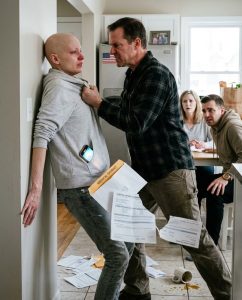
His hand shot out before I took one full step.
He grabbed the front of my hoodie at my throat and slammed me backward into the wall.
Pain flashed white behind my eyes.
The story continues — don’t miss what happens next