The mug fell from my hand and broke against the tile.
Coffee spread in a brown shine under the table.
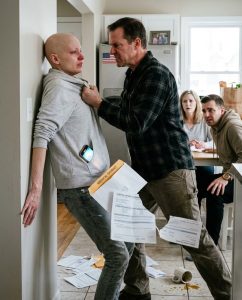
The envelope tore halfway out of my bag, and papers skidded across the floor like frightened birds.
I could hear my mother screaming my name.
Not to save me.
To stop me from making it worse.
“Don’t fight him,” she cried.
That was when I understood she had made her choice long before that night.
She was not frozen.
She was loyal.
I had one hand against the wall.
My father’s fist was twisted in my hoodie.
My lungs were fighting for a clean breath.
For one violent heartbeat, I wanted to hurt him back.
I wanted the broken mug handle in my palm.
I wanted Evan to see blood and understand that family did not give him permission to consume people.
But I had prepared for a reason.
Rage would have made me easier to dismiss.
Evidence would not.
I tapped the side button on my phone three times.
The tiny chime sounded from inside my hoodie pocket.
Everyone heard it.
My father looked down.
My mother went still.
Evan’s face changed first.
It drained from gray to something almost white.
My attorney’s voice came through the speaker a few seconds later.
She said my name.
Then she said, “Are you safe enough to answer yes or no?”
My father let go of me as if my skin had burned him.
I slid down the wall but did not fall.
“No,” I said.
There was a pause.
Not a frightened pause.
A professional one.
“Is your father in the room?”
“Yes.”
“Is your mother?”
“Yes.”
“Is Evan?”
Evan whispered, “Oh God.”
“Yes,” I said.
My attorney said, “Emergency services are being contacted. Do not touch her. Do not touch the documents. Do not touch the phone.”
My father took one step back.
He looked at the scattered paperwork.
He looked at my phone.
He looked at me, and for the first time in my life, he seemed unsure which version of me he was dealing with.
That was the phone call that turned their faces pale.
Not because my attorney shouted.
She never raised her voice.
She simply spoke like a person who knew the difference between a family argument and evidence.
At 7:43 p.m., the automatic email landed in her inbox.
It contained the live recording, the screenshots, the hospital intake estimate, the bank alert, and the transfer form with my mother’s handwriting beside the routing number.
My mother saw the notification on my screen.
Her hand flew to her mouth.
“Sweetheart,” she said, and I hated that word in her voice more than I had hated my father’s hand.
“Don’t,” I whispered.
Sirens came nine minutes later.
I remember the lights flashing through the front window and washing the kitchen in red and blue.
I remember Evan stepping backward until he hit the stove.
I remember my father saying, “This is a family matter,” with the confidence of a man who had never been contradicted by anyone carrying a badge.
The officer did not argue with him.
He looked at me, at the broken mug, at the papers on the floor, and at the phone still recording.
Then he asked whether I needed medical attention.
I said yes before my mother could answer for me.
That was the first yes I gave myself that night.
At the hospital, the intake nurse put a plastic wristband around my wrist and asked me questions in a voice so gentle it almost undid me.
No one asked why I made my father angry.
No one asked why I had not just helped my brother.
They asked where it hurt.
They asked whether I felt safe going home.
They asked whether I wanted the police report number written down before I was discharged.
The report used words my family had spent years avoiding.
Assault.
Coercion.
Attempted forced transfer.
Threat.
I stared at those words until they blurred.
My attorney arrived after midnight with her hair pulled back and a folder under her arm.
She did not hug me.
I was grateful for that.
She placed the folder on the rolling table and said, “Your account is secure.”
I cried then.
Not because my father had hurt me.
Not because my mother had chosen him.
Not because Evan had almost cost me the money I needed to survive.
I cried because for the first time in weeks, someone said the one sentence I had needed more than comfort.
Your account is secure.
The next morning, my mother called seventeen times.
I did not answer.
Her messages changed shape over the day.
At 8:06 a.m., she said Dad had not meant it.
At 9:40 a.m., she said Evan was scared.
At 11:12 a.m., she said I had humiliated the family.
By 2:25 p.m., she said if anything happened to my brother, it would be on me.
That was the last message I saved before blocking her.
My attorney told me not to delete anything.
So I did what sick women learn to do when the world does not believe them the first time.
I documented.
I saved.
I forwarded.
I wrote dates on paper when my hands shook too hard to type.
Three days later, I stood in a family court hallway wearing a knit cap and the same sneakers I wore to treatment.
My father came in with my mother beside him.
Evan did not come.
I learned later he had left town for two days, not to find help, but to avoid the men he owed.
My father looked smaller under courthouse lighting.
That should have made me feel sorry for him.
It did not.
The judge reviewed the recording, the police report, and the medical documentation.
My father stared at the table.
My mother cried quietly.
When the protective order was granted, she turned and looked at me like I had betrayed her.
That look might have broken me five years earlier.
Maybe even one year earlier.
But not then.
Not after hearing my father’s sentence played back in a room where nobody called it love.
My surgery stayed on schedule.
A volunteer from a patient support group drove me to the hospital because I refused to let my family back into the story just because I needed help.
My attorney checked in before they took me back.
The nurse tucked a warm blanket around my shoulders.
The hallway smelled like antiseptic and coffee, and for once, coffee did not smell like fear.
Recovery was not beautiful.
It was hard and boring and painful.
It was pill organizers, insurance calls, lukewarm soup, and learning which side I could sleep on without pulling at stitches.
It was also quiet.
No one demanded money.
No one told me Evan had it worse.
No one stood in my doorway and asked whether I was done being selfish.
The first time Evan tried to contact me, he used a new number.
He wrote, I didn’t know Dad would do that.
I stared at the message for a long time.
Then I typed back, You knew what you were asking for.
I blocked that number too.
My mother sent one letter through an aunt.
It said she hoped someday I would understand what fear makes a mother do.
I folded the letter and placed it in the same folder as the transfer form.
Fear had made my mother protect the wrong person.
Fear had made my father violent.
Fear had made Evan desperate.
Fear had made me quiet for most of my life.
But fear did not get to have the last word.
Months later, when my hair came back in soft and uneven, I took the Disney World photo off the wall of memory in my mind.
Not because that day had been fake.
Children can be happy inside families that later hurt them.
That is part of what makes leaving so hard.
I kept the child in the photo.
I let go of the adults.
The $65,000 paid for surgery, medication, and the recovery time my body needed.
It did not buy forgiveness.
It bought distance.
It bought locks changed on my apartment door.
It bought rides to follow-up appointments from people who did not keep score.
It bought groceries chosen for nausea instead of guilt.
It bought time.
And time, when you have been treated like a burden, feels almost like mercy.
People ask whether my family ever apologized.
My father did not.
My mother apologized for the police being called, for the neighbors seeing lights, for my aunt hearing about it before she could explain.
She never apologized for the sentence that started it.
Evan sent one final message through someone else.
He said he hoped I was happy now.
I was not happy.
I was alive.
There is a difference, and for a while, alive was enough.
I still think about that kitchen sometimes.
The broken mug.
The green clock.
The way my mother’s red nail hovered above my future like she had the right to tap it into place.
I also think about the chime from my phone.
Small sound.
Huge door.
For years, Evan destroyed, Mom excused, Dad enforced, and I learned to make myself small enough not to cost anyone anything.
That night, I stopped shrinking.
I did not save myself with a speech.
I saved myself with a folder, a recording, a blocked transfer, and one phone call placed before my fear could talk me out of it.
And when my father’s voice came back through that recording in court, saying my brother needed the money more than I needed my life, nobody in that room treated it like family.
They treated it like what it was.
Evidence.