The night I was admitted to Crestview Regional Hospital, the room smelled like bleach wipes, rain-soaked coats, and old coffee cooling in paper cups.
Fluorescent lights hummed over my bed with a sound so thin and steady it made my teeth ache.
Outside the window, rain ran down the glass in crooked silver lines, and every time I tried to move my left leg, pain burned through my hip like someone had struck a match beneath the bone.
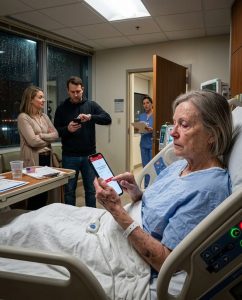
I had fallen outside a grocery store after a storm turned the entrance slick.
One careless step.
One hard crash against wet concrete.
One bag of groceries split open beside me, oranges rolling under a parked SUV while a young cashier shouted for someone to call 911.
At sixty-eight years old, I was still the kind of woman who drove herself everywhere.
I carried my own groceries.
I changed my own furnace filter.
I shoveled just enough snow off my front walk to prove I could still do it, even when my hands ached afterward.
Then a doctor stood by my hospital bed and said fractured pelvis, badly bruised shoulder, several weeks of limited mobility, and no living alone right away.
He said it gently.
That did not make it easier to hear.
I nodded like a reasonable patient while the skin around my hip throbbed under the blanket and the hospital wristband kept scratching the soft inside of my wrist.
The discharge nurse gave me a list of things I could not do.
No stairs alone.
No driving.
No bending.
No pretending pain was character.
That last one was not on the paper, but it might as well have been.
I had been pretending strength for most of my life.
When my husband died, Daniel was nine years old and still small enough to curl into my side on the couch.
He did not understand life insurance or funeral homes or why adults kept bringing casseroles we were too sad to eat.
He understood only that his father had gone into a hospital and never come home.
So I became the parent who stayed.
I packed lunches with notes tucked under the sandwich bag.
I sat on the bathroom floor through fevers.
I learned how to fix a leaky faucet because calling someone cost money we did not have.
I pushed Daniel through college applications when grief made him tired of trying.
I worked extra shifts and told him it was fine when the car needed brakes the same week his school fees came due.
I told myself my body would recover later.
Later, of course, is where mothers store everything they are not allowed to need.
By the time Daniel was grown, married to Jessica, and raising children of his own, I thought the hard years had softened into something like gratitude.
He called on Sundays.
He brought the kids by when the weather was nice.
Jessica sent photos from school programs and birthday mornings.
When they struggled, I helped.
At first, it was small.
A utility bill.
A car insurance payment.
A grocery card slipped into Daniel’s hand in the driveway because he looked ashamed and I could not bear to make him say it out loud.
Then his construction jobs slowed down.
Jessica decided staying home was best for their family.
The mortgage gap became a monthly problem, then a monthly expectation, then a line item I stopped questioning because questioning it felt like accusing my own son of failing.
For nearly two years, I transferred $6,000 into Daniel and Jessica’s account every month.
In my banking app, it was labeled Daniel Household Support.
It looked harmless that way.
Clean.
Administrative.
Almost kind.
But a label can make almost anything look decent if you stare at it long enough.
I paid when my granddaughter’s program needed tuition.
I paid when their car insurance came due.
I paid when Daniel texted, Mom, please don’t tell Jessica I asked.
Sometimes I paid before they asked, because I knew the rhythm of their trouble by then.
I knew the tone in Daniel’s voice when a bill was late.
I knew Jessica’s clipped politeness when she wanted something but did not want to appear grateful.
I knew the little silence after the word “vacation” when they mentioned flights, hotels, and activities for the kids, as if I was supposed to understand that memories mattered more than math.
I understood too much.
That was my mistake.
The night Daniel and Jessica walked into my hospital room, I truly believed help had arrived.
Daniel came in first, his hair damp from the rain, his hoodie dark at the shoulders.
Jessica followed behind him with her purse tucked tight under one elbow and her phone already in her hand.
She stopped near the foot of the bed.
Daniel stopped three feet from my side.
Neither of them touched my hand.
“Mom,” he said, rubbing the back of his neck, “we can’t take care of you.”
I waited because I thought the sentence was unfinished.
Maybe he meant they could not take care of me full-time.
Maybe he meant they needed help arranging a nurse.
Maybe he meant their house had stairs, or the kids had school, or they were overwhelmed and ashamed and trying to say it badly.
I gave him room to be better than what he had said.
He did not use it.
He looked straight at me and said, “Our vacation comes first.”
The monitor beside me beeped once.
Then again.
That tiny sound seemed louder than his voice.
Jessica sighed, not cruelly exactly, but with the weary impatience of someone discussing a delayed flight.
“We already paid for everything,” she said.
“Flights, hotel, activities for the kids. This trip is important to us. We can’t just put our lives on hold because of an accident.”
Because of an accident.
That was what she called my fractured pelvis while I lay in a hospital bed with a call button clipped to my blanket because I could not stand by myself.
I looked at my son and tried to find the boy who used to fall asleep in the old recliner with his hand curled around my sweater sleeve.
All I saw was a grown man checking his watch.
There are moments when a person does not become cruel all at once.
They simply reveal how long they have been practicing.
Daniel shifted his weight.
“The doctor said you’ll need assistance, right? Can’t the hospital set something up?”
“The hospital can recommend options,” I said.
Jessica’s shoulders dropped with relief.
“Great,” she said.
“Then that’s settled.”
Settled.
I remember that word more clearly than the pain medicine.
It landed in me harder than the fall outside the grocery store.
I did not yell.
I did not remind them of the monthly transfer.
I did not say that the vacation they were protecting existed because I had been filling the holes in their life with money I had earned and saved over decades.
For one ugly heartbeat, I imagined opening my banking app and reading out every payment.
Mortgage gap.
Car insurance.
Groceries.
Tuition.
Emergency cash.
I imagined making Daniel look at the list until he remembered I was not a convenience.
Then I looked at the hospital tray beside me, at the untouched cup of water and the folded discharge papers, and something inside me went calm.
Not numb.
Not weak.
Calm.
I smiled.
“That’s okay,” I said.
Daniel blinked.
Jessica smiled back too quickly.
It is strange how people relax when you stop asking them to be decent.
They mistake your quiet for surrender.
They do not realize quiet is sometimes the sound of a door locking.
I picked up my phone with my good hand.
My fingers shook, partly from pain and partly from the effort of holding the phone at the right angle.
Daniel watched me, but not closely.
Jessica was already looking at her own screen.
At 8:18 p.m., I called my attorney.
His name had been in my contacts for years because my husband and I had used him for estate papers before Daniel ever needed help with bills.
When he answered, I told him I was in the hospital.
I told him I needed my financial arrangements cleaned up immediately.
I wanted everything in writing.
I wanted documentation that no one had authority to speak for me, move my money, pressure me, or present themselves as my decision-maker while I was recovering.
He listened without interrupting.
Good attorneys can hear the difference between panic and clarity.
He said he would send a written confirmation before morning.
He also told me to save every message.
At 8:31 p.m., I called a private care agency my neighbor from church had used after knee surgery.
The coordinator sounded calm, practical, and blessedly uninterested in family drama.
Full-time nurse.
Temporary in-home assistance.
Transportation after discharge.
Medication schedule.
Bathroom safety check.
Email paperwork.
Hospital intake coordination.
For the first time all evening, I felt like I was speaking to someone who understood that needing help did not make me helpless.
When I hung up, Daniel looked almost proud of himself.
“See?” he said.
“You’re fine.”
I looked at him for a long moment.
My son had mistaken my survival skills for permission to abandon me.
I opened my banking app.
The recurring transfer sat right where it always did.
Scheduled for the first day of every month.
$6,000.
Daniel Household Support.
It had moved for so long that it almost felt like weather.
Automatic.
Expected.
Unquestioned.
My thumb hovered over the screen.
Not because I was unsure.
Because I wanted to remember the exact feeling of choosing myself without asking permission from the people who had benefited from me never doing that.
Then I tapped Cancel.
A confirmation notice appeared at 8:42 p.m.
Daniel and Jessica were standing three feet away.
Neither of them noticed.
Jessica glanced toward the door.
“We should go,” she said.
Daniel leaned down and kissed my forehead.
It was the kind of kiss a person gives before leaving a room they do not intend to think about again.
“Rest up, Mom,” he said.
Jessica added, “Text us if you need anything.”
She was already scrolling when she said it.
Their suitcase wheels clicked down the hallway later that night when they left for the airport.
The sound moved past the nurses’ station, past the vending machines, past the framed hospital poster with a small American flag in the corner.
I lay there listening until the wheels faded.
The room felt bigger without them.
Not emptier.
Bigger.
The story continues — don’t miss what happens next