The night nurse came in around midnight to check my blood pressure.
She adjusted the cuff gently around my arm and asked if my pain was manageable.
I told her yes, which was only partly true.
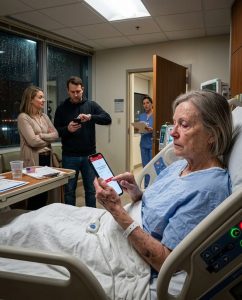
Pain is easier to manage when it is honest.
At 12:17 a.m., my phone lit up.
Daniel.
I watched it ring until it stopped.
Then Jessica called.
Then Daniel again.
Then Jessica.
The names stacked on the screen one after another, frantic and bright in the dark room.
By the time the nurse returned, there were 87 missed calls.
They looked almost unreal.
A tower of panic.
A record of sudden love arriving only after the money stopped.
The nurse glanced at the screen and asked if I wanted her to silence it.
“Yes,” I said.
My voice sounded steadier than I felt.
She turned the phone face down on the tray.
A minute later, it buzzed again anyway.
This time, Daniel left a voicemail.
The preview appeared before the screen went dark.
Mom, what did you do to our account—
That was all I could see.
I did not play it right away.
I knew enough.
But then another notification came through from my bank.
The canceled recurring transfer had triggered an automatic confirmation email.
The next $6,000 deposit would not process.
No replacement date.
No pending transfer.
No Daniel Household Support.
A few seconds later, Jessica sent a photo from the airport gate.
Daniel was in the corner of the image with one hand over his mouth.
His boarding pass was bent nearly in half.
On Jessica’s phone screen, captured by accident in the photo, I could see a declined hotel hold and a checking balance that explained every missed call.
Jessica texted three words.
Call us now.
I did not.
Daniel left another voicemail.
This one began with anger.
By the middle, it had turned into bargaining.
By the end, he was whispering.
“Mom, the mortgage is due next week,” he said.
“What are we supposed to do?”
I looked at the ceiling and let the question sit there.
For years, I had made sure he never had to answer that question honestly.
That night, I let him hear it.
At 12:46 a.m., my attorney’s email arrived.
The subject line was simple.
REVOCATION OF FAMILY FINANCIAL SUPPORT — EFFECTIVE IMMEDIATELY.
Attached were two documents.
One was a written confirmation of my instructions.
The other was a notice stating that no family member had authority to access, direct, or claim my funds on my behalf.
My attorney had also written down the time I called him.
8:18 p.m.
Before the airport panic.
Before the hotel hold failed.
Before Daniel suddenly remembered I existed.
That timestamp mattered.
Not because I planned to punish my son.
Because people who rely on your silence will often rewrite your choices as confusion the moment those choices cost them something.
The next morning, the private nurse coordinator arrived before breakfast with a folder, a pen, and the calm efficiency of a woman who had seen every kind of family disappointment.
Her name tag said intake coordinator.
She reviewed my medication schedule.
She reviewed my discharge restrictions.
She asked about my house, the number of steps, the bathroom setup, the kitchen layout, and whether I had someone who could pick up groceries.
I told her I could arrange delivery.
I did not mention Daniel.
There are some names you stop offering as emergency contacts before your hand fully understands why.
By 9:10 a.m., Daniel finally reached the hospital room phone.
I answered because I wanted to hear whether my son would ask about my pain before asking about his money.
He did not.
“Mom,” he said, “you can’t just cancel something like that.”
“Something like what?” I asked.
“Our support,” he said.
He said our like he had earned part of it.
I turned my head toward the window.
Morning light had washed the rain off the glass.
The hospital parking lot below was full of wet cars, nurses changing shifts, and one old pickup idling near the entrance.
“I canceled my transfer,” I said.
“That money was helping us live.”
“I know.”
There was silence.
He had expected denial, maybe guilt, maybe a long explanation he could interrupt.
He did not know what to do with agreement.
Jessica came on the line then, her voice sharp and breathless.
“We had expenses based on that money.”
“Yes,” I said.
“And I had recovery needs based on my fractured pelvis.”
“That’s not fair,” she snapped.
“No,” I said.
“It isn’t.”
For the first time, I meant myself.
Daniel tried again.
“Mom, we were under stress last night. You know we didn’t mean it like that.”
I closed my eyes.
I could still hear him in the room.
Our vacation comes first.
People think apologies begin when regret appears.
Often, regret is just inconvenience wearing a softer shirt.
“You meant it exactly like that,” I said.
He went quiet.
The intake coordinator pretended not to listen while she clipped papers into her folder.
Her face stayed professional, but her hand paused for one second on the page.
Even strangers can recognize when a family bill finally comes due.
Daniel lowered his voice.
“Are you really going to do this to your grandchildren?”
There it was.
The last door.
When guilt fails, some people reach for children like a shield.
I loved my grandchildren.
That love was the reason I had paid tuition, bought coats, mailed birthday cards, and kept quiet about things no child should have to carry.
But loving children did not require funding their parents’ entitlement forever.
“I will always help the kids directly when I choose to,” I said.
“I will not send you and Jessica $6,000 a month anymore.”
Jessica made a sound in the background.
A small, broken breath.
Daniel said my name, not Mom this time.
“Margaret.”
He had not called me that in years.
It sounded wrong in his mouth.
I looked down at the purple bruise spreading along my shoulder, at the plastic wristband, at the call button resting by my hand.
I thought of the grocery store entrance, the wet concrete, the oranges rolling under the SUV.
I thought of Daniel standing three feet away from my hospital bed and choosing a hotel over his mother.
Then I thought of my banking app, the clean confirmation screen, and the strange peace that had settled over me after I tapped Cancel.
“I am recovering,” I said.
“I am not negotiating.”
The words were not loud.
They did not need to be.
Daniel breathed into the phone.
Jessica whispered something I could not make out.
Maybe she was crying.
Maybe she was angry.
Maybe she was finally doing the math.
The coordinator placed the intake folder on my tray and pointed gently to the signature line.
I signed with my good hand.
The letters came out crooked because my shoulder hurt, but they were mine.
When Daniel realized I was signing paperwork while he was still trying to talk me backward, his voice changed.
“Mom, please,” he said.
There was the word he had saved for the account, not the hospital bed.
Please.
I almost laughed.
Not because it was funny.
Because if I did not laugh, I might have cried, and I was tired of giving my pain to people who only valued it when it inconvenienced them.
“I hope you have a safe flight home,” I said.
“We can still fix this,” he said.
“No,” I answered.
“You can face it.”
Then I ended the call.
The room went quiet except for the monitor and the soft squeak of the coordinator’s shoes on the floor.
She did not offer pity.
She simply slid the pen back into her pocket and said, “We’ll make sure you’re taken care of.”
Those words nearly undid me.
Not because they were grand.
Because they were practical.
A nurse helped me sit up a little higher before breakfast.
The movement hurt so badly my eyes watered, but I did it.
The tray arrived with eggs, toast, and coffee that tasted exactly like hospital coffee always tastes.
I ate half the toast.
I answered two emails from my attorney.
I added the care agency as a contact.
I removed Daniel as my automatic emergency financial note.
Small actions.
Plain actions.
The kind that rebuild a life without making a speech about it.
Over the next few days, Daniel and Jessica kept calling.
Some messages were angry.
Some were frightened.
Some were dressed up as concern.
How are you feeling, Mom?
Then, one line later:
Can we talk about the transfer?
I saved everything.
Not because I wanted revenge.
Because I had finally learned that memory is fragile when other people need you to doubt yourself.
My attorney kept a file.
The care agency kept a schedule.
The hospital kept my discharge notes.
For the first time in years, my life was being documented by people who were not trying to spend it.
When I finally went home, there was a nurse beside me, not Daniel.
There were groceries on the porch from a delivery order I placed myself.
There was a small American flag tucked into my neighbor’s flowerpot across the street, damp from the morning rain.
There was my mailbox, my driveway, my front step, my quiet house.
Nothing about it looked dramatic.
Everything about it felt different.
The private nurse helped me inside and made sure the rugs were moved so I would not trip.
She checked the bathroom rails.
She set my medication chart on the kitchen counter.
She asked where I wanted my phone charger.
I looked around at the home I had kept standing through widowhood, motherhood, work, fear, bills, grief, and every version of later I had promised myself.
Then I said, “By my chair.”
That evening, Daniel sent one final message.
Mom, I don’t understand how you can just cut us off.
I stared at it for a long time.
Then I typed back:
I did not cut you off. I stopped letting you cut pieces off me and call it family.
He did not answer.
Maybe he was angry.
Maybe he was ashamed.
Maybe he was looking at his own bank account and finally seeing what mine had carried.
I do not know what happened in his house that night.
I only know what happened in mine.
I slept in my own bed with a nurse down the hall, medication on the nightstand, and my phone face down for the first time in years.
The pain was still there.
The bruises were still there.
The recovery was still going to be slow.
But the helpless woman Daniel thought he had left in that hospital bed never existed.
She had simply been generous for so long that everyone mistook her kindness for a permanent arrangement.
And when the $6,000 stopped, they finally discovered what I had learned at 8:42 p.m. under fluorescent hospital lights.
I was not abandoned.
I was free.