The scream did not sound human at first.
It came through my phone on a Sunday afternoon while sunlight lay soft across the kitchen floor and a cup of coffee cooled beside my hand.
I had just come back from overseas, six days of conference rooms, quiet handshakes, and men pretending billion-dollar decisions did not make them sweat.
My shirt was still creased from the flight.
My suitcase sat unopened near the pantry.
Then Brooke called.
My sister had cried in front of me only three times in her life.
Once when our mother died.
Once when Amelia was born too early and the doctor told her not to make plans past the next forty-eight hours.
And once when she realized her husband was not coming back from a job site accident.
This fourth time was worse.
“Dom,” she sobbed. “They found Amelia on the highway.”
I stood very still.
The refrigerator hummed behind me.
The spoon in my mug tapped the ceramic because my hand had started to shake before the rest of me understood why.
“Where is she?” I asked.
“County General. They said she’s alive. Dom, they dragged her. Five bikers dragged her by the hair for fun. Somebody left her near the field behind Miller’s Diner.”
The room did not spin.
That would have been easier.
Instead, everything became too clear.
The white edge of the countertop.
The black coffee ring near the saucer.
The little brass key hook beside the pantry door.
I set the cup down with both hands.
Men who have survived ugly places learn not to waste rage on noise.
Noise warns people.
Quiet arrives.
I took my keys and drove.
The road toward the hospital ran gray under a washed-out California sky.
Rain had not started yet, but the air had that metallic pressure it gets before a storm, and somewhere near the highway shoulder there was a burnt smell like scorched rubber.
I passed a gas station, a church sign with missing letters, and a diner parking lot where two men turned their heads as my SUV went by.
Miller’s Diner sat just beyond the bend, low and faded, with a cracked sign and three pickups parked out front.
I did not stop.
Not yet.
At County General, two deputies stood near the emergency entrance holding paper coffee cups.
They recognized me.
I saw it happen in their eyes.
Then both of them looked away too fast.
That was the first clue.
The ER smelled of bleach, rubber gloves, and fear people had no place to put down.
Nurses moved with quiet urgency.
A young doctor stopped talking when I approached.
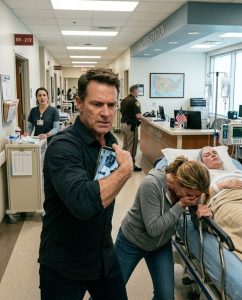
My sister Brooke sat in a plastic chair against the wall, both hands pressed over her mouth.
She looked smaller than I remembered.
Grief does that to people.
It folds them inward until even their bones seem unsure where to stand.
When she saw me, she tried to get up.
Her knees gave out.
I caught her before she hit the floor.
“Dom,” she whispered into my shirt. “They dragged her.”
Amelia was behind a curtain.
White sheets.
Thin wires.
A monitor that beeped with a stubborn little rhythm I knew I would hear in my sleep for years.
Her face was swollen.
One eye had purple shadows around it.
Her lips were cracked.
There were bare patches in her hair where someone had pulled hard enough to take pieces of her with them.
I had seen combat.
I had seen men do things they later claimed they could not remember.
But this was not confusion, panic, or war.
This was cruelty performed for an audience.
Brooke held onto my sleeve.
“Someone filmed it,” she said. “People saw. Nobody helped.”
I looked at Amelia’s hand on the sheet.
She was nineteen.
She still painted one fingernail a different color because she said life was too boring otherwise.
She still called me Uncle Dom when she wanted money and Dominic when she wanted advice.
I had bought her first used SUV after she got into community college.
I had lectured her about oil changes, tires, emergency cash, and leaving parties early.
She had rolled her eyes at all of it and hugged me anyway.
That was the part that got under my ribs.
Amelia trusted the world more than the world deserved.
A small American flag stood in a mug near the nurses’ station, faded at the edges.
Somebody had stuck it there after a holiday and forgotten to take it down.
It looked tired.
So did everybody else.
The sheriff arrived ten minutes later.
Samuel Calder wore his uniform like armor and his sympathy like something rented for the occasion.
He glanced at Amelia for half a second.
Half a second was all he gave her.
Then he turned to me with a clipboard.
“Mr. Hart, we’re treating this as a street gang incident,” he said.
“She was going to dinner.”
“Kids get mixed up with rough people sometimes.”
Brooke flinched like the words had touched her daughter.
I kept my voice low.
“She is nineteen. She had a dinner plan and a curfew. She did not get mixed up with anything.”
Calder’s jaw shifted.
“We’ll piece it together.”
“Piece it together?”
The pen in his hand tapped once against the clipboard.
“The diner cameras malfunctioned. No witnesses willing to talk. These groups intimidate people. We have to be realistic about what we can prove.”
I looked at the pen until he stopped tapping it.
“Find them,” I said.
He nodded.
There was no promise in it.
Only procedure.
By 7:42 p.m., the first incident summary used the phrase suspected altercation.
By 8:06, the deputy at the desk had logged no available exterior footage from Miller’s Diner.
By 9:15, Brooke had signed a visitor form with a hand that could barely hold the pen.
I read every line they gave her.
Hospital intake form.
Incident summary.
Preliminary police report number written in blue ink at the top of a cheap folder.
Paperwork has a smell when people use it to make violence smaller.
It smells like toner, thin folders, and somebody deciding the truth is too expensive.
Rain finally came after midnight.
It tapped the hospital windows in small nervous fingers.
Brooke slept badly in a chair with her coat pulled over her knees.
I sat beside Amelia and watched her breathe.
There are rooms where time stops behaving normally.
Hospital rooms are one of them.
A minute can be an hour.
A beep can become a prayer.
Near 2:03 a.m., Amelia’s eyelids fluttered.
I leaned forward so fast the chair legs scraped the floor.
“Amy?”
Her lips moved.
No sound came out.
I took her hand gently because there were bruises near her wrist and I did not know where pain began anymore.
“I’m here,” I said. “It’s Uncle Dom.”
Her mouth opened again.
This time one word came through, thin and torn.
“Bikers.”
“I know, sweetheart.”
Her fingers twitched against the sheet.
“He knew.”
My spine went cold.
“Who knew?”
Her eyes rolled back.
The medication pulled her under before she could answer.
I stayed beside her for several minutes.
I did not move because moving would have meant choosing.
And some choices, once made, do not leave the room with you.
Then my phone buzzed.
Unknown number.
I stepped into the hallway before I answered.
“Hart.”
Sheriff Calder’s voice came through low and tight.
No office noise behind him.
No radio.
No deputy chatter.
Just rain and breathing.
“Sir,” he said, “they’re protected. We can’t touch them.”
I looked through the glass at Brooke sleeping crookedly in the chair, her hand still near Amelia’s blanket.
“Protected by who?” I asked.
Silence.
Then the line went dead.
I lowered the phone slowly.
For the first time that night, I smiled.
Not because anything was funny.
Because fear had just shown me its paperwork.
This was not a failure to investigate.
It was a system.
I walked to the end of the corridor where the vending machines buzzed beside a framed map of the United States.
I opened my contacts and found a number I had not used in years.
Julian Cross answered on the fifth ring.
His voice was rough with sleep and history.
“Dominic Hart,” he said. “You only call when the world is burning.”
Julian had been my spotter before I was a man in suits.
Before boardrooms.
Before headlines.
Before people learned the word billionaire and forgot there had been a different word first.
Sniper.
He knew the version of me that could stay motionless for seventeen hours and still remember every license plate that passed a checkpoint.
He also knew the version of me that had spent fifteen years making sure that man never came home.
“My niece was attacked,” I said. “Five names. Maybe six. Bikers. Miller’s Diner. Highway field. Sheriff says they’re protected.”
Julian went quiet.
“Brother,” he whispered. “How clean?”
I looked back at Amelia.
At Brooke.
At the deputy pretending not to watch me from the nurses’ station.
“Surgical,” I said.
Julian inhaled once.
“Send me the hospital intake time, every document you have, and a photo of the wristband. Do not call anyone else. Do not threaten anyone. Do not let Calder know you moved.”
“Already understood.”
“Good,” he said. “Then let’s find where the protection starts.”
I photographed the intake stamp.
2:18 p.m.
I photographed Amelia’s wristband.
I photographed the first page of the incident summary, including the phrase suspected altercation.
Then I sent the location of Miller’s Diner and the field behind it.
Six minutes passed.
Brooke stirred once but did not wake.
The deputy at the desk stood, checked his phone, and sat back down.
At 2:31 a.m., Julian sent the first message.
Not a name.
A license plate.
Then came a still frame.
Grainy.
Rain-streaked.
Pulled from an angle the diner cameras apparently did not have.
Three motorcycles sat near the highway lights.
A black pickup was parked behind them.
One man had his hand raised.
Another held up a phone like he was filming a joke.
In the lower corner of the frame, near the weeds and gravel, was a shape I did not let myself study for more than half a second.
Amelia’s hair.
My hand closed around the phone until the case creaked.
Brooke woke when my chair scraped backward.
“Dom?”
I turned the screen away too late.
She saw enough.
Her face emptied.
The story continues — don’t miss what happens next