Then she folded forward with one hand over her mouth and the other gripping the bed rail so hard her knuckles went white.
“No,” she whispered. “No, no, no.”
I reached for her shoulder.
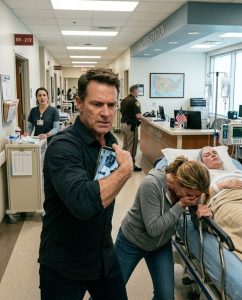
She shook me off, not from anger, but because her body had no room left for comfort.
A second text arrived.
Julian wrote: One of them has Sheriff Calder on speed dial.
Below that, he sent a name.
Deputy Marcus Vane.
I knew the name.
Not personally.
People in counties like that collect reputations the way old houses collect dust.
Vane had been in photographs with Calder at charity breakfasts, road safety events, and one county fundraiser where local business owners smiled under a banner with an American flag printed across the corner.
Julian sent more.
A call log.
Four calls between Deputy Vane and one of the bikers in the six hours before Amelia was found.
Two calls after.
One at 6:58 p.m., just before Calder arrived at the hospital.
Then a still from a gas station near the highway.
The black pickup was clearer there.
So were the motorcycles.
So was the man stepping out from the passenger side.
Sheriff Calder.
He had not been protecting them from the investigation.
He had been protecting himself from the timeline.
Brooke looked up at me from beside the bed.
“Dom,” she said, and for a moment she sounded like our mother. “What are you going to do?”
I wanted to say the thing she feared.
I wanted to say I was going to make five men disappear from the world they had made uglier by being in it.
For one ugly heartbeat, I imagined it.
A quiet road.
No witnesses.
No speeches.
No more phone calls from protected men.
Then Amelia made a small sound in the bed.
Not a word.
Just pain trying to become one.
That sound saved me from myself.
I put the phone in my pocket.
“I’m going to make sure everybody can see them,” I said.
At 3:12 a.m., Julian sent the first full packet.
Names.
Plates.
Known addresses.
Phone connections.
A rough map of the route from Miller’s Diner to the highway field.
He had pulled what public systems would not admit existed and what private cameras had no reason to protect.
A delivery truck dashcam.
A gas station pump camera.
A motel parking lot feed.
A blurry phone video from someone who had uploaded twelve seconds to a private group and then deleted it.
Deleted does not mean gone.
It only means someone was scared after they were cruel.
By sunrise, Julian had traced the video to a man named Cole Ransom, one of the bikers seen laughing near the pickup.
Cole had sent it to three people.
One of them was Deputy Vane.
Deputy Vane had forwarded it to Calder with the message: We have a problem.
Calder replied: Keep the girl quiet.
I read that sentence twice.
Then I placed the phone face down on the windowsill because if I looked at it a third time, I might forget every promise I had just made myself.
Brooke stood behind me.
Her hair was tangled from the chair.
Her eyes were swollen.
“Did he say that?” she asked.
I nodded.
Something in her changed then.
Not healed.
Not strong.
Those words are too clean for a mother looking at proof.
But she stopped shaking.
“Then don’t let them write this,” she said.
I turned.
“What?”
She pointed at the county folder on the side table.
At suspected altercation.
At no available footage.
At the little official lies stacked neatly around her daughter’s pain.
“Don’t let them write what happened to her.”
That became the line I held onto.
Not revenge.
Record.
Not rage.
Exposure.
Not five men in the dark.
A whole room forced into the light.
At 7:05 a.m., I called my attorney.
At 7:22, she called a state investigator she trusted.
At 7:41, we delivered copies of the video packet, call logs, and the hospital intake documents through channels Calder could not close.
By 8:10, Deputy Vane’s phone was no longer answering.
By 8:36, Calder called me again.
I let it ring.
He called twice more.
Then he texted: We should talk before this gets misunderstood.
I showed Brooke.
For the first time since I had arrived, she laughed.
It was not a happy sound.
It was a broken little thing with teeth in it.
“Misunderstood,” she said.
At 9:14 a.m., Amelia woke again.
Her eyes opened only halfway.
I leaned close.
“Amy, it’s me.”
She swallowed.
“Mom?”
“I’m here,” Brooke said, rushing to her side.
Amelia’s gaze drifted between us.
Then she whispered, “He told them nobody would care.”
The room went still.
“Who did?” I asked.
Her lips trembled.
“The sheriff.”
Brooke made a sound I will never forget.
It was not crying.
It was the sound of the last door inside her breaking open.
I touched Amelia’s hand.
“People care,” I said. “You’re going to hear that a lot soon.”
She looked afraid of believing me.
That hurt worse than the bruises.
Because an entire town had taught her, for one terrible afternoon, to wonder if she deserved to be left there.
By noon, she did not have to wonder anymore.
The state team arrived first.
Then internal affairs.
Then two investigators who asked for the county folder, the intake records, and every message Brooke had received from the hospital and sheriff’s office.
Calder did not come through the ER doors with confidence this time.
He came with his jaw tight and his eyes moving too quickly.
He saw me standing beside Amelia’s room.
He saw Brooke.
He saw my attorney holding a printed copy of his own text.
Keep the girl quiet.
His face changed in a way I will remember longer than any headline.
Men like Calder do not fear guilt first.
They fear being seen.
The bikers were picked up before dark.
Not all at once.
Not in some movie scene with shouting and spinning tires.
One at a repair shop.
One at his girlfriend’s apartment complex.
Two outside a gas station.
Cole Ransom in the back room of Miller’s Diner, where he had gone because stupid men often hide near the place they think made them powerful.
Deputy Vane tried to call Calder fourteen times after the first arrest.
Julian sent me the call log with no comment.
He did not need one.
Weeks later, when Amelia could sit up without wincing, she asked me if I had wanted to kill them.
I told her the truth.
“Yes.”
She looked at the blanket.
“Why didn’t you?”
I thought about the road.
The rain.
The old version of me standing at the edge of the hallway, waiting to be invited back.
Then I looked at Brooke sleeping in the chair beside her, one hand still curled around a hospital coffee cup gone cold.
“Because then they would have made the story about me,” I said. “And this story belongs to you.”
Amelia cried then.
Quietly.
Not like a movie.
Not like the first scream that brought me home.
Just tears sliding down a face still healing.
I sat beside her until she slept.
The case did not heal her.
The arrests did not give back what those men took.
The headlines did not make Brooke stop checking the window every time a motorcycle passed.
But the official record changed.
Suspected altercation became aggravated assault.
No available footage became recovered third-party video evidence.
No witnesses became multiple cooperating witnesses after protection was removed.
And Sheriff Samuel Calder became the man whose own words pulled the first thread from the cover-up he thought would hold.
Months later, Amelia walked into Miller’s Diner again.
Not alone.
Brooke was on one side of her.
I was on the other.
The place had new cameras by then.
The cracked sign had been replaced.
There was a small American flag taped near the register, curling at one corner.
Amelia ordered pancakes because she said refusing to eat there made the building more important than it deserved to be.
Her hand shook when the waitress brought the plate.
She ate anyway.
That is courage more often than people admit.
Not a speech.
Not a clean victory.
A girl cutting a pancake in a diner that once stood too close to the worst day of her life.
Brooke watched her with wet eyes and said nothing.
I drank bad coffee from a chipped mug and kept my chair facing the door.
Some habits stay.
Some habits earn their keep.
Before we left, Amelia looked at me and said, “Uncle Dom?”
“Yeah?”
“Thank you for not disappearing them.”
I almost smiled.
“You’re welcome.”
She pulled her hoodie tighter around herself and looked out at the highway.
“I’m glad everybody saw.”
That was the ending people never put in the headlines.
Not revenge.
Not power.
Not a billionaire sniper shaking the nation.
A young woman learning that the men who hurt her did not get to write the last sentence.
And neither did the sheriff who tried to keep her quiet.