The call came at exactly 3:00 a.m.
Julianne knew the time because the numbers burned themselves into her mind before she was even fully awake.
The house was dark, the heat had clicked off, and frost had made a white crust along the bottom of her bedroom window.
Her phone buzzed on the nightstand with a hard, angry sound that did not belong in that hour.
Mom.
She reached for it so quickly the charging cord snapped against the hardwood floor.
“Mom?”
For a second, there was only breathing.
Not normal breathing.
Wet, thin breathing.
The kind that made Julianne sit up before her mother said a word.
Then came the whisper.
“Help… me, Julianne. Please—”
The line went dead.
Julianne froze with the phone pressed to her ear, listening to nothing.
The silence on the other end felt bigger than the storm outside.
She called back immediately.
Voicemail.
She called again.
Voicemail.
By the fifth time, her hands were shaking so badly she laid the phone flat on the blanket and hit redial with one finger.
The call log showed one clean fact.
Mom, 3:00 a.m., eleven seconds.
That was all.
Eleven seconds was not enough time for an explanation.
It was enough time for terror.
Her mother lived three hundred miles away in a mountain town that never felt close, even in summer.
In winter, with snow closing roads and wind turning the highway white, it felt like another country.
Julianne had hated that distance since the day her mother married Arthur Vance.
Arthur was the kind of man who called himself practical whenever he was being cruel.
He had money, polished shoes, a quiet house, and a way of making every kindness sound like something he owned.
At first, Julianne’s mother tried to defend him.
“He’s just particular,” she would say.
Then it became, “He worries.”
Then, “He doesn’t mean it like that.”
Julianne knew those sentences.
They were the little rugs people laid over trapdoors.
The first real warning had come at Thanksgiving.
Her mother had brought a pumpkin pie, proud of the crust because it had not cracked in the middle.
Arthur looked at it and said, in front of everyone, “Did you use my credit card for that?”
The room had gone quiet in that way families pretend is normal.
Her mother laughed too softly and said she would pay him back.
For pie crusts.
Julianne had stared at him across the table and felt something in her chest turn cold.
After that, the signs came faster.
Arthur checked her mother’s phone.
Arthur corrected her clothes.
Arthur explained her own medical appointments to her as if she were not sitting beside him.
Arthur told Julianne and Leo that their mother needed “structure.”
That word stayed with Julianne.
Structure sounded clean.
It sounded responsible.
But in Arthur’s mouth, it meant obedience.
Leo did not want to hear it.
He liked Arthur’s contacts, his restaurants, his clean version of family.
Leo had always been gifted at stepping away from anything that made him uncomfortable.
Julianne had not been given that talent.
At 3:09 a.m., she pulled on jeans, wool socks, boots, and the thickest coat she owned.
At 3:14, she backed out of her driveway with a travel mug of coffee in the cupholder and the county hospital address glowing on the dashboard.
She did not remember deciding on the hospital.
She only remembered opening the location app and seeing the nearest one to her mother’s town.
The snow hit her windshield sideways.
The wipers worked in frantic arcs, clearing just enough glass to show the next few feet of road.
Beyond that was white.
The world narrowed to headlights, lane markers, and the sound of tires pushing through slush.
Julianne called her mother again at 3:22.
Voicemail.
She called Leo at 3:25.
No answer.
She called again at 3:27.
No answer.
She almost threw the phone into the passenger seat, but instead she placed it facedown beside the untouched coffee and kept driving.
There are kinds of fear that make people frantic.
There are other kinds that make them precise.
Julianne became precise.
She checked the road signs.
She watched the gas gauge.
She kept both hands on the wheel.
She did not let herself imagine her mother on the floor, or in a ditch, or sitting somewhere alone while Arthur stood over her with that calm, polished voice.
Every time her mind tried to go there, she forced it back to the road.
Mile marker.
Snowplow light.
Brake slowly.
Breathe.
The storm thickened around 4:40 a.m.
A semi passed in the opposite lane and threw a wave of dirty snow across the windshield so hard she saw nothing for three full seconds.
She held the wheel straight and whispered, “Not today.”
She did not know who she was saying it to.
Maybe the storm.
Maybe Arthur.
Maybe God.
By 5:30, her shoulders ached from gripping the wheel.
By 6:10, her coffee was cold.
By 6:45, her phone battery had dropped below twenty percent, and the charging cord kept slipping from the port because her hands were clumsy with cold and panic.
At 7:58 a.m., the mountains finally appeared as dark shapes beyond the storm.
The town came into view slowly.
A gas station with snow piled against the pumps.
A closed diner with a paper sign taped to the window.
A row of small houses with porch lights still glowing in the gray morning.
Then the hospital.
It sat at the end of a plowed road, brick and glass washed pale by snow.
A small American flag snapped hard on the pole near the front entrance.
The visitor lot was nearly empty.
Salt crunched under Julianne’s tires as she pulled in too fast.
She was looking for an ambulance.
She was looking for police lights.
She was looking for anything that would tell her where to run.
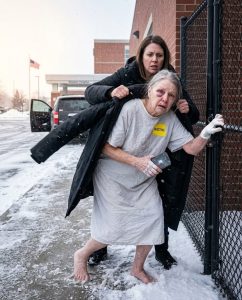
Then she saw the side gate.
It was a black metal gate near the ambulance bay, closed and rattling in the wind.
At first, Julianne thought someone had left a sheet caught on it.
Then the sheet moved.
It was a hospital gown.
Her mother was standing outside the locked side gate, barefoot in the snow.
Julianne’s mind refused the image for one merciful second.
It broke into pieces instead.
Bare feet blue-white against slush.
Gray hair stuck to one cheek.
One hand curled around the iron bars.
The other pressed against her ribs.
Then her mother lifted her face.
One eye was swollen almost shut.
Purple bruising spread across her cheekbone.
Dried blood had cracked at the corner of her mouth.
Her lips were split from the cold.
Her whole body shook so violently that the gate trembled with her.
Julianne did not remember putting the SUV in park.
She remembered the driver’s door flying open.
She remembered the cold hitting her lungs like glass.
She remembered slipping once on the salted pavement and catching herself with one hand before she ran the rest of the way.
“Mom.”
Her voice came out thin and strange.
Her mother flinched before she recognized her.
That flinch hurt Julianne more than the bruises.
Because fear had moved faster than love.
Because Arthur had trained her body to expect danger first.
Julianne pulled off her coat and wrapped it around her mother’s shoulders.
The coat was still warm inside.
Her mother folded into it like someone falling through a door.
“I’m here,” Julianne said. “I’m right here.”
Her mother made a sound that was almost a sob and almost an apology.
For one ugly heartbeat, Julianne wanted Arthur Vance in front of her.
She wanted to grab his expensive coat.
She wanted him on that pavement with snow soaking through his knees.
She wanted him to understand what it felt like to be left outside with no door open and no voice strong enough to call for help.
She did not move.
She held her mother tighter.
Rage wants an audience.
Love has work to do.
Love gets the coat.
Love checks the pulse.
Love keeps the person alive before it goes looking for the person who caused the harm.
A yellow intake sticker clung to the side of her mother’s hospital gown.
The printed time on it was 2:27 a.m.
Under insurance, in red block letters, someone had stamped one word.
INACTIVE.
Julianne stared at it until the letters blurred.
“Arthur drove me here,” her mother whispered into her collar.
Julianne lowered her face closer.
“He left me at the entrance,” her mother said. “He said I could explain myself to strangers.”
The wind shoved snow against their legs.
Julianne looked at the locked gate, the empty ambulance drive, the American flag snapping in the gray light, and the cracked phone frozen in her mother’s hand.
“Did you call anyone else?” Julianne asked.
Her mother’s fingers tightened around her sleeve.
Her face broke before the answer did.
“Leo.”
The name was almost swallowed by the wind.
Julianne looked down at the phone.
The screen was cracked across the corner, but the call log was still visible.
Leo, 2:31 a.m.
Leo, 2:34 a.m.
Leo, 2:39 a.m.
Leo, 2:44 a.m.
Leo, 2:49 a.m.
Six calls.
No answer.
For a moment, Julianne could not feel the snow anymore.
She only felt the old shape of her brother’s absence.
Leo had always arrived when there was applause.
He came to birthdays after someone else had cooked.
He showed up for Christmas photos after Julianne had cleaned the kitchen, wrapped the gifts, and driven their mother to the doctor the week before.
He smiled at family dinners and called himself easygoing.
Easygoing, Julianne had learned, often meant other people carried the hard things.
“Was he awake?” she asked.
Her mother did not answer quickly.
That was answer enough.
Then she whispered, “I saw the typing bubbles.”
Julianne closed her eyes.
The cold went through her coat, her sweater, her skin.
“He typed,” her mother said. “Then he stopped.”
A side door opened beyond the gate.
A nurse stepped out with a clipboard pressed to her chest and stopped so suddenly her badge swung forward.
She saw the bare feet.
She saw the bruised face.
She saw the hospital gown and the yellow sticker.
“Oh my God,” she said.
Julianne turned toward her.
“My mother needs help,” she said.
The nurse fumbled with the gate keypad, missed the first try, and punched the code again.
The lock clicked.
Julianne guided her mother through, half carrying her when her knees began to buckle.
Inside, the hospital corridor was too bright and smelled of disinfectant, wet coats, and burnt coffee from a machine near the wall.
The nurse kept saying, “We need a wheelchair.”
The story continues — don’t miss what happens next