Julianne did not let go of her mother’s arm.
A security guard came around the corner.
An intake clerk stood up behind the desk with one hand over her mouth.
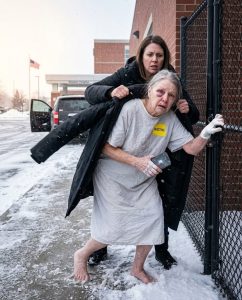
For a second, everyone seemed to understand at the same time that this was not confusion, not a billing issue, not an old woman wandering outside.
This was abandonment.
This was harm.
This was a person somebody had decided was no longer worth keeping warm.
Julianne placed the cracked phone on the intake counter.
“I need the call log preserved,” she said.
The nurse blinked.
Julianne surprised herself with how steady her voice sounded.
“I need the intake sticker documented. I need the time noted. I need her examined. And I need someone to write down exactly where she was found.”
Her mother looked up at her from the wheelchair.
There was fear in her face.
But there was also something else.
Recognition.
As if she had forgotten that her daughter could become solid when the ground disappeared.
The nurse nodded.
“We’ll document it.”
Julianne heard the word and held onto it.
Document.
Not whisper.
Not excuse.
Not family shame.
Document.
Arthur had spent years keeping things soft around the edges.
Julianne wanted edges now.
At 8:17 a.m., a hospital social worker introduced herself by first name only and pulled a chair into the exam room.
At 8:22 a.m., the nurse cut off the wet hospital socks someone had found and wrapped Julianne’s mother’s feet in warm blankets.
At 8:31 a.m., a doctor came in, examined the bruising, and asked questions in a careful voice.
Julianne stood beside the bed and watched her mother’s hand search for hers.
She took it.
Her mother’s fingers were cold and thin.
They still knew the shape of Julianne’s hand.
“Did he do this?” the doctor asked.
Her mother stared at the blanket.
Julianne did not answer for her.
That was important.
Arthur had answered for her long enough.
After a long silence, her mother nodded.
“Yes,” she whispered.
The doctor did not look shocked.
That made Julianne angry in a new way.
Not because the doctor was cold.
Because she had clearly seen this before.
The social worker wrote something in a folder.
The nurse took photos of the bruising for the medical record.
Julianne watched every process.
She watched the timestamps.
She watched the forms.
She watched her mother’s name being written correctly.
It should not have felt powerful.
But after years of Arthur correcting, minimizing, and explaining her away, even a hospital chart felt like proof that her mother existed.
Then Leo called.
His name lit up the cracked screen on the counter.
For one second, everyone in the room looked at it.
Her mother inhaled sharply.
Julianne answered before the second ring ended.
“Where is she?” Leo demanded.
No hello.
No apology.
No panic that sounded like love.
Just irritation.
Julianne looked at her mother in the hospital bed.
“Safe,” she said.
Leo exhaled hard.
“Jules, don’t start. Arthur called me. He said Mom had some kind of episode. He said you were making it worse.”
There it was.
Arthur’s version had arrived before the truth had even been cleaned from her mother’s face.
“Did you see her calls?” Julianne asked.
A pause.
Too long.
“I was asleep.”
“No, you weren’t.”
“Don’t do this.”
Julianne looked at the nurse, who was still standing near the foot of the bed, pretending not to listen and failing because her face had gone tight.
“She called you six times,” Julianne said. “She saw you typing.”
Leo’s voice dropped.
“Arthur said she was being dramatic.”
Julianne almost laughed.
Not because anything was funny.
Because sometimes cruelty is so lazy it borrows the same words from house to house.
“She was barefoot outside a locked hospital gate in a gown,” Julianne said. “Her face is bruised. Her intake sticker says 2:27 a.m. She called you while she was freezing.”
Leo said nothing.
That silence was the most honest thing he had given her all morning.
Then he said, “You don’t understand what Arthur’s like when he’s mad.”
Julianne closed her eyes.
That sentence told her everything.
Leo had known.
Maybe not the details.
Maybe not the exact shape of the night.
But he had known enough to be afraid of a man three hundred miles away, and still he had left their mother to be more afraid.
“You’re right,” Julianne said. “I don’t understand leaving Mom outside.”
She ended the call.
Her mother began to cry then.
Not loudly.
Not dramatically.
Just a quiet breaking, one breath at a time.
Julianne climbed onto the edge of the hospital bed and held her the way her mother had held her through fevers, school heartbreaks, and the first time a landlord raised their rent so high they ate pancakes for dinner three nights in a row.
“I’m sorry,” her mother whispered.
Julianne shook her head.
“No.”
“I should have listened.”
“No.”
“I didn’t want to be alone.”
That was the one that made Julianne’s throat close.
Because she understood it.
Because loneliness can make a cage look like a front porch if someone paints it nicely enough.
“I know,” Julianne said.
The regret did not come all at once.
It came in pieces.
It came when the doctor read the injury notes aloud and Arthur’s name was written in the chart.
It came when the social worker asked where her mother felt safe going after discharge, and her mother looked at Julianne instead of the floor.
It came when Leo texted three times, then called twice, and Julianne sent one sentence back.
Everything is documented.
After that, he stopped.
Arthur called at 9:46 a.m.
Julianne did not answer.
He left a voicemail in the smooth voice she hated.
He said there had been a misunderstanding.
He said her mother was fragile.
He said he had done everything he could.
He said Julianne needed to be careful about making accusations.
Julianne played it once on speaker with the social worker in the room.
Then she saved it.
Arthur had always believed calm made him believable.
He did not understand that calm sounds different when it is sitting beside medical photos, timestamps, call logs, and a woman with bruises on her face.
By noon, Julianne had moved her SUV closer to the discharge entrance.
By 12:18 p.m., she had gone back to the intake desk and asked for copies of every paper her mother was allowed to have.
By 12:40 p.m., she had a folded discharge packet, a social worker’s safety plan, and her mother’s cracked phone sealed in a plastic hospital bag.
At 1:05 p.m., her mother signed the form that listed Julianne as the person authorized to take her home.
Her signature shook.
But it was hers.
That mattered.
On the drive back, her mother slept under two blankets in the passenger seat.
Julianne kept the heat high.
Every few minutes, she glanced over to make sure her mother’s chest was rising.
The storm had weakened by then.
The sky was still low and gray, but the road was visible.
A gas station flag moved stiffly in the wind as they passed.
Her mother woke once and whispered, “Where are we going?”
“Home,” Julianne said.
Her mother looked confused for a moment.
Then Julianne added, “Mine.”
Her mother turned her face toward the window and cried silently.
There was no grand speech.
No movie ending.
No instant healing.
When they reached Julianne’s driveway after dark, her mother needed help getting up the front steps.
She apologized for leaning too much.
She apologized for bleeding through the gauze.
She apologized when Julianne warmed soup on the stove and set crackers beside the bowl.
Julianne finally put both hands on the counter and said, gently, “Mom, you do not have to apologize for being alive.”
Her mother stared at her.
Then she covered her mouth.
That night, Julianne made up the guest room with flannel sheets.
She plugged in a night-light near the hallway because she remembered her mother hated unfamiliar dark.
She placed the hospital paperwork in a folder on the kitchen table.
The folder was not a weapon.
Not yet.
It was a record.
It was proof that the world had seen what Arthur tried to leave outside in the snow.
At 10:12 p.m., Leo texted again.
Can I come by tomorrow?
Julianne stared at the message for a long time.
Then she walked to the guest room door.
Her mother was asleep, one hand curled under her cheek, looking smaller than Julianne had ever seen her.
Julianne thought of six unanswered calls.
She thought of typing bubbles appearing and disappearing while their mother stood outside freezing.
She thought of every family dinner where Leo had chosen ease over truth.
She typed back one sentence.
You can come when she says she is ready to see you.
Three dots appeared.
Then disappeared.
Then appeared again.
No message came.
Julianne set the phone facedown.
In the morning, her mother woke to the smell of coffee and toast.
She came into the kitchen wearing Julianne’s robe, her steps slow, one hand on the wall.
The bruising looked worse in daylight, purple and yellow along the edge.
But her eyes were clearer.
Julianne poured coffee into the mug with the chipped blue rim, the one her mother always used when she visited years ago.
Her mother wrapped both hands around it and looked out at the driveway.
For a long while, neither of them spoke.
Then she said, “I thought if I kept quiet, everyone could stay comfortable.”
Julianne sat across from her.
“Everyone but you.”
Her mother gave a small nod.
That was the beginning.
Not the end.
The beginning was a cracked phone on a kitchen table.
A discharge packet in a folder.
A daughter who had driven three hundred miles through a blizzard and found her mother barefoot outside a hospital gate.
An entire family had taught her to wonder whether her fear was an inconvenience.
Julianne taught her something different.
Fear is not an inconvenience when it is telling the truth.
By the end of that week, the locks at Julianne’s house had been checked.
Her mother’s medications were lined up beside the sink.
The hospital folder sat in a drawer where Julianne could reach it.
Arthur left two more voicemails.
Leo sent one apology that used the word “complicated” three times.
Julianne saved all of it.
Her mother did not go back.
That was the part Arthur had not planned for.
He had left her outside a hospital gate believing cold, shame, and silence would do his work for him.
But he had forgotten one thing.
He had not married a woman with no one.
He had married Julianne’s mother.
And at 3:00 a.m., when her mother’s voice became nothing but a whisper in the dark, Julianne heard it.
She came.
And this time, she did not leave her there.