By the time the divorce decree landed in my inbox, I had already decided I was done paying for people who called me family only when the bill arrived.
The email came at 7:04 PM.
A stamped copy from the family court clerk sat at the top of the thread, quiet and final, as if five years of swallowing insults could be reduced to one gray PDF.
I stared at my married name on the first page for longer than I expected.
Not because I wanted it back.
Because I wanted to remember the exact moment it stopped owning me.
My apartment was silent except for the dishwasher and the low hum of traffic below.
The smell of espresso still lingered in the kitchen from the cup I had made and abandoned an hour earlier.
I had not cried in court.
I had not cried in the hallway.
I had not cried when Anthony walked out ahead of me, shoulders stiff, pretending he was the one who had endured something unfair.
That was his talent.
He could spend years letting someone bleed and still act wounded when she finally reached for a bandage.
I opened my laptop at the kitchen counter and logged into the credit card portal.
Eleanor’s name appeared under authorized users.
Eleanor Whitmore.
Anthony’s mother.
My ex-mother-in-law.
The woman who had once looked at the engagement ring Anthony gave me and said, with a smile thin enough to cut glass, “Well, practical girls do appreciate practical stones.”
For five years, I had paid for her lunches, her holiday gifts, her alterations, her wine club, her sudden emergencies, and the little luxuries she insisted were necessary for a woman of her “standing.”
She never thanked me in a way that sounded like thanks.
She thanked me the way a person thanks a chair for holding them.
The first charge had been small enough to excuse.
A lunch.
Then a taxi.
Then a department store purchase Anthony promised was a one-time thing because his mother was embarrassed and he did not want her to feel old.
I was still trying to be a good wife then.
I still believed marriage meant carrying what your spouse could not, even when he handed you burdens that were never his to place in your arms.
By the second year, Eleanor had her own card attached to my account.
By the third year, she had stopped pretending to ask.
By the fourth, Anthony called it easier than arguing.
By the fifth, I understood that “easier” meant easier for everyone except me.
I clicked the menu beside her name.
Remove authorized user.
The portal asked if I was sure.
I was.
A confirmation screen appeared at 7:19 PM.
I saved it as a PDF.
Then I exported the last twelve months of statements, saved those too, and printed the final divorce decree.
I had learned to document things because Anthony had taught me what happened when I relied on memory.
He would tilt his head and say I was exaggerating.
He would tell me his mother did not mean it that way.
He would ask why I kept score, as if scorekeeping was the problem and not the fact that the same team kept making me pay admission to my own life.
I put the papers into a plain manila folder and wrote Eleanor across the tab.
Then I poured a glass of wine.
For one hour, I let my apartment belong only to me.
No Anthony leaving his shoes in the entryway.
No Eleanor calling at 9 PM because she had decided she needed a table at some restaurant where the hostess knew her name.
No lectures about tone.
No pretending that cruelty became classier when it wore pearls.
I ate dinner by the window and watched lights flicker on across Manhattan.
The city looked polished from that height.
Up close, everything was bills, noise, pride, and locked doors.
At 8:11 PM, Anthony called.
I knew before I answered.
Something had declined.
“What on earth did you do, Marissa?” he snapped.
There was no hello.
There had rarely been a hello near the end.
“My mother’s platinum card was just declined at Bergdorf Goodman,” he said.
I looked at the wineglass in my hand.
I did not smile, though some bitter part of me wanted to.
“They treated her like a common shoplifter in front of half the Upper East Side,” he continued. “She is completely humiliated.”
“No,” I said. “Her card didn’t work.”
“You know what I mean.”
“I do.”
That was the saddest part.
I knew exactly what he meant.
He meant Eleanor’s embarrassment mattered more than my years of being used.
He meant the public part was the crime.
He meant she could take from me quietly, but I was unforgivable for stopping it out loud.
“She’s your mother, not mine,” I said.
His breath caught.
“If she still wants quilted Chanel bags from Fifth Avenue, figure out how to pay for them yourself.”
“Don’t be petty.”
There it was.
The word men like Anthony reached for when a woman stopped cooperating.
Petty.
Bitter.
Difficult.
Cold.
Never accurate.
“You don’t get to punish her because our marriage failed,” he said.
“Our marriage failed,” I replied, “because you kept asking me to fund the people who disrespected me.”
He went quiet for half a second.
Then his voice lowered.
“You’ll regret this.”
Maybe once, that would have scared me into softening.
Maybe once, I would have apologized just to smooth the room back into shape.
But divorce does something strange to fear.
It does not erase it.
It just teaches you that survival and obedience are not the same thing.
I hung up.
Then I blocked his number.
I stood in the kitchen with my hands flat on the cold counter until my breathing settled.
After that, I checked the door lock.
I checked it again before bed.
At 10:38 PM, I set the Eleanor folder on my nightstand.
It looked plain there under the lamp.
Almost harmless.
A stack of paper can look harmless until someone realizes it has their name on it.
I slept in the middle of the bed for the first time in years.
At 6:42 AM, the pounding started.
It was not a knock.
It was a demand made with bone and entitlement.
BOOM.
BOOM.
BOOM.
The sound traveled through the bedroom wall and hit my body before my mind understood where I was.
I sat up, heart slamming, gray dawn pressing through the curtains.
For one second, I thought something had fallen in the hallway.
Then it came again.
BOOM.
BOOM.
BOOM.
My phone showed three blocked-call notifications.
Anthony.
Of course.
I climbed out of bed, the floor cold against my feet, and grabbed the manila folder without thinking.
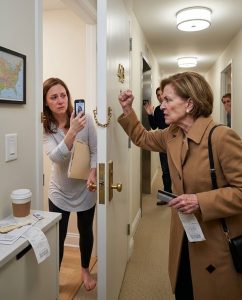
By the time I reached the entryway, a woman’s voice was slicing through the door.
“Open this door, Marissa! Right this instant!”
Eleanor.
I did not open it.
The old version of me would have.
The old version of me would have worried about the neighbors, about being rude, about making a scene.
The old version of me believed a woman could earn peace by being reasonable with unreasonable people.
That woman had signed divorce papers yesterday.
“No ungrateful, arrogant wretch humiliates me in public and gets away with it!” Eleanor screamed.
Her fist hit the door again, hard enough to make the brass numbers rattle.
I opened my phone camera and pressed record.
The red timer began.
00:01.
00:02.
00:03.
I held the phone chest-high and stood where the peephole could see only one of us clearly.
She was in a camel coat.
Of course she was.
Pearls at dawn.
Perfect hair.
Fury dressed like a luncheon.
“Open it, Marissa,” she said, lower now, “before I make sure everyone in this building knows what kind of woman you are.”
“The kind of woman who removes an authorized user from her own credit card?” I asked through the door.
There was a brief silence.
Then her palm struck the wood again.
“You stole from me.”
That almost made me laugh.
“Eleanor, you were spending my money.”
“I am your family.”
“No,” I said. “You were my husband’s mother.”
Something scraped against the bottom of the door.
A small folded paper slid into my apartment and stopped near my foot.
I looked down.
A receipt.
Bergdorf Goodman.
Declined.
6:14 AM.
The story continues — don’t miss what happens next