She had brought evidence of her own humiliation as if it proved my guilt.
That was Eleanor in one object.
A receipt for something she could not buy with money that had never belonged to her.
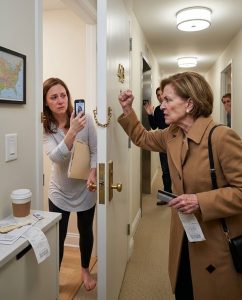
“Do you know what they thought of me?” she demanded.
“I know what you thought of me,” I said.
The hallway went still.
I heard another door open somewhere nearby.
Then the elevator chimed.
Anthony’s voice came next.
“Mom. Stop. People can hear you.”
People could hear him too.
I looked through the peephole and saw him standing beside her in yesterday’s shirt, his jaw tight and his face pale.
He looked smaller than he had in court.
Not sorry.
Just exposed.
He saw the phone in my hand through the narrow side of the peephole reflection.
“Marissa,” he said. “Don’t do this.”
I unlocked the chain one inch.
Not the door.
Just the chain.
The sound made both of them stop breathing for a second.
I held up the stamped divorce decree so they could see the first page through the gap.
Then I held up the cancellation confirmation.
Then the receipt.
“My attorney already has copies of the statements,” I said.
Anthony’s eyes flicked from the folder to my phone.
Eleanor’s mouth opened.
Nothing came out at first.
That was new.
“Take that camera off me,” she said finally.
“No.”
“You cannot record me.”
“I can record a person pounding on my door and threatening me in my own apartment.”
Anthony stepped closer.
Not enough to touch the door.
Enough to use his voice.
“Marissa, you’re escalating this.”
There was the old trick again.
A person breaks your window, and you are accused of making a scene by pointing at the glass.
“I am ending this,” I said.
Eleanor shoved the receipt harder under the door with the toe of one polished shoe.
“You will restore that card.”
“No.”
“You will apologize to me.”
“No.”
“You will not embarrass this family.”
I looked at Anthony then.
For five years, I had waited for him to step between his mother and me.
Not dramatically.
Not with speeches.
Just once.
A hand on the table.
A quiet, “That’s enough.”
A look that said I was his wife before I was his mother’s wallet.
He had never done it.
So I did.
“Eleanor,” I said, “if you hit this door one more time, I call 911.”
Her face changed.
Not fear exactly.
Offense.
As if consequences were a vulgar thing to mention before breakfast.
Anthony whispered, “Mom, please.”
That was the first crack.
Not in Eleanor.
In him.
He had brought her there, or followed her there, or failed to stop her there.
It did not matter which.
He was standing in the hallway at dawn beside a woman who thought my money was a birthright, and for the first time, someone else’s door was open enough to witness it.
A neighbor’s voice came from down the hall.
“Is everything okay?”
No one answered.
Eleanor’s cheeks flushed.
She hated witnesses more than she hated limits.
I kept recording.
“I am going to say this once,” I told them. “The divorce is final. Your mother’s card is canceled. Any charges made before cancellation are already documented. Any further contact about my money goes through the attorneys.”
Anthony’s mouth tightened.
“You’re really going to make this legal?”
“You made it financial,” I said. “I made it documented.”
The words landed harder than I expected.
His shoulders dropped.
He looked tired suddenly, but I had learned not to mistake tiredness for remorse.
Remorse moves toward repair.
Tiredness only wants the consequences to stop.
Eleanor looked at him.
“Do something.”
He did nothing.
For once, his silence did not protect her.
It exposed him.
I shut the door.
The chain slid back into place.
The lock turned.
On the other side, Eleanor made a sound I had never heard from her before.
Small.
Almost shocked.
Then I called the front desk and told them there were two people outside my door refusing to leave.
After that, I called my attorney.
I did not embellish.
I gave the time.
6:42 AM.
I described the pounding.
I saved the video.
I photographed the receipt on my floor.
I forwarded everything in one email with the subject line: Post-divorce harassment and financial dispute.
The attorney called back nine minutes later.
Her voice was calm in a way that steadied me.
“Do not open the door again,” she said. “Do not negotiate in the hallway. Save everything.”
So I did.
By 7:18 AM, building staff had asked Anthony and Eleanor to leave.
By 7:31, Anthony had sent an email because he was blocked everywhere else.
The subject line was ridiculous.
Family misunderstanding.
I did not respond.
I forwarded it.
That afternoon, my attorney sent a formal notice to his attorney.
No direct contact.
No financial demands.
No attempts to access my accounts.
No visits to my home.
The language was plain and dry, but I read it three times because it felt like someone had finally put walls around my life and called them reasonable.
Eleanor did not apologize.
People like Eleanor rarely do.
She told mutual acquaintances that grief over the divorce had made me unstable.
She said I had humiliated her over a minor billing matter.
She said families should not treat each other like strangers.
I let her talk.
Then one of those acquaintances, a woman who had smiled at me through years of Eleanor’s little jokes, called and asked if it was true I had canceled the card while Eleanor was shopping.
“Yes,” I said.
The woman inhaled.
“And the card was yours?”
“Yes.”
Another silence.
Then she said, very quietly, “Oh.”
That was how the story changed.
Not all at once.
Not in a grand public reversal.
Just one small truth landing after another.
The receipt.
The recording.
The statements.
The decree.
Paperwork does not shout, but it has a patience that gossip does not.
Anthony tried twice more through email.
The first time, he said his mother had acted emotionally.
The second time, he said I had always known how sensitive she was about public embarrassment.
I read that line for a long time.
Not because it hurt.
Because it explained everything.
Eleanor was sensitive to embarrassment.
I was supposed to be numb to disrespect.
That had been the family contract.
I never signed it.
I just paid under it for five years.
A month later, I received the final packet from my attorney.
No new motions.
No claims about the card.
No demand for reimbursement.
Just the clean administrative end of a messy private habit.
The manila folder stayed in my desk after that.
For a while, I thought about throwing it away.
Then I kept it.
Not because I wanted to live inside the anger.
Because some documents are not souvenirs of pain.
They are proof that you stopped agreeing to it.
The first Sunday after everything quieted down, I made coffee and sat by the same window where I had eaten alone the night the decree arrived.
The city looked almost the same.
Traffic below.
Sun on glass.
Someone walking a dog in a coat nicer than most people’s suits.
But my apartment felt different.
The silence was not waiting for the next insult anymore.
It was just silence.
Mine.
I thought about the old version of me who would have opened the door.
She would have apologized.
She would have restored the card, maybe not that morning, but eventually, after enough pressure and enough talk about family.
She would have told herself peace was worth the price.
She did not know yet that peace bought with self-betrayal always comes due with interest.
I wish I could say freedom felt dramatic.
It did not.
It felt like deleting an authorized user.
It felt like saving a PDF.
It felt like keeping the chain on the door.
It felt like saying no through solid wood and letting the whole hallway hear it.
And when I opened my next credit card statement, there were no Bergdorf charges.
No champagne lunches.
No Fifth Avenue ghosts dressed up as obligations.
Just my own purchases.
Coffee.
Groceries.
A new lock for the door.
That was when I finally understood what the divorce decree had really given me.
Not revenge.
Not victory.
Access control.
To my money.
To my home.
To my life.
For five years, Eleanor had treated me like a human ATM, and Anthony had called that family.
At 6:42 on a gray morning, with her fist on my door and her declined receipt on my floor, I learned the difference.
Family does not require you to fund your own humiliation.
Love does not arrive with a statement balance.
And when the card does not have your name on it, neither does the woman who finally cancels it.