The bus did not stop in front of my house.
It let me out two blocks away, beside a gas station with a faded coffee sign and a cracked strip of sidewalk where weeds had pushed through the concrete.
I stood there with a paper cup in my hand, a clear plastic property bag hanging from my wrist, and three years of prison noise still ringing in my ears.
The world was too wide.
Cars passed too close.
A dog barked behind a fence, and my shoulders pulled tight before I could tell them not to.
Freedom was supposed to feel like relief.
That morning, it felt like being dropped into a life that had kept moving without asking whether I was ready to rejoin it.
I told myself not to think about the years I had lost.
I told myself not to think about the way people looked at me now, the slight pause before they said my name, the careful distance in their eyes.
I told myself there was only one thing that mattered.
My father.
Thomas Vance had been the kind of man who did not waste words, money, or promises.
When I was a boy, he could fix a screen door with two screws and half a curse.
He kept a thermos of coffee in his truck even in July.
He wrote dates on the backs of photographs, balanced his checkbook with a pencil, and saved every key he ever owned on a metal ring so heavy it could have anchored a boat.
When I went away, he visited until Linda made it difficult.
Then he wrote.
The letters were short.
He told me when the roof leaked.
He told me the neighbor’s maple dropped branches again.
He told me the wind chime on the porch still sounded cheap but honest.
During my last year inside, the letters slowed.
I blamed mail delays.
I blamed Linda.
I blamed anything except the fear that he was getting old without me.
The neighborhood looked the same from a distance.
Same driveways.
Same trimmed yards.
Same mailboxes leaning a little where winter plows had bumped them.
But as I got closer to the house, the details stopped matching the memory I had carried through three years of concrete walls.
The porch railing was slate blue.
My father had always kept it white, even when the paint peeled in long strips and made the place look tired.
The flower beds had been replanted with glossy shrubs he would have called “too fancy for dirt.”
A newer SUV sat in the driveway.
The front door was charcoal gray.
The old navy door, the one with the scratch near the knob from when I carried a bookcase through it at seventeen, was gone.
The wind chime was gone too.
I stopped at the bottom step when I noticed that.
My father had bought that cheap brass chime at a hardware store because the cashier told him nobody wanted it.
He brought it home laughing and hung it on the porch beam.
Linda hated it.
She said it made the house sound like a roadside stand.
My father kept it there anyway.
Now there was only clean paint and quiet.
I climbed the steps.
The mat said HOME SWEET HOME in thick letters.
I knocked hard.
Not polite.
Not angry.
Just desperate.
The door opened, and Linda stood there like she had been expecting a package she planned to refuse.
She wore a cream silk blouse, gold earrings, and her hair in a smooth style that looked expensive even before she opened her mouth.
Her eyes moved over my face, my clothes, and the plastic bag in my hand.
Then she looked behind me toward the street.
There was no warmth in her expression.
There was not even surprise.
“You’re out,” she said.
Those two words told me more than any welcome could have.
I swallowed.
“Where’s Dad?”
The question sounded too loud in the doorway.
Linda did not look back into the house.
She did not call for him.
She did not soften.
Her mouth tightened, and for one second I saw satisfaction hiding under all that polish.
“Your father was buried a year ago.”
I stared at her.
The sentence did not fit inside my head.
Buried.
A year ago.
Those words belonged to other families, other porches, other sons.
Not me.
Not Thomas Vance.
“A year ago?” I said.
Linda folded her arms.
“We live here now,” she said. “So you should go.”
Behind her, the hallway looked staged.
The small table was different.
The framed photo of my father with a trout he was too proud of was gone.
The leather chair near the living room window was gone.
His work boots were not beside the kitchen door.
It was as if Linda had not cleaned the house.
She had erased him.
“Why didn’t anyone tell me?” I asked.
That was when she gave me the closest thing to a smile.
“You were in prison, Eli. What were we supposed to do? Send you a sympathy card?”
For a moment, I could not breathe.
I had prepared myself for coldness.
I had prepared myself for blame.
I had not prepared myself for someone using my father’s death like a locked gate.
“I need to see his room,” I said.
Linda shifted her body into the doorway.
“There is nothing to see.”
“He was my father.”
“And he is gone.”
I took one step forward.
It was not a threat.
It was instinct, the way a child still moves toward a parent even after the room is empty.
Linda’s hand went to the door.
“This is my property now,” she said. “Get off it.”
Then she closed it.
Slowly.
Carefully.
The deadbolt clicked into place.
That sound stayed in my bones.
I stood on the porch with my hand still half raised while someone across the street paused beside a parked car.
A woman with a paper grocery bag looked at me, then at the house, then down at her keys.
She did not ask if I was all right.
She did not have to.
I already knew what I looked like.
A man released from prison standing on a porch that no longer belonged to him, asking for a dead father nobody had bothered to mention.
I walked away before Linda could call someone.
The cemetery was a mile and a half from the house.
My father had shown me the place once when I was younger, not in a dramatic way, not with tears or speeches.
He had parked by the back fence and pointed toward an oak tree.
Beside your mother, he had said.
That was all.
He had already bought the plot.
He had the receipt in a folder at home.
Thomas Vance did not leave that sort of thing to chance.
That was why Linda’s words made no sense.
If he had been buried a year ago, I knew where he should be.
I knew what stone I should find.
I knew which patch of grass should have had his name.
The cemetery office was open, but barely.
A small sign hung in the window.
The room inside smelled like dust, cut grass, and old copy paper.
A fan clicked overhead with each rotation.
Outside, an older groundskeeper was dragging leaves from the gravel path with a rake.
He wore a faded cap, work pants, and boots stained green from grass.
His hands looked strong in the way old men’s hands get when life has been work for too long.
He glanced up when he heard my steps.
“You looking for someone?” he asked.
“My father,” I said. “Thomas Vance.”
The rake stopped.
It was such a small change that most people would have missed it.
I did not.
“Linda Vance told me he was buried here last year,” I said. “I need to see his grave.”
The old man looked toward the back of the cemetery.
Then he looked at me again.
The expression on his face shifted from caution to pity.
“Don’t look,” he said quietly.
I felt my stomach drop.
“What do you mean, don’t look?”
He lowered the rake.
“He’s not here.”
I almost laughed because the alternative was screaming.
“He bought a plot here,” I said. “By the oak. Beside my mother.”
“I know.”
“Then where is he?”
The old man did not answer right away.
That silence frightened me more than any answer could have.
He leaned the rake against the office wall and motioned me inside.
When he shut the door behind us, the fan’s clicking suddenly sounded as loud as a clock in a courtroom.
“What is going on?” I asked.
He went to a dented metal file cabinet, opened the bottom drawer, and moved aside a stack of maintenance forms.
Behind them sat a yellow envelope.
My name was written across the front in my father’s block letters.
ELI VANCE.
I knew that handwriting.
I had seen it on birthday cards, oil change notes, grocery lists, and the backs of photographs.
Seeing it there, in a cemetery office, nearly broke me.
The groundskeeper placed the envelope on the desk.
“Your father brought this to me himself,” he said. “Before things got bad.”
I did not ask what that meant.
Not yet.
My fingers opened the envelope carefully because some foolish part of me thought paper could bruise.
Inside was a folded letter.
Taped to the front was a small brass key.
For several seconds, I could only stare.
Then I unfolded the paper.
The first line used my full name.
The second line told me that if Linda claimed the house was hers, she was lying.
Everything inside me went still.
It was not the stillness of peace.
It was the stillness before a storm breaks.
The groundskeeper turned away, giving me privacy, but his hand stayed on the file cabinet as if he needed it to remain standing.
The letter was short, because my father had always hated long explanations when one clean fact would do.
He had written that he expected Linda to keep me away from the house if she could.
He had written that grief made people honest or greedy, and he had learned too late which one Linda was.
He had written that the key opened a lockbox he had left at the cemetery office because it was the one place Linda never had a reason to search.
My hands shook so badly I had to put the letter down.
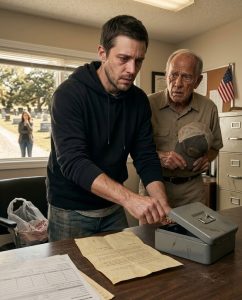
The groundskeeper reached behind a shelf of irrigation manuals and pulled out a gray metal box with dust across the lid.
My father’s initials were scratched into one corner.
T.V.
The brass key fit.
When the lid opened, the first thing I saw was a folder wrapped in a rubber band.
The story continues — don’t miss what happens next