Inside were copies of property documents, dated letters, a receipt for the cemetery plot beside my mother, and instructions written in my father’s hand.
There was also a house key.
Not the old heavy key from my childhood, but a new one, cut clean and taped to a note.
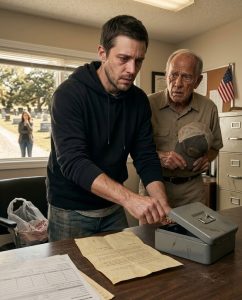
The papers did not make my father alive.
Nothing could do that.
But they did something Linda had not expected.
They brought him back into the room as a witness.
My father had not left the house to Linda.
He had signed papers placing it for me before his death, with Linda allowed to remain only until I was released or until I came forward to claim what he had preserved.
The language was plain enough that even I understood the shape of it.
My father had known what she would do.
He had known she would wait until I could not answer the door, then turn his home into hers and his death into a weapon.
The burial papers were worse.
Thomas had paid to be laid beside my mother.
The receipt was there.
The instructions were there.
His signature was there.
But the groundskeeper’s records showed no burial under his name in that plot.
The old man did not accuse Linda of anything he could not prove.
He only told me the arrangement had been changed after my father died and that he had never been given Thomas Vance to bury.
That was why he had said not to look.
There was no stone.
There was no grave.
There was only the empty place my father had bought and the lie Linda had used to push me off the porch.
I sat down hard in the chair beside the desk.
For three years, I had dreamed of coming home and hearing my father say my name.
Instead, I was sitting in a cemetery office with proof that he had spent the end of his life preparing for the day I would be shut out.
The groundskeeper placed one paper cup of water in front of me.
He did not tell me to calm down.
People only say that when they need your pain to become convenient.
He waited.
After a while, I folded the letter and put it back in the envelope.
Then I took the house key.
The walk back to the house felt longer than the walk to the cemetery.
Every step carried a new weight.
Grief was still there, deep and dull.
But under it was something harder.
Not rage exactly.
Rage burns too fast.
This was colder.
This was purpose.
Linda’s SUV was still in the driveway.
The porch still looked freshly painted.
The mat still said HOME SWEET HOME.
I did not knock as hard the second time.
I knocked once.
Linda opened the door with irritation already prepared.
Then she saw the envelope in my hand.
For the first time that day, her face changed.
It was not big.
Her chin lifted a little.
Her eyes dropped to the handwriting.
Then the color moved out of her cheeks.
“You need to leave,” she said.
I held up the brass key.
“No,” I said. “I need to come in.”
She looked behind her, toward the living room she had scrubbed clean of my father.
“You have no right.”
I did not answer with a speech.
My father had already done the talking.
I opened the envelope and laid the first page against the glass panel beside the door, facing her.
She saw his handwriting.
She saw the date.
She saw the line about the house.
Her hand tightened on the edge of the door.
For one second, the woman who had mocked me on that porch disappeared, and what remained was someone cornered by paper.
Paper does not shout.
Paper does not chase.
Paper simply waits until the right person reads it.
Linda stepped back.
Inside, the house smelled the same way it had that morning, lemon cleaner and candles trying too hard.
But now I noticed what was missing with sharper eyes.
No chair.
No boots.
No wind chime.
No photographs.
Every trace of him had been removed, but the walls still held the shape of his life.
I placed the lockbox folder on the dining table.
Linda did not sit.
She stood across from me with her arms folded, but her hands were not steady anymore.
I took out the property documents first.
Then the burial receipt.
Then my father’s written instructions.
With each page, her face tightened.
By the time I placed the cemetery record beside them, her mouth had gone thin and white.
She tried once to say the papers were old.
She tried once to say Thomas had changed his mind.
She tried once to say I did not understand what I was reading.
The documents answered her better than I could.
Dates.
Signatures.
Receipts.
The small brutal facts people forget cannot be talked out of a room.
I did not ask where my father was.
Not yet.
I was afraid that question would open a door I could not close.
I asked the only question I could stand.
“Why did you tell me he was here?”
Linda looked toward the window.
For the first time since I had come home, she did not have a polished sentence ready.
That was enough.
Some truths do not arrive as confessions.
Sometimes they arrive as silence in the exact place a lie used to stand.
Over the next few days, the papers did what my grief could not.
They moved through the hands that needed to see them.
The house stopped being Linda’s performance.
Her claim to it collapsed under my father’s handwriting and the documents he had locked away for me.
She packed quietly because there was no audience left for cruelty.
The SUV left the driveway on a gray morning.
No neighbors clapped.
No music swelled.
Life is not that generous.
I stood on the porch and watched the taillights turn the corner.
Then I went inside.
The first thing I brought back was not furniture.
It was the wind chime.
The groundskeeper had found it in a box of things Linda had thrown into the garage, tangled with old cords and a cracked picture frame.
I hung it from the porch beam with my father’s old screwdriver.
The sound was thin.
Cheap.
Honest.
I still did not know every detail about where Linda had sent my father after he died.
That search would take time, papers, and a kind of strength I did not have all at once.
But I knew this.
She had not buried him where he asked to be buried.
She had not owned what she claimed to own.
And she had not erased him.
A man like Thomas Vance leaves more behind than a grave.
He leaves habits.
He leaves handwriting.
He leaves a key taped to a letter because he knows his son may come home with nothing but a plastic bag and still deserve one door that opens.
That night, I sat in the living room without turning on the television.
The house was too quiet, but it was no longer empty.
The envelope lay on the table beside me.
The brass key rested on top of it.
For the first time since the bus station, I let myself cry.
Not loudly.
Not neatly.
Just enough to admit what had been taken.
Then the wind moved across the porch, and the chime answered.
It sounded like my father had not been waiting in the chair after all.
He had been waiting in the proof.