The house smelled like old rain and reheated coffee when Sarah Bennett came through the front door after twelve hours at the children’s hospital.
Her pediatric scrubs were wrinkled at the hips and stiff at the knees.
Her badge was still clipped crooked to her pocket.
Her shoes squeaked once on the entryway tile.
Then the whole house went silent.
That was not normal.
In her parents’ house, silence was usually something earned after an argument, not something waiting politely by the door.
Sarah stood there with her tote bag sliding off one shoulder and felt the change before she understood it.
The living room lamp was on.
The television was off.
Somebody had left the basement door open.
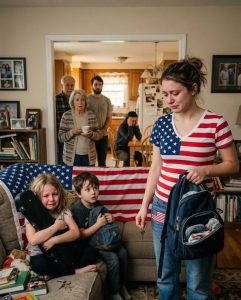
Leo and Chloe sat together on the couch, pressed shoulder to shoulder as if the cushions had become a waiting room bench.
They were ten years old, but in that moment they looked younger.
Chloe’s eyes were swollen, her cheeks blotchy from crying she had probably tried to swallow before Sarah got home.
She had her clarinet case hugged against her chest, both arms wrapped around it like she was afraid someone would take that too.
Leo sat beside her with his backpack at his feet.
His inhaler lay on the cushion next to his thigh.
Sarah noticed that first.
Mothers notice the breathing things first.
The little plastic inhaler was not in the kitchen drawer where it usually stayed, not in Leo’s backpack, not beside his bed.
It was on the couch, staged beside him, as though his asthma had been part of whatever had been moved.
Sarah looked from the twins to the open basement door.
The damp smell coming from below told her more than anyone in the room had said.
“What happened?” she asked.
Chloe’s chin trembled.
Leo looked at the floor.
For two years, Sarah had been living in that house with her children because she had run out of better options.
After her divorce, her parents told her she could come home.
Her father, George, called it family.
Her mother, Eleanor, said the twins would be safe there.
At the time, Sarah had been too exhausted to question what kind of safety came with conditions attached.
She was a pediatric nurse, and she knew how to keep calm in rooms where parents were crying and machines were beeping.
She knew how to start an IV in a frightened child while speaking gently enough to keep the fear from taking over.
She knew how to smile at a mother in a hospital hallway when there was nothing else useful to hand her.
But knowing how to hold other people together did not mean she always knew how to hold herself.
When her marriage ended, Sarah had packed two children, four laundry baskets, a stack of school papers, and whatever dignity she could carry into her parents’ house.
She told herself it was temporary.
One season.
Maybe two.
She would work double shifts, save every extra dollar, and get Leo and Chloe into a place where no one could make them feel like guests in their own lives.
At first, her parents seemed generous.
George fixed the loose railing by the twins’ room.
Eleanor bought Chloe a new comforter with little yellow flowers on it.
They cleared space in the pantry and said things like, “This is what family does.”
Sarah wanted to believe them.
When you are broke and tired and trying not to cry in front of your children, kindness can look real even when it has a hook buried inside it.
Then Mark moved back in.
Mark was Sarah’s younger brother.
He had always been the easy one in Eleanor’s eyes, the son whose mistakes came with explanations and whose needs somehow arrived already prioritized.
He moved in with his wife, Brooke, and their baby, Owen, while their house was being renovated.
That was the official reason.
It was supposed to be temporary too.
But temporary arrangements have a way of revealing permanent truths.
From the first week, the house shifted around Owen.
His bottles had a special drying rack by the sink.
His stroller blocked the laundry room door and nobody mentioned it.
His toys spread across the living room floor, bright plastic proof that everyone else was expected to step carefully.
Sarah loved her nephew.
He was a baby, and none of this was his fault.
That was part of what made it harder.
Cruelty that uses a child as its shield is still cruelty.
It just expects you to feel guilty for noticing.
The small things came first.
At Christmas, Owen received gifts that cost more than everything Leo and Chloe got combined.
When Leo tried to show Eleanor the drawing chosen for the district art exhibit, Eleanor waved him off because Brooke needed help deciding between two nursery curtain patterns.
When Chloe practiced clarinet in the afternoon, Eleanor scolded her because the baby might nap.
Owen was not napping.
He was in the living room banging a plastic spoon on his high chair and laughing.
Then came the medication argument.
Leo’s asthma had been manageable, but it was not optional.
Sarah picked up his refill after work one Tuesday, paid the co-pay, and came home to her mother sighing over the receipt on the counter.
“Everything is so expensive now,” Eleanor said.
That same week, a four-hundred-dollar high chair arrived for Owen.
It sat in the dining area like a throne.
Every time Sarah tried to name the imbalance, her mother turned it back on her.
“You’ve always been jealous of your brother, Sarah.”
The first time, Sarah argued.
The second time, she explained.
By the fifth time, she understood the sentence was not part of a conversation.
It was a door Eleanor closed whenever truth got too close.
So Sarah stopped wasting her breath.
She started planning instead.
Her shifts at the hospital ran long.
Some nights she came home with the smell of antiseptic in her hair and juice stains on her scrub pants from a toddler who had finally stopped crying long enough to drink something.
Some mornings she woke before sunrise and packed lunches in a kitchen where Brooke’s baby bottles covered half the counter.
She drank bad coffee from paper cups in the break room.
She skipped takeout.
She skipped new clothes.
She skipped every little comfort that made a hard week feel human.
On her phone, she kept a folder of screenshots.
School office emails.
Medication receipts.
Dates and times when Eleanor “forgot” to pick up the twins but somehow always remembered Owen’s appointments.
At 11:38 p.m. on a Wednesday, sitting in her car in the hospital parking lot with her hands still smelling faintly of latex gloves, Sarah wrote down the first version of her exit plan.
Find a rental.
Pay deposit.
Leave quietly.
Do not warn people who think permission is power.
A realtor friend from high school helped her.
The rental was not fancy.
It had older carpet, a small kitchen, and a bedroom ceiling fan that clicked if you turned it above medium.
But it had two bedrooms for the twins.
It had working heat.
It had a dry basement for storage, not children.
And when Sarah walked through it, she could breathe.
Three weeks before the October evening that changed everything, she signed the lease.
She folded the papers and slid them into the back pocket of her tote bag.
She told no one in the house.
Not her mother.
Not her father.
Not Mark.
Not Brooke.
She did tell Leo and Chloe that things would get better soon.
She did not tell them how close soon was.
Children who have been disappointed learn to flinch at promises.
Sarah did not want to hand them hope until she could put keys behind it.
That Thursday morning, before her twelve-hour shift, she stopped by the rental office.
The woman at the desk handed over a small brass key on a plain ring.
Sarah put it in her scrub pocket.
For the rest of the day, she felt it there against her thigh every time she moved.
Cold.
Real.
Mine.
Now, standing in her parents’ living room, she looked at Leo and Chloe and knew the waiting was over.
Chloe lifted her face.
“Grandma said Owen deserves the good rooms,” she whispered.
The words seemed too heavy for a ten-year-old mouth.
Sarah felt her heartbeat slow in the dangerous way it did during emergencies.
“What rooms?” she asked, though she already knew.
“Grandpa and Uncle Mark took our beds downstairs,” Chloe said.
Leo still did not speak.
He just looked at the open basement door, then back at Sarah.
That look broke something in her.
Not loudly.
Not dramatically.
It broke like a thread finally giving way after being pulled for too long.
Sarah crossed the room and kissed Chloe’s hair.
Then she kissed Leo’s forehead.
“Stay right here,” she said.
The kitchen lights were warmer than the living room, but nothing about that kitchen felt warm.
Eleanor sat at the table with a mug of tea cupped between both hands.
Brooke sat across from her, phone face-down beside her elbow.
A little American flag magnet held the school lunch calendar to the refrigerator.
One of Chloe’s storage bins sat open in the hallway.
Her soccer cleats were tossed on top of Leo’s sketchbooks.
Sarah looked at that pile for one long second.
There are moments when anger turns hot and useless.
There are other moments when it turns cold and clean.
This was the second kind.
“Why are my children’s things in the basement?” Sarah asked.
Brooke shifted in her chair.
“We needed to make adjustments,” she said.
Eleanor did not look embarrassed.
That was what Sarah noticed most.
No flinch.
No apology.
No sign that moving two children into a damp basement without asking their mother had required even a small battle with conscience.
“Owen needs a real nursery now,” Brooke continued, “and I need office space for work calls.”
Sarah turned to her mother.
Eleanor took a sip of tea.
“The older children can adapt,” she said. “Our other grandson deserves the best rooms.”
The sentence landed flat on the kitchen table.
Deserves.
Not needs.
Not would benefit from.
Deserves.
Sarah thought of Leo’s inhaler on the couch.
She thought of Chloe’s clarinet case pressed against her chest.
She thought of every small humiliation she had swallowed because she needed a roof over her children’s heads.
“Have you looked at the basement since the rain?” Sarah asked.
Eleanor sighed.
“Don’t start.”
“The concrete is damp,” Sarah said. “There’s a stain in the corner. The window barely opens. Leo has asthma.”
“My goodness,” Eleanor said. “It is not a dungeon.”
“It is not a bedroom.”
Brooke looked down at her mug.
For a second, Sarah thought she might say something decent.
She did not.
“Family makes sacrifices,” Eleanor said.
Sarah almost laughed.
It would have sounded terrible.
“Yes,” Sarah said quietly. “I’ve noticed who usually gets assigned the sacrifice.”
The back door opened before Eleanor could answer.
George came in first, wiping his shoes on the mat.
Mark followed with work gloves in one hand.
They both stopped when they saw Sarah standing there.
George’s expression did not read as guilty.
It read as inconvenienced.
“We made some changes,” he said.
That was all.
As if beds were chairs.
As if children were furniture.
As if a mother coming home from work to find her kids displaced should simply appreciate the efficiency.
The room froze around them.
Brooke stared into her mug.
Eleanor kept her hands wrapped around her tea.
Mark stood by the counter with his chin lifted.
George looked everywhere except toward the basement door.
The refrigerator hummed.
A spoon rested in a little puddle of tea on Eleanor’s saucer.
Downstairs, one of the metal bed frames gave a faint creak.
Nobody moved.
Sarah looked at her father.
“How could you do this without speaking to me?”
Mark answered before George could.
“Owen’s the baby,” he said. “He needs the better setup.”
“He has two parents,” Sarah said.
“So do your kids,” Mark said, then seemed to remember exactly what he had just said.
The words hung there, ugly and careless.
Sarah did not react.
That took more strength than yelling would have.
George cleared his throat.
“They should be grateful they have a place to stay at all.”
There it was.
The sentence under every favor.
The bill that had always been waiting.
For one ugly heartbeat, Sarah pictured herself screaming.
She pictured every mug on the table hitting the floor.
She pictured telling her father that gratitude had already cost her children enough sleep, enough confidence, enough small moments of feeling wanted.
But she had spent two years learning the limits of explaining pain to people who benefited from it.
So she did not scream.
The story continues — don’t miss what happens next