She did not throw anything.
She reached into her scrub pocket and touched the brass key.
Then she walked back into the living room.
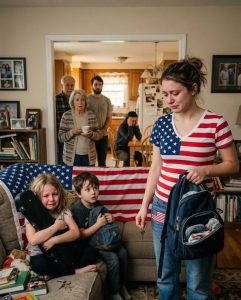
Leo and Chloe looked up at her.
They were waiting for the verdict.
Sarah smiled.
It was not a happy smile.
It was the kind of smile a woman gives when she has finally stopped asking the wrong people for room.
“Pack your bags,” she said.
Chloe blinked.
Leo’s hand closed around the strap of his backpack.
From the kitchen came the soft scrape of Eleanor’s chair.
“Sarah,” her mother said.
Sarah did not turn around yet.
“Just what you can carry tonight,” she told the twins. “Clothes for school. Shoes. Medicine. Clarinet. Sketchbooks. We’ll come back for the rest.”
Leo stood first.
He grabbed his inhaler and shoved it carefully into the front pocket of his backpack.
Chloe rose slower, like she did not trust the floor to stay under her.
Sarah picked up one of the storage bins and set it upright.
Her hands were steady.
That seemed to frighten the adults more than anger would have.
Eleanor appeared in the doorway with her teacup still in one hand.
“You are not taking those children out of this house at night because you got your feelings hurt.”
Sarah looked at her then.
For a moment, she saw the woman who had once packed her lunches, signed her permission slips, and sat in the front row at her nursing school pinning ceremony.
That history made what came next hurt more, not less.
“You moved my children’s beds into a damp basement,” Sarah said. “You don’t get to call this feelings.”
George came up behind Eleanor.
“Where are you even going?” he asked.
Sarah reached into her tote bag.
She pulled out the folded lease packet.
The paper had softened at the crease from being carried for weeks.
She held it where they could see her name at the top.
“My place,” she said.
Mark laughed once.
It sounded forced.
“You don’t have a place.”
Sarah slid the brass key onto the top page.
The laugh died.
Brooke stepped into the hallway behind him and went very still.
The first page showed the move-in date.
The second showed the deposit receipt.
The third was the rental checklist, marked by the office manager that afternoon.
Two bedrooms.
Working heat.
Dry storage.
Sarah had not planned to show them everything that night.
She had not planned to leave in her scrubs with her hair coming loose and her children packing through tears.
But some doors do not wait for perfect timing.
Some doors open the moment you finally admit the house behind you is not safe.
Eleanor looked from the papers to the key.
Her face changed.
Not sadness.
Not regret.
Recognition.
The kind that comes when a person realizes control has already slipped out of her hand.
“You signed a lease without telling us?” she asked.
Sarah almost said, You moved my children without telling me.
She did not need to.
Everyone in the hallway heard it anyway.
Chloe came back from the bedroom with a small duffel bag and her clarinet case.
Leo followed with two hoodies, his sketchbooks, and the rescue inhaler he kept by the bed.
His pillow was missing.
Sarah noticed.
Mothers notice the softness things too.
“Where’s your pillow?” she asked.
Leo hesitated.
“Downstairs.”
Sarah looked at Mark.
His eyes dropped first.
That was the only confession she needed.
She walked to the basement door.
Eleanor said her name again, sharper this time.
Sarah went down anyway.
The basement smelled like wet concrete and cardboard.
The beds had been set up under the stairs, both mattresses bare except for the blankets the twins had used upstairs.
A dark stain marked the far corner of the floor.
The little window near the ceiling was shut tight.
Leo’s pillow was on the bottom step, as if someone had dropped it and decided it was close enough.
Sarah picked it up.
Then she took out her phone and photographed the beds.
She photographed the stain.
She photographed the window.
She did not do it because she wanted revenge.
She did it because she had learned that people who rewrite what happened count on you being too emotional to keep records.
When she came back upstairs, George saw the phone in her hand.
“What are you doing?”
“Documenting,” Sarah said.
That word did more to quiet him than any insult would have.
Brooke sat down on the bottom stair like her knees had given out.
“I thought you knew,” she whispered.
Sarah looked at her.
“No, you didn’t.”
Brooke’s eyes filled, but Sarah did not comfort her.
There are tears that ask for forgiveness and tears that ask to avoid consequences.
Sarah had spent too much of her life confusing the two.
Mark muttered something under his breath.
George told him to be quiet.
Eleanor stood rigid in the hallway, both hands empty now, the teacup abandoned somewhere behind her.
“You’re overreacting,” she said, but the words had lost their shape.
Sarah zipped Chloe’s duffel.
She checked Leo’s backpack for the inhaler.
She made sure both children had shoes.
Then she picked up her tote bag and the lease packet.
“We’re leaving,” she said.
George stepped in front of the door.
Not close enough to touch her.
Just close enough to remind her he thought the house was still his answer to everything.
“Sarah, be reasonable.”
That was when Leo spoke for the first time since she got home.
“Grandpa,” he said, his voice small but clear, “I couldn’t breathe down there.”
No one moved.
The sentence did what Sarah’s anger had not.
It made the room look at the child.
Leo’s face was pale.
His backpack straps were too big on his shoulders.
His fingers were wrapped around the inhaler in his pocket.
George looked away.
That was the moment Sarah knew she would never bring her children back to sleep in that house again.
Not after an apology.
Not after a holiday invitation.
Not after Eleanor found a softer version of the story to tell relatives.
Sarah stepped around her father.
This time, he moved.
Outside, the October air hit cold and clean.
The driveway was damp from earlier rain.
A small porch flag stirred beside the mailbox.
Sarah opened the back door of her old SUV, and the twins climbed in with their bags.
Chloe held the clarinet case across her lap.
Leo leaned his forehead against the window for one second, then sat back and buckled himself in.
Sarah put their things in the trunk.
When she turned, Eleanor was standing on the porch.
For once, she did not look calm.
“You’ll come back,” Eleanor said.
Sarah looked at the house.
She saw the front window where Leo and Chloe used to wave at the school bus.
She saw the porch light George had fixed the first week they moved in.
She saw the place she had mistaken for shelter because she had needed shelter so badly.
Then she looked at her mother.
“No,” Sarah said. “We won’t.”
She got in the SUV.
Her hands shook only after she shut the door.
Chloe noticed.
“Mom?”
Sarah took one breath.
Then another.
“We’re okay,” she said.
She started the engine.
The new apartment was fifteen minutes away.
Sarah had already dropped off a box of towels, three air mattresses, paper plates, and a bag of groceries the day before.
It was not home yet.
But when she unlocked the door, the twins stepped inside and froze.
The living room was empty except for the air mattresses and a lamp Sarah had bought at a thrift store.
The kitchen smelled faintly of lemon cleaner.
On the counter sat two paper cups of hot chocolate from the gas station, still warm because Sarah had stopped on the way.
Chloe walked into the smaller bedroom and saw the yellow comforter folded on the floor.
Leo stood in the doorway of the other room and stared at the window.
It opened.
That was the first thing he checked.
Sarah saw him do it and had to turn away for a second.
Not because she was embarrassed.
Because relief can hurt when it arrives late.
They slept badly that night, all three of them on air mattresses in the living room.
Every sound from the hallway made Chloe lift her head.
Leo woke twice and asked where his inhaler was.
Each time, Sarah told him the same thing.
“Right beside you.”
By morning, the twins were different.
Not healed.
That would take longer.
But lighter.
Chloe ate cereal from a paper bowl sitting cross-legged on the floor.
Leo taped his district art exhibit notice to the refrigerator with a plain magnet Sarah had found in a drawer.
There was no American flag magnet yet.
No lunch calendar.
No family pretending fairness was disrespect.
Just a refrigerator with one child’s drawing notice on it and two school backpacks by the door.
At 7:16 a.m., Sarah’s phone started buzzing.
Her mother.
Her father.
Mark.
Then Brooke.
Then her mother again.
Sarah did not answer during breakfast.
She drove the twins to school.
She walked them inside because Chloe asked her to.
At the school office, she updated the emergency contact forms.
She removed Eleanor and George.
The secretary handed her a pen and did not ask questions.
Some kindness is quiet like that.
Sarah wrote her own name twice.
Then she wrote the name of the neighbor from her old apartment building, a retired woman who had once sat with the twins during a stomach flu while Sarah worked a night shift.
Trust did not have to be blood.
Sometimes trust was the person who showed up without making you pay for it forever.
When Sarah got back to the apartment, there were seventeen missed calls.
The last text from Eleanor said, You embarrassed this family.
Sarah stared at it for a long time.
Then she typed back one sentence.
No, Mom. You did.
She did not send another message.
Over the next week, George tried practical guilt.
He left voicemails about the beds, the bins, the cost of replacing things.
Mark tried anger.
He said Sarah had made everyone look bad and that Brooke had been crying.
Brooke sent one message that said, I really thought it would be temporary.
Sarah believed that part.
That was the problem.
Temporary pain is still pain when you assign it to someone else’s child.
Eleanor tried the old sentence again.
You have always been jealous of your brother.
Sarah deleted it.
Then she bought two used bed frames from a neighbor and assembled them with a borrowed drill while Leo read the instructions upside down and Chloe handed her screws from a sandwich bag.
The frames were not perfect.
One corner wobbled until Sarah tightened it twice.
But that night, both twins slept in rooms with doors.
Dry rooms.
Rooms no one had to deserve.
A month later, Sarah returned to her parents’ house with a coworker and a rented moving van.
She did not go alone.
She had learned.
Her father opened the door.
He looked older than he had that night, but Sarah did not let that soften the memory into something harmless.
Eleanor stayed in the kitchen.
Mark was not there.
Brooke had taken Owen to her mother’s, according to George, as if Sarah had asked.
Sarah packed only what belonged to her and the twins.
She took the yellow comforter.
Leo’s drawings.
Chloe’s music stand.
The box of winter coats.
The chipped mug she had bought during nursing school.
She left behind anything that came with a hook.
At the basement door, she stopped.
The beds were gone.
The stain in the corner was still there.
Her coworker stood beside her, silent.
Sarah took one final picture.
Then she closed the door.
In the months that followed, the story Eleanor told changed depending on the audience.
To relatives, Sarah had “stormed out.”
To neighbors, Sarah had “always been sensitive.”
To Mark, Sarah had “punished everyone over a room situation.”
Sarah stopped correcting every version.
She had two children to raise and a home to build.
Some people do not want the truth.
They want your exhaustion.
Because if you are tired enough, you will let them keep the story.
Sarah was tired, but not that tired anymore.
The twins changed slowly.
Chloe started practicing clarinet again after school.
At first, she played softly, stopping every few minutes as if someone might yell from another room.
Sarah would call from the kitchen, “Keep going.”
Eventually, Chloe did.
Leo drew a picture of their new apartment building for the district art exhibit.
It had crooked windows, a tiny SUV in the parking lot, and three stick figures standing under a yellow square of light.
At the bottom, in careful pencil, he wrote: Our Place.
Sarah cried when she saw it.
She did it in the bathroom with the fan running so the twins would not hear.
Not because she was sad.
Because an entire house had taught her children to wonder if they deserved space, and one small apartment was teaching them they did not have to earn it.
The first holiday invitation came before Thanksgiving.
Eleanor left a voicemail saying they should all “move forward as a family.”
Sarah listened once.
Then she saved it in the folder with the screenshots, not because she needed it for anything, but because records had become a way of reminding herself she was not imagining things.
On Thanksgiving morning, Sarah worked half a shift.
When she came home, the twins were waiting with instant mashed potatoes, grocery store rolls, and a rotisserie chicken because nobody had the energy for a turkey.
Chloe had taped a paper leaf to the wall.
Leo had drawn a little key on it.
“What’s that?” Sarah asked.
He shrugged.
“Our first Thanksgiving here,” he said.
Sarah looked at the taped paper leaf, the cheap rolls, the chicken cooling on the counter, and her children setting mismatched plates on a card table.
It was not the kind of holiday anyone posted online to impress strangers.
It was better than that.
It was theirs.
That night, after the twins went to bed, Sarah stood by the kitchen counter and held the brass key in her palm.
She thought about the evening she came home to find Leo’s inhaler on the couch and Chloe’s clarinet case clutched against her ribs.
She thought about the damp stairs they had been expected to sleep beneath.
She thought about her mother’s teacup stopping halfway to her mouth when she finally realized Sarah was not asking permission.
For years, Sarah had believed leaving required a perfect plan, a perfect paycheck, a perfect moment when nobody could accuse her of being ungrateful.
But freedom had not arrived perfect.
It arrived in wrinkled scrubs, with swollen-eyed children, a folded lease, and one small brass key.
It arrived the moment Sarah stopped begging for room in a house that had already chosen who deserved it.
And after that, no one in her family ever got to move her children into the dark again.