My parents said, “We are done raising your mistake. Get out and never come back,” then they kicked me and my 5-year-old out in the middle of a snowstorm. I didn’t beg. I didn’t argue. Three hours later, there was a knock at their door. They opened it — and started screaming …
If you’re wondering how orange juice turned into homelessness, same.
It was 10:45 p.m., the kind of late where the house was asleep and quiet, and the snow outside was doing that aggressive sideways thing like it had a personal vendetta.
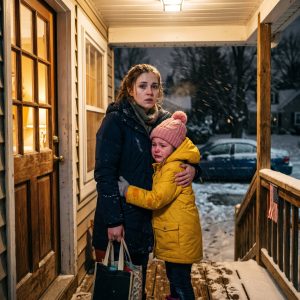
My daughter Zoe couldn’t sleep.
Not cute toddler can’t sleep. She was five. She had opinions now. She had questions. She had the emotional range of a tiny CEO who just discovered corporate betrayal.
“I don’t like the wind,” she whispered, eyes shiny in the dark.
“It’s just weather,” I whispered back like that was comforting, as if weather ever listened to logic.
I scooped her up and carried her down the hallway because waking up my parents at night was like poking a bear and then acting surprised when it mauled you.
The house was tense even when it was quiet.
It was that kind of quiet that didn’t feel peaceful. It felt like everyone was holding their breath, waiting for someone, me, to mess up.
I tried to be careful.
I tried to do everything right.
I tried to be invisible.
We made it to the kitchen. I flipped on the smallest light, just enough to see. I moved like a thief in my own house.
I poured Zoe a small cup of orange juice because it was the one thing that usually made her settle.
It felt like a tiny, harmless solution.
Lights on equals problem.
Footsteps on the stairs.
A door opening upstairs.
A sigh heavy with disgust like I’d committed a crime by needing air.
Mom appeared at the top of the stairs, her voice sharp and tired in that special way that meant it wasn’t about the moment.
It was about me.
“What are you doing?”
“Zoe couldn’t sleep,” I said quietly. “I’m just.”
My sister Savannah appeared too, hair messy, face already irritated like she’d been woken from a life of luxury by peasants.
Savannah was seventeen, which is old enough to know better and young enough to think the world owed her silence.
She squinted at Zoe like Zoe was a bug on her shoe.
“Are you kidding me?” Savannah hissed. “I have school. Some of us actually have plans.”
I apologized automatically because that was the family religion.
Apologize first.
Explain never.
“I’m sorry,” I said. “We’ll be quick.”
Savannah stepped farther into the kitchen, arms folded, and said very calmly, like she’d rehearsed it, “Can you please just keep it down? It’s late.”
Zoe’s hands were small and clumsy, shaking.
She reached for the cup.
Her fingers slipped.
The cup tipped.
Orange juice spilled onto the carpet.
One beat of silence.
Just one.
My brain instantly went into fix-it mode.
Towels.
Paper towels.
Something.
Anything.
It’s juice.
It’s not acid.
It’s not blood.
It’s not.
Dad’s footsteps hit the stairs hard enough to make them creak.
Mom gasped like the house had been stabbed.
Savannah went cold and disgusted.
“Are you serious?”
I dropped to my knees with towels.
“It’s okay. It’s fine. I’ll fix it,” I said, talking fast, talking small, like if I made myself tiny enough, the moment wouldn’t hurt us.
Zoe’s lip trembled.
“I’m sorry.”
“It’s okay,” I whispered. “Baby, it’s okay.”
Dad moved like he’d been waiting for this, like he’d been sitting there his whole life waiting for orange juice to give him permission.
“I’m done,” he said. “I’m done with this.”
Mom backed him immediately.
“This house is not a daycare. We are sick of your mess.”
“I’ll clean it,” I said. “It was an accident. She’s five.”
Savannah added fuel like she always did.
“She can’t even control her own kid.”
Dad’s eyes fixed on Zoe for half a second.
Not like she was a child.
Like she was evidence.
Then he said it, all of it, in one clean hit, like the sentence had been living on his tongue for years.
“We are done raising your mistake. Get out and never come back.”
For a second, my brain just stalled because what do you do with that?
What do you do when someone says your child is a mistake?
Like it’s a fact.
Like it’s a stain.
I stared at them from the floor, towels in my hands, orange juice soaking into the carpet like a crime scene.
“Dad.”
My voice sounded far away.
“It’s snowing. It’s a storm. Where are we supposed to.”
“I don’t care,” he said.
Mom didn’t look at me.
She looked at the carpet like the carpet was the victim.
I kept thinking, they don’t mean it. They’ll cool down. Any second now, someone will stop this.
Any second now, Mom will sigh and say, “Fine, just tonight.”
Any second now, Dad will come to his senses.
Nobody stopped it.
Dad grabbed bags like he’d practiced this in his head, like there was a checklist and he’d finally gotten to use it.
Mom yanked Zoe’s coat off a hook and shoved it toward me like evidence.
As Dad shoved a bag at me, he twisted the house key off my key ring.
He curled it in his fist and said, “These aren’t yours anymore.”
I felt the air leave my lungs.
“Just let us stay tonight,” I said. “Please, I’ll sleep in the car in the driveway. I’ll.”
“You will not,” Savannah said, voice tight. “You’re not staying here.”
Mom didn’t look at me.
Savannah watched, too calm, too satisfied.
Dad opened the door.
Cold punched in like a fist.
Snow blew sideways into the hallway. Zoe whimpered and pressed into my side.
They pushed us out like we were trash that needed taking out before morning.
The door shut.
The lock clicked.
It wasn’t the shouting that broke me.
It was that small final sound.
Zoe started crying right away.
Full-body shaking sobs.
She looked at the orange stain on her sleeve and whispered, “I’m sorry. It’s my fault.”
I crouched down, wiping her cheeks with my thumbs, trying not to fall apart right there on the porch.
“No,” I told her. “No, never your fault. Do you hear me? Never.”
Inside my head, panic screamed.
I have no plan.
I have no one.
I have a child.
The porch light glared down on us like we were on stage.
I hauled the bags to my cheap car, my one tiny piece of independence, and got Zoe buckled in.
My hands were shaking so badly I fumbled the latch.
Phone battery low.
Bank account basically a joke.
The kind of money that disappears the second you look at it.
I searched my brain for names to call.
It was late, storming.
Everyone I knew had warm homes they didn’t want to complicate.
So, I started the car because sitting still felt like dying.
I aimed for the nearest place that meant lights and heat, cheap motel, 24-hour diner, anywhere that wouldn’t ask questions and wouldn’t kick us out for being too sad.
The road was slick.
Snow was coming down hard.
The windshield wipers fought a losing battle.
Zoe sniffled in the back seat.
“Where are we going?”
I answered too bright because mothers lie to keep the world from collapsing.
“An adventure,” I said.
Zoe didn’t laugh.
I was so focused on keeping the car straight that I didn’t see the other headlights until.
An intersection.
Ice.
A blur.
Another car slid.
The impact hit hard enough to steal the air from my lungs.
Zoe screamed, one sharp sound, and then it cracked into sobbing.
The world narrowed to one thing.
Her.
I twisted around, hands shaking, scanning her face, her arms, her legs.
“Talk to me, baby,” I said, forcing my voice steady. “Look at me. Are you hurt? Where do you hurt?”
She shook her head hard, crying.
“I’m scared.”
I scanned again anyway.
Her cheeks.
Her hands.
Her coat.
No blood, nothing obvious, just fear, loud and real.
A woman approached through the snow, steady, controlled, not panicking.
She looked in my back seat, saw Zoe’s tear-streaked face, saw the bags, saw the whole picture.
She didn’t bark at me.
She didn’t accuse me.
She didn’t even seem angry.
She asked quietly, “Why are you out in this weather with a five-year-old?”
I tried to lie, then couldn’t.
“We got kicked out,” I heard myself say. “Tonight.”
Her face changed like she’d been slapped by the sentence.
“What’s your name?” she asked.
“Clara,” I said.
Her eyes flicked to my face like she was checking it against a memory she didn’t want to be right.
Then she said very quietly, like she was talking to herself.
“Clara Walker.”
I froze.
“I haven’t seen you since.”
“Since what?”
“You were in my.”
She stopped herself.
“Where did you go?”
How did she know my last name?
I learned early that my role in the house wasn’t daughter.
It was buffer.
Savannah cried. My parents soothed.
I achieved. My parents nodded and moved on.
If Savannah was upset, the universe stopped.
If I was upset, I was told to be mature.
I learned to shrink because taking up space always cost me.
I didn’t know why they needed a villain in the family until the year I got pregnant.
Before that, I had a path, a real one.
Sophomore year, I got into a selective state university Future Scholars research mentorship program for high-performing high school students.
It wasn’t a sit-in-a-lecture-and-clap-politely program.
It was real work.
Every Saturday, a small group of us met on campus and worked on a project.
Data collection.
Presentations.
Reports.
The whole this could be your life someday thing.
And built into it was the part that made me feel like a person with a future.
A weekly one-on-one mentor meeting.
Fifteen minutes that felt like oxygen.
Someone who asked me what I wanted, not what I’d done wrong.
I kept one thing from that program.
One small thing.
I didn’t know it would come back when everything fell apart.
It was my Future Scholars badge on a blue lanyard.
I never wore it again, but I never threw it away.
Back then, I thought my life was finally opening.
Then I fell for Brendan.
Brendan was sweet when it was easy and distant when it got real.
He made me feel chosen after living in a house where I was mostly tolerated.
So yes, I fell hard, like a cliché, like a girl who’d been starving for affection and mistook attention for love.
When I found out I was pregnant, my first thought wasn’t fear.
It was, I can still do this.
I can still finish school, still do the program, still be me.
I was fifteen at the time.
Brendan was seventeen.
He promised he’d be there, then stopped replying.
Later, I found out that he moved away for college to Europe.
I haven’t heard much from him since.
I thought the hardest part would be telling my parents.
I was wrong.
I told them in the kitchen, hands shaking so badly I could barely get the words out.
There was a pause, just long enough for hope to flicker.
Then my mother’s face changed first.
Not anger.
Disgust.
My father didn’t ask if I was okay.
He asked who knew.
They didn’t say, “How can we help?”
They said things like, “Do you know what people will think?”
“You embarrassed us.”
“You threw your future away.”
Savannah watched like it was entertainment, like this proved something she’d always believed about me.
I expected punishment.
I didn’t expect erasure.
They decided I wouldn’t go back to school for a while.
Then it became homeschool.
Then it became you’re not going back at all.
They said it was to avoid gossip, to keep the family respected, to not parade my shame around, like my body was a billboard and my baby was a scandal.
They pushed me to drop the mentorship program immediately.
No more Saturdays.
No more meetings.
No more future.
I tried to fight it.
I tried to bargain.
I tried.
“Just let me finish the semester.”
My father said something like, “If you weren’t smart enough to avoid getting pregnant, you’re not smart enough for college.”
And that was that.
The program moved on without me.
I stopped showing up.
I stopped answering calls.
The worst part is I didn’t even get to say goodbye.
Zoe was born, and I loved her so fiercely it scared me.
But in that house, love didn’t protect you.
It just gave them another target.
My parents treated Zoe like noise, mess, inconvenience.
Never fully cruel in public, always cruel in private.
Savannah got a normal teen life.
Sleepovers.
School.
Friends.
I got exhaustion and reminders that I owed my parents for letting me stay.
I promised my daughter she was never a mistake.
And then five years later, she spilled orange juice.
Back in the car, my mouth was still open with a question I couldn’t ask.
Zoe’s voice came small behind me.
“Mommy, are we going home?”
My hands locked around the steering wheel like it could fix things.
“We’re going somewhere warm,” I said.
Because that’s what you say when you don’t have a home and your kid is five.
Outside my window, the woman didn’t look angry.
She looked alert, like she was already scanning for the next thing that could go wrong.
She leaned just enough so Zoe could see her face.
Then her eyes flicked over Zoe.
Seat belt.
Cheeks.
Hands.
Quick, checking, not lingering.
And she looked at me.
“Is she hurt?”
“No,” I said too fast. “I don’t think so. She’s just scared.”
Zoe made a small broken sound that confirmed it.
The woman nodded once.
“Okay.”
My heart was still trying to climb out of my chest.
Snow hissed across the glass.
“I’m sorry,” I blurted. “I didn’t see you. I was.”
She cut through it like she’d heard panic before.
“It’s a bumper,” she said. “Don’t worry about it.”
I stared at her.
Most people worry about bumpers.
Entire neighborhood feuds have started over less.
“I hit you,” I said, because my brain needed reality acknowledged.
Needed someone to be mad so the world made sense.
“You misjudged in a storm,” she corrected. “That happens.”
Then, like she was changing channels, “How old is she?”
“Five.”
Her expression tightened.
Not at me.
Not at the dent.
At the five.
She looked at Zoe again.
“Hi, sweetheart. What’s your name?”
Zoe hesitated, looked at me like she was asking if we were allowed to speak.
“Zoe,” I said for her. “Her name is Zoe.”
The woman nodded.
“Hi, Zoe. I’m Simona.”
Then she looked back at me.
“Clara, where were you headed?”
“A motel?” I said, and it sounded pathetic the second it left my mouth.
“And after that?” she asked.
My throat tightened.
“I don’t know.”
She didn’t judge me.
She didn’t pity me.
She just waited like she could tell the truth was right there and she didn’t need to chase it.
I swallowed.
My voice came out small.
“My parents kicked us out,” I said. “Tonight.”
Something shifted in her face.
Not surprise.
More like anger deciding where to land.
“In this weather?” she asked, voice quiet.
I nodded once.
Zoe made a small whimper behind me like she understood enough to be scared.
Simona exhaled through her nose.
Then she said very calmly, like she’d made a decision that didn’t require my permission.
“Okay. You’re not driving anywhere else tonight.”
“I have to,” I said automatically. “I don’t. I don’t have.”
“I heard you,” she said. “You don’t have anywhere. That’s why you’re not driving.”
She stepped back from my window and pointed toward a small parking lot nearby.
“Hazards on,” she said. “Pull into that lot slow. I’ll follow you.”
I wanted to argue.
My pride tried to sit up like it still had rights.
But Zoe whispered, “Mommy.”
And my pride sat back down immediately.
I flicked my hazards on.
I eased the car forward and into the lot with the delicacy of someone diffusing a bomb.
Simona parked behind me.
She got out, took two quick photos of the bumpers and the intersection, then tucked her phone away like she’d just filed the dent into a drawer labeled later.
I got out too, and the cold hit hard enough to steal my breath.
“I’m really sorry,” I said again, because I guess I’m committed to this brand.
“It’s fine,” she said, eyes already on Zoe through the glass. “Is her car seat secure?”
“Yes.”
“Good.”
Then she looked at me.
“Do you have your keys?”
“My car key,” I said. “Yeah. My house key, no. He took it.”
Her jaw tightened slightly.
“Okay.”
She didn’t say more.
She walked to her back door, opened it, and pulled out a blanket.
Not as a dramatic prop, just matter-of-fact, like she kept one because life happens.
She spread the blanket across the back seat and opened the door.
“Hey,” she said softly. “Come sit here. We’re getting warm.”
Zoe stared at her, then checked my face.
I nodded.
“It’s okay, baby.”
The story continues — don’t miss what happens next