She climbed in, coat clutched tight, and her breathing finally slowed.
I grabbed our bags from my car.
My fingers fumbled the zipper.
I dropped one bag because of course I did.
Simona picked it up and handed it to me without making it a moment.
“Lock your car,” she said.
I did.
That click felt too small for the night we were living.
And then I slid into the front seat of Simona’s car, heart still trying to climb out of my throat.
As we drove, my brain tried to catch up.
It finally remembered the thing she’d said at the crash.
Quiet.
Exact.
Walker.
I didn’t ask.
Zoe was right behind us listening, and I couldn’t risk the answer being something she’d carry.
Simona drove in calm silence for a minute, then asked, “Do you have any friends you can call?”
I stared at the dashboard.
“No.”
No explanation.
No excuses.
Just no.
She nodded once.
“Okay.”
That word again.
Okay, like it was a fact, not a failure.
We pulled up to a modest house with warm lights.
Nothing flashy, nothing cold, just stable.
Inside, heat wrapped around us so suddenly, my eyes stung.
Zoe sagged under the blanket the moment the door shut, like her body had been holding itself together on pure fear.
Simona disappeared for thirty seconds and came back with thick socks and a mug of hot chocolate that smelled like it had actual effort in it.
Zoe blinked up at her.
“Are you nice?” she asked because five-year-olds have no filter.
Simona paused like she was choosing her words carefully.
“I’m trying,” she said. “Is that okay?”
Zoe looked at me.
I nodded, throat tight.
“Yeah, baby.”
Simona turned to me.
“Sit.”
I sat on the edge of the couch, still in my coat, still braced for yelling that never came.
The house was quiet.
Soft lamps.
Books.
A neat stack of mail.
One coat on a hook.
The kind of quiet that doesn’t feel like a trap.
My hands wouldn’t stop trembling, so I opened my bag just to give them something to do.
And the blue Future Scholars lanyard peeked out.
My face went hot.
Of course, I still had it, like some embarrassing little souvenir from the life I didn’t get to live.
I shoved it down fast, like hiding it would hide the fact that I used to be someone with a plan.
Simona’s eyes flicked to it anyway.
She didn’t say anything, but she went still, just for a beat.
Then she stepped into the light by the kitchen doorway, and my brain finally did the thing it should have done earlier.
Her posture.
Her voice.
The way she looked at me like I mattered.
My stomach dropped.
“No,” I whispered.
Her expression softened.
Sadness, maybe.
Or relief.
Or both.
“It’s me,” she said quietly. “Dr. Carr.”
The room tilted.
Dr. Simona Carr.
My mentor five years ago.
The one adult who’d looked at me like I had a future instead of a flaw.
Zoe yawned and slid sideways against the couch cushion, too tired to notice my entire brain combusting.
Dr. Carr kept her voice low.
“Where did you go?”
I tried to make it small.
“Life happened.”
She waited.
Not pressure.
Space.
And the truth came out in rough pieces.
Pregnant at fifteen.
Pulled out of school.
Homeschool.
No diploma.
No program.
No goodbye.
Years stuck.
Tonight’s lockout.
I waited for the look, the disgust, the disappointment.
It didn’t come.
She nodded once, slow, then asked, “What’s still in that house that you need?”
“My wallet,” I said automatically. “Zoe’s school papers.”
I stopped because my brain finally caught up.
“My EpiPen,” I said. “Shellfish allergy.”
I tried to shrug it off like it wasn’t a big deal, like I wasn’t one cross-contamination away from a nightmare.
Dr. Carr didn’t let me.
“No,” she said, quiet and absolute. “We’re not gambling with that.”
“I’m not going back there.”
“Of course you don’t,” she said. “We’ll get what you need.”
She slid a notepad toward me.
“Essentials now.”
My pen moved.
EpiPen.
Wallet.
Zoe’s school papers.
Anything with our names on it.
Dr. Carr called non-emergency.
I caught fragments.
Lockout.
Minor child.
Emergency medication.
Civil standby.
Avoid confrontation.
Then my phone lit up.
Dad.
Then Mom.
I stared at the screen for half a second too long.
Dr. Carr stayed close, silent.
I answered.
“Hello?”
My dad shouted immediately.
“What did you do? We had police at our door in the middle of the night.”
Mom cut in, furious.
“How dare you call police on your own parents? Do you know how this looks?”
My throat tightened.
The old reflex, apologize, shrink, tried to climb up my spine.
I looked at Zoe, curled up on the couch, finally asleep.
“I called because I needed my EpiPen,” I said. “That’s it.”
Dad scoffed.
“Always a story.”
“I’m hanging up,” I said.
They talked over each other louder, uglier.
I hit end.
Click.
Later, an officer brought back the essentials.
My EpiPen.
My wallet.
Zoe’s forms.
And took a brief statement.
What happened?
Are we safe?
Is Zoe safe?
When the door closed again, the quiet finally felt different.
Not the quiet before punishment.
The quiet after survival.
Dr. Carr didn’t praise me, didn’t lecture me.
She just asked, “Are you hungry?”
It was so normal it almost broke me.
Later, after Zoe was tucked under a blanket and my EpiPen was placed somewhere I could grab fast, I said, because politeness is my default, even when my life is on fire, “Thank you. We’ll find somewhere tomorrow.”
Dr. Carr looked at Zoe, then at me.
“You can stay here,” she said.
Not pity.
Not a suggestion.
A fact.
“For tonight,” I whispered.
She shook her head once.
“Until you’re stable. Until you’re safe.”
Zoe’s eyes fluttered open like she’d been listening from the edge of sleep.
“Can we stay?” she whispered.
And the scariest part was this.
I still didn’t know why she was doing it, why she was so nice to us.
I only knew what it felt like to imagine morning without fear.
The next morning was quiet in a way that didn’t feel peaceful.
It felt like the calm after a fire.
Everything still smells like smoke, even if the flames are gone.
Zoe slept on Dr. Carr’s couch like she’d earned it.
I didn’t.
I sat upright, fully dressed, staring at my phone like it might bite.
No calls.
No texts.
No screaming.
The silence was suspicious.
Dr. Carr slid a mug of coffee toward me like it was medicine.
Not comforting.
Functional.
She sat across from me.
“Where do you work?”
“Grocery store,” I said. “Stocking mornings.”
“And you’re scheduled today.”
“I missed it.”
She didn’t blink.
“We’ll call.”
We.
That word landed like a door unlocking.
She put the phone on speaker so I couldn’t hide from my own life.
I explained.
Weather.
Accident.
Emergency.
“I can come tomorrow.”
My manager grumbled, but the shift stayed mine.
When the call ended, my shoulders dropped a fraction.
Zoe wandered in, rubbing her eyes.
She looked around like she expected the room to vanish.
“Are we still here?” she asked.
“Yeah, baby.”
I kissed her forehead.
“We’re still here.”
Zoe nodded.
Then, “Are they still mad?”
I almost told the truth.
That my parents didn’t have mad settings. They had permanent disappointment settings.
Instead, I said, “We’re safe.”
Zoe accepted that like kids do, like safety is a fact you can hold on to.
After I dropped Zoe at school, I came back and stood in Dr. Carr’s kitchen like a person waiting to be yelled at.
She glanced at me.
“You don’t have to wear that face here.”
“What face?”
“The one that says you’re bracing.”
I laughed once.
It came out rough.
Old habit.
She nodded like she understood old habits too well.
Then she said, matter-of-fact, “You never finished school.”
My stomach tightened.
“No.”
“GED?” she asked.
“No.”
She didn’t ask why.
She didn’t lecture.
She just looked at me and said, “Do you want to finish?”
The question hit like a slap because I’d spent years believing I didn’t get to want things anymore.
“I work,” I said automatically. “Zoe.”
“She’s in school,” Dr. Carr said. “And you’re smart.”
“That was.”
“Five years ago,” she finished. “Not fifty.”
I hated that she was right.
She slid a notepad across the table.
Not a motivational quote.
A plan.
“Two hours a night,” she said. “Four nights a week. We start small. We don’t negotiate with shame.”
I stared at the notepad like it might explode.
“And if I fail?” I asked.
“Then you take it again,” she said, like gravity was optional.
That was the moment it stopped feeling cozy.
It felt like rebellion.
Not dramatic rebellion.
Quiet rebellion.
The kind that looks like a grown woman opening a math book and refusing to believe the voice that says she’s too late.
My schedule became ridiculous on purpose.
Work early mornings.
Zoe’s school drop-off.
Study at Dr. Carr’s table while Zoe colored beside me.
Dinner.
Bath.
Zoe’s bedtime.
Then another hour with a book I’d been told I didn’t deserve.
Some nights I wanted to quit.
Not because it was hard.
Because it made me angry.
Angry that my parents stole my education and called it discipline.
Angry that I had to rebuild what should have been mine the first time.
The first time I passed a GED practice test, Zoe cheered like I’d won a championship.
“Mom is smart,” she announced.
I snorted.
“Mom is stubborn.”
When I passed the real test, I cried in my car in a parking lot like a person with excellent emotional regulation.
Zoe asked why I was crying, and I told her, “Happy.”
And she said, “Oh,” like happy crying was normal.
Then community college because tuition doesn’t care about inspirational stories.
I kept my job.
I took classes when I could.
I learned to live in the space between not enough time and do it anyway.
Dr. Carr didn’t rescue me with speeches.
She showed up with logistics.
A ride when my car wouldn’t start.
Babysitting when Zoe got sick and I had an exam.
A calm email when a professor acted like accommodations were a moral failure.
I didn’t become fearless.
I became practiced.
Then I transferred back to State University.
Walking onto campus felt like stepping into an alternate timeline, one where I hadn’t been erased.
And there, on a random weekday, I saw the building where Future Scholars used to meet.
My stomach flipped so hard it felt like the past had hands.
Dr. Carr didn’t say anything.
She just walked beside me.
Student-parent life on campus was brutal.
Everyone acted like you could be a perfect student if you just managed your time.
As if time management includes materializing childcare from thin air.
I met other student moms in quiet panic.
Always apologizing.
Always one emergency away from dropping out.
So I started helping.
Small at first.
A group chat.
Shared notes.
Babysitting swaps.
A list of who can you call at midnight.
Dr. Carr watched it grow and one night slid an envelope across her table.
“Funding opportunity,” she said. “Write a proposal.”
I stared.
“I’m not qualified.”
She lifted an eyebrow.
“You’re living it. That’s more qualified than most.”
So, I wrote it.
We got the grant.
Then another.
The first time a mom told me this kept me enrolled, I went to the bathroom and cried for exactly thirty seconds because I still had a shift to work.
Somewhere in that year, Dr. Carr’s kindness started to feel less like charity and more like choice.
Zoe’s drawings appeared on her fridge.
Snacks Zoe liked were always in the pantry.
A small toothbrush in the upstairs bathroom that hadn’t been there at first.
One night, Zoe fell asleep on the couch with homework on her lap.
Dr. Carr covered her with a blanket and stood there for a beat too long.
The question slipped out before I could swallow it.
“Why are you doing this?”
Dr. Carr didn’t look at me right away.
She watched Zoe breathe.
“I thought I had time,” she said quietly.
I waited.
“I kept postponing the family part,” she added. “Career, tenure, later. And then later didn’t show up.”
Her voice stayed controlled.
Her hand didn’t.
“This house has been quiet for a long time,” she said.
I didn’t know what to do with that honesty, so I made it a little lighter.
“So, we’re your loud little invasion.”
Her mouth twitched.
“Something like that.”
Then she looked at me and said the part I’ll never forget.
“I chose you not because I needed a project, but because no child should grow up believing she’s a mistake.”
My throat closed.
I nodded because I still didn’t know how to accept something good without apologizing for it.
By the time graduation came, Zoe was ten, old enough to remember the storm like a scar.
And Savannah was graduating too.
Same university, same ceremony.
My parents were there for her.
Of course they were.
I saw them before they saw me and felt something old try to rise.
An instinct to shrink.
It didn’t win.
The announcer’s voice rolled through the auditorium.
“Please welcome our student speaker and founder of the Student Parent Support Initiative, Clara Walker.”
I stepped into the light.
Savannah was clapping.
Then her hands froze midair.
Two rows behind her, my mom’s face drained so fast it looked unreal.
My dad leaned forward, staring like his eyes could undo time.
I reached the podium and adjusted the mic.
“Good evening,” I said. “I’m Clara Walker. I’m a graduate, and I’m a mom.”
Zoe sat near the front with Dr. Carr, staring up at me like she was holding me steady.
“When Zoe was five,” I said, “my parents looked at me and said, ‘We are done raising your mistake. Get out and never come back.’”
The room went dead quiet.
Heads turned, subtle at first, then sharper, toward the section where my parents sat frozen.
My mom covered her mouth.
My dad’s hands clenched together until his knuckles went white.
Savannah stared hard at her lap like it might swallow her.
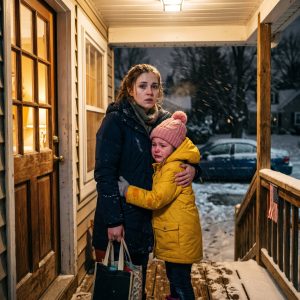
“They took my house key,” I continued, voice level. “They pushed a couple bags into my arms. They shut the door while it was snowing sideways.”
I didn’t need to embellish it.
The truth carried itself.
“I sat in my car with a child asking me if we were going home,” I said, “and I had to answer like a mother, even when I felt like a scared kid myself.”
You could feel the room change.
People weren’t politely listening anymore.
They were there.
“And that same night, I got into a minor car accident,” I said. “Nobody was hurt, but I remember thinking, of course.”
A few uneasy laughs, because pain plus timing is comedy’s darker cousin.
“The woman who got out of the other car didn’t care about the bumper,” I said. “She asked me one question. Where are you going?”
I paused.
“I said, I don’t know.”
Silence, heavy, real.
“She took us home,” I said. “She gave us a home.”
I turned toward the front row.
“That woman is Dr. Simona Carr.”
Applause hit fast.
Dr. Carr didn’t stand.
She just nodded once, eyes bright.
“That’s why this initiative exists,” I said. “Because being smart doesn’t matter if you don’t have childcare. Ambition doesn’t matter if one sick day can knock you out of school. And nobody should have to choose between feeding their kid and finishing a degree.”
I let it land.
“If someone has ever called you a mistake,” I finished, voice steady, “they were wrong.”
I stepped back from the mic.
The applause rose, stronger now, not polite anymore.
My mom was crying openly.
My dad stared straight ahead like the floor had shifted.
Savannah still couldn’t lift her hands to clap.
For the first time in my life, they didn’t get to control the story.
Afterward, they found me.
Of course they did.
Tears.
Apologies.
The sudden desperate need to rewrite history into something softer.
I didn’t raise my voice.
“I forgive you,” I told them, because I didn’t want poison in my body forever. “But I’m not coming back.”
They tried.
“Family is family.”
I looked at Zoe, then at Dr. Carr.
“No,” I said quietly. “Family is who shows up.”
And I walked away.
Not angry.
Not triumphant.
Just done.
Because my life wasn’t a punishment anymore.
It was mine.
Everyone loves to say, “But they’re your parents,” until they’re the ones getting thrown out in a snowstorm.
I forgave them.
I just didn’t hand them access to my life.
Reconnect or no contact.
What would you choose?
END!
Comment below and subscribe if you want
If you came here from Facebook because of this story, please go back to the Facebook post, tap like, and comment exactly: “So moving”. That small action means a lot. It supports the storyteller and gives them real motivation to keep sharing stories like this, where one act of kindness can change everything.