My parents demanded that my 12-year-old daughter pay $100 towards a present for her cousin; “If you don’t pay, you are no longer family,” my mom said; I didn’t shout; I showed them who is “no longer family”; the next day, I had 53 missed calls…
When I opened the front door, I knew something was wrong before I even saw Mia.
The house had that too-quiet feeling, like it was holding its breath, like the air had been told to keep a secret.
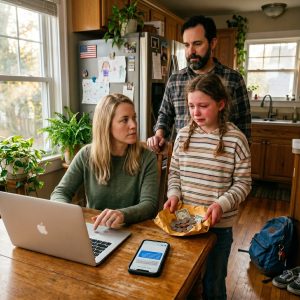
Mia was at the kitchen table, shoulders hunched, backpack still on the floor where she’d dropped it.
Her hair was pulled back too tight.
Her hands were flat on the tabletop, palms down, like she was trying to keep them from trembling.
“Hey,” I said softly. “What’s going on?”
She looked up, and that’s when I saw it.
The exhaustion that didn’t belong on a 12-year-old.
Not the normal middle-school-is-annoying tired.
Not I-stayed-up-reading tired.
This was the kind of tired you’re not supposed to see on a 12-year-old.
The kind that makes someone’s eyes look older than the rest of their face.
“Mia.”
I set my keys down slowly, like making noise might break her.
“Did something happen at school?”
She blinked once, like she was loading the right expression.
“No.”
Her voice came out careful, normal on purpose.
“I just worked.”
I frowned.
“Worked?”
She nodded and tried to sit up straighter, like posture could hide fatigue.
“I cleaned Mrs. Novak’s house,” she said. “For three hours.”
Three hours.
I stared at her hands.
Her knuckles looked rubbed raw. The skin around her nails was red, like she’d been scrubbing at something that didn’t want to come off.
“You cleaned?” I repeated, because my brain was stalling.
“Mrs. Novak’s house.”
Mia nodded again, as if this was the most ordinary sentence in the world.
“She paid me,” Mia added, a small flicker of pride breaking through the exhaustion. “$20.”
I didn’t react immediately because at first, my mind tried to file this under responsible kid, good work ethic.
Neighbors pay for chores sometimes.
I wanted to be that mom who says, “Wow, honey, that’s impressive.”
But then Mia flexed her fingers, winced, and rubbed her palm like it hurt to exist.
“And I still have homework,” she said, voice dipping. “But I’m so tired, and my hands… I can’t hold the pen right now. It hurts.”
I stepped closer, careful.
“Let me see.”
She hesitated just a beat, then turned her hands over.
The skin was pruny in places, like she’d been in water too long.
There were faint purple-yellow patches on her wrist, like she’d knocked it against something.
Not dangerous.
Not hospital.
Just too much.
My throat tightened.
“Mia,” I said quietly. “Why did you do that today?”
She looked down at the table like the grain of the wood was giving her instructions.
“I needed money.”
There it was, the first crack.
I forced my voice to stay steady.
“Okay. For what?”
I asked it gently, like I expected her to say a toy, a book, some game she didn’t want to ask me for.
And honestly, if Mia wanted something, she could ask.
My husband Thomas and I weren’t struggling.
We weren’t rich rich, but we were comfortable, stable.
The kind of stable that lets your kid be 12 without becoming an exhausted miniature adult.
So, I smiled a little, just enough to keep her calm.
“What are you saving up for?” I asked. “Do you want something special?”
Mia’s mouth opened, closed.
She swallowed.
“It’s not for me,” she said.
And something in my chest went cold.
“It’s for Sophie.”
Sophie, my niece.
My sister Heather’s older kid, the one my family spoke about like she’d solved world peace.
Mia cleared her throat.
“They’re collecting money for her birthday.”
I stared at her.
“Who is collecting money?”
Mia shrugged like shrugging could make this smaller.
“Everyone.”
Everyone.
The word hit like a weight.
“How much?” I asked, already knowing I wasn’t going to like the answer.
Mia’s voice got smaller.
“100.”
My brain did a strange little stutter.
“$100?”
She nodded.
I just stood there frozen, trying to make it make sense.
Sophie was 12, same as Mia.
There was no universe where a 12-year-old should be working herself into soreness to fund another 12-year-old’s birthday gift.
That sentence shouldn’t even be possible.
“Mia,” I said slowly. “Who told you that you had to pay $100?”
She hesitated again.
Then, “Grandma.”
My mother.
Mia said it the way you say the name of someone who decides whether you’re safe.
And that’s when I saw it.
Beyond the tiredness, the other thing.
The part that didn’t come from cleaning.
The part that didn’t come from scrubbing floors.
Fear.
The kind that sits behind the ribs and presses.
“Mia,” I said very carefully. “What exactly did Grandma say?”
Mia’s eyes got shiny.
She blinked hard, like she could keep the tears inside by force.
“She said…”
Mia’s voice wobbled just once, then she clamped it down.
“She said, ‘If I don’t pay, I’m not family.’”
I felt my whole body go still.
“What?”
Mia stared at the table.
“She said if I don’t contribute, I’m no longer family.”
I didn’t move.
I didn’t breathe because my brain was trying to reject it like it was a phishing scam and my mind was highlighting the obvious red flags.
That’s ridiculous.
That’s not real.
That’s not something a grandmother says to a child.
But Mia’s hands were still red.
Mia’s eyes were still wet.
And Mia looked like she’d believed it.
“Are you sure you understood her right?” I heard myself ask, because denial is a powerful drug.
Mia nodded quickly.
“Yes. She said everyone is contributing. And if I don’t, then I’m not family.”
A tear slid down her cheek.
Then she added, “I didn’t ask you. I thought it had to be my money. Like, if you pay, it wouldn’t count. And I broke open my piggy bank, but it wasn’t enough.”
“Mia,” I said, and my voice did something I didn’t like.
It cracked at the edges.
“Oh, honey.”
She wiped her face with the heel of her hand like she was annoyed at herself for leaking.
“I think I shouldn’t have told you,” she whispered.
My stomach twisted.
“Listen to me,” I said. “You didn’t do anything wrong.”
But even as I said it, I knew something.
This wasn’t a misunderstanding.
This wasn’t a weird joke.
This wasn’t my mother being a little intense.
This was my mother being my mother.
I stood up so suddenly the chair scraped.
Mia jumped.
“I’m going to call Grandma,” I said.
Mia’s eyes widened.
“Mom, it’s okay.”
I lied.
Because it was not okay, and we both knew it.
I walked into the living room with my phone like physical distance could keep me safe from whatever was about to happen.
I didn’t call to scream.
I didn’t call to fight.
I called because there was a part of me, one stubborn, hopeful, humiliating little part, that needed to hear my mother deny it.
She answered on the second ring, cheerful like she hadn’t just snapped a child’s sense of belonging in half.
“Hi, sweetheart,” my mother said. “Everything okay?”
I stared at the wall.
“Mom,” I said. “Mia told me something. I’m sure it’s a misunderstanding.”
“Oh.”
My mother’s voice was light, curious, performative.
“Mia said you told her she has to contribute $100 towards Sophie’s birthday present.”
A pause.
Not surprised.
Not confused.
Just a pause like she was deciding how to phrase it.
“Yes,” my mother said. “That’s right.”
My hand tightened around the phone.
“She’s 12,” I said, because sometimes stating reality feels like a prayer.
“So?” my mother replied. “Twelve-year-olds can work. They can learn.”
My pulse thudded in my ears.
And I said slowly, “Did you tell her that if she doesn’t pay, she’s no longer family?”
My mother didn’t miss a beat.
“Yes,” she said, calm as tap water, “because she needs to learn what it means to support family. Financial obligation. Values.”
Values.
Like Mia’s sore hands were a lesson plan.
I stood there staring at nothing, feeling something inside me go quiet.
Not angry.
Not explosive.
Quiet like a door closing.
“Okay,” I heard myself say.
“What?” my mother asked, suspicious now because okay is not the response she likes.
“I have to go,” I said.
“Eleanor—”
I ended the call.
I stood there for a second with the phone in my hand, and I could hear Mia in the kitchen shifting in her chair, the soft squeak of it.
And I knew exactly what was going to happen next.
I didn’t know how yet, but I knew this wasn’t over.
I need you to understand something about me.
I wasn’t born with a backbone.
I grew one the hard way, like a callus.
I was the oldest of three, two years between each of us.
Heather came after me.
Then Leo, the baby, the miracle boy, the one who could burp and still get applause.
When I was little, my parents loved to say we were struggling.
They said it like it was a weather pattern, like poverty was a season that just happened to us.
And when families struggle, someone always gets assigned to understand it.
That someone was me.
Heather got to be cute.
Leo got to be little.
I got to be reasonable.
On Christmas mornings, Heather would unwrap something that made her squeal.
Leo would get something soft and bright and age appropriate, and my mom would clap her hands and say, “Look at his face.”
And I would get something.
Not nothing.
That would have been too obvious.
Something small.
Something safe.
Something that came with a smile and a line that sounded like praise.
“You’re older,” my mother would say. “You understand.”
They said it like understanding was a gift, like it should make me proud.
And for a long time, it did.
Because if you’re the kid who gets less, you learn to make a story that doesn’t hurt.
You tell yourself, “They’re younger. They need more.”
You tell yourself, “We don’t have money.”
You tell yourself, “It’s fine. I’m fine.”
Chores came next.
When I was old enough to reach the sink, I was old enough to scrub it.
I did dishes.
I folded laundry.
I cleaned.
I held.
Heather was too busy with school.
Leo was too little.
Except then Heather stopped being too little, and somehow she stayed too busy.
By the time Heather was the age I’d been when I started doing half the house, she still had the kind of chores that were optional, the kind you could forget without consequences.
I had the kind that became my personality.
“You’re the responsible one,” an adult would say, like responsibility was a crown and not a chain.
And I believed them because, again, rigged game, but I didn’t know it was rigged yet.
I was 12 when I started working.
Dog walking, small cleaning jobs, odd little things neighbors paid kids for because it made them feel like they were helping.
My parents loved it.
Not in a we’re-proud-of-you way.
In a this-is-useful way.
They called me independent, mature, a helper.
And what happened to the money?
It didn’t become mine.
It went where family money goes when you’re the oldest.
Into the household.
Groceries.
Bills.
“We need it this week.”
“Just until payday.”
“You understand, right?”
I understood.
I always understood.
When Heather and Leo got old enough to work, they didn’t.
Not once.
Not even for fun money.
And do you know what I told myself?
Not favoritism.
I told myself, “We must be doing better now,” because imagining your parents are unfair is like imagining the floor might vanish.
You’d rather keep walking and pretend you don’t feel it wobble.
If I ever hinted at it, if I ever let a sentence slip that sounded like, “Why do they get—”
My parents shamed it out of me.
“How could you even think that?” my mother would say, wounded. “Of course we love you all equally.”
Then she’d smile.
Sweet as poison.
“But you’re the oldest,” she’d add. “You need to contribute. You need to be useful. That’s what family is.”
Useful.
That word stuck to me.
It shaped me.
It became the reason I didn’t go to college.
My parents told me they supported whatever I wanted.
They were very generous with words.
But money?
They couldn’t.
They said it was wiser not to.
They said it like they were giving advice.
I looked at the costs and the lack of support and felt that heavy practical certainty.
There’s no way.
So, I went straight to work after school.
I started low.
I climbed anyway.
I didn’t get the college experience.
I got the pay-rent-and-don’t-die experience.
I worked hard.
I got promoted.
I became reliable.
Eventually, I ended up in management.
Stable, decent income, the kind of job that makes your parents proud when they can brag about it.
And then Heather went to college.
And Leo.
There was money then.
Not huge, not lavish, but enough.
Enough that they could go.
When I asked about it, careful, casual, pretending I didn’t care, my parents gave me the same story.
“It was a few years later.”
They said we were doing a little better.
And then the line that always finished the conversation.
“You’re the oldest. You have to understand.”
Heather studied something arts related.
She changed majors.
She got married.
Had two kids.
Money was always a problem.
Always just out of reach.
Leo graduated and then went traveling.
I remember hearing about it and thinking, “Where did he get the money?”
I also remember the way my parents’ voices sounded when they talked about it.
“He needed it.”
“He was finding himself.”
“It was important for his life.”
So, they helped him.
And by then, I was the only one with a truly stable income.
Thomas and I built a solid life.
We worked for it.
We budgeted.
We planned.
We didn’t treat other people’s money like a backup plan.
My parents retired, and the family story shifted smoothly into the next chapter.
Eleanor contributes.
I sent money regularly.
Helped with mortgage gaps, bills, emergencies, little monthly transfers that became background noise.
And it was treated like normal.
Like air.
Like gravity.
Then Heather’s kids became the center of everything.
Sophie, the golden child, got gifts that made my jaw tighten.
Not because I wanted Sophie to have less, but because my parents would call me to say they couldn’t afford something, and then two days later, they’d be squealing about a gift they couldn’t resist buying for Sophie.
“We just couldn’t help ourselves,” they’d laugh.
And Mia?
Mia got budget gifts and familiar explanations.
“We’d love to do more, honey, but…”
And Mia would smile politely because she had the same illness as me.
Understanding.
Thomas noticed.
He said it out loud once.
“They treat Sophie like royalty,” he said. “And Mia like an afterthought.”
I told myself he was imagining it because if he wasn’t imagining it, then I’d have to accept something I’d spent my whole life refusing to accept.
And then Mia came home with sore hands, and my mother looked at my daughter and did to her what she’d done to me.
Only this time, I could see it because it wasn’t happening to me anymore.
It was happening to my child.
And suddenly understanding didn’t feel like a virtue.
It felt like a trap.
The call with my mother ended, and the house felt different.
Like the moment a song cuts off mid-note and you realize you’ve been bracing for the chorus.
Mia was still at the table.
Thomas hadn’t come home yet.
And I was standing there with my phone in my hand, staring at the screen like it might apologize.
I didn’t call my sister right away.
I want to say I did.
Like I was fearless and decisive and ready to burn bridges with a match and a smile.
The truth is, I stood in the living room and told myself there had to be a reason.
There always is.
That’s what people like me do.
We collect reasons like receipts.
Proof.
Proof.
Proof.
So we’re allowed to finally stop.
Then I thought, Heather.
And the weird thing is, I wasn’t even calling to fight.
I was calling because I needed clarity.
Did my sister know they were shaking down a 12-year-old?
Heather picked up like she’d been waiting.
“Hey,” she said, bright.
I stared at my wall again.
My walls have heard a lot.
“Did you know,” I said, keeping my voice flat, “that Mia was asked to contribute $100 towards Sophie’s birthday gift?”
Heather didn’t hesitate.
“Oh, yeah.”
Just yeah.
Like I’d asked if she knew it was raining.
I swallowed.
“Heather, she’s 12.”
Heather sighed, already annoyed.
“Eleanor, listen. It’s for something big.”
“What?” I said slowly. “Is something big?”
Heather’s voice warmed up like she couldn’t wait to talk about it.
“It’s a horse camp,” she said. “It’s offered through school, like an optional thing. Sophie’s best friends are going. She’s been talking about it forever.”
A horse camp.
Of course, it was a horse camp.
The kind of thing that costs a lot and makes everyone act like it’s more important than it actually is.
“How much?” I asked.
Heather said it like it was obvious.
“Tuition is 900.”
“900?”
I blinked hard.
So, I said very calmly, “You’re collecting money so your 12-year-old can go to a horse camp, and you decided my 12-year-old should help pay for it?”
Heather made a sound like I was being difficult, like I was refusing to join a group project.
“Come on,” she said. “It’s only $100.”
Only $100.
I let the silence sit just a beat.
Heather filled it with a little laugh that tried to sound light.
“And I mean,” she added, “I knew she’s doing jobs now, so she has an income.”
My jaw tightened.
I could hear Mia in the kitchen moving her pencil around, trying to pretend she wasn’t listening.
Heather continued, and her voice got that tone, half compliment, half expectation.
“She’s just like you were. Responsible,” Heather said. “I thought you’d be proud.”
I felt something in my chest settle into place.
Not rage.
Not shock.
Recognition.
“No,” I said.
Heather paused.
“No what?”
“No,” I repeated, clearer. “My daughter isn’t paying for Sophie’s trip.”
“It’s not a trip,” Heather snapped. “It’s a camp.”
“Oh, sorry,” I said dryly. “My bad. My 12-year-old isn’t paying for your 12-year-old’s $900 horse camp.”
Heather exhaled sharply.
“God, you’re so dramatic.”
I didn’t raise my voice.
I didn’t argue the way we used to argue as kids, where you try to win by outlasting the other person.
I just said, “We’re not contributing.”
Heather’s tone shifted slightly colder.
“Fine. It’s your choice. But supporting family is a good thing, Eleanor. You know that.”
And there it was again.
Family.
Obligation.
Contribution.
The same song, different verse.
“I have to go,” I said.
Heather scoffed.
“Whatever.”
I ended the call.
The story continues — don’t miss what happens next