I stood there for a second, phone still in my hand, and I felt empty.
Not sad.
Empty, like you finally stopped carrying something and your arms don’t know what to do.
Then I went to my computer, not because I’d planned it, but because my body moved before my fear could argue.
My banking app opened with that cheerful, neutral design, soft colors, friendly fonts, like it wasn’t about to become a crime scene.
I clicked into recurring payments, and there they were.
Little lines.
Little labels.
Little normal things that had been siphoning off my life.
Standing transfer, Mom and Dad mortgage, $450 per month.
Standing transfer, Heather mortgage top-up, $300 per month.
Monthly transfer, Heather kids, $75 per month.
Monthly transfer, Leo support, $100 per month.
Family utilities help, $60 per month.
I stared because when you see it all in one place, it stops being helping.
It starts being a system.
I clicked the first one.
Cancel.
Confirm.
The screen asked if I was sure in that polite tone apps use when they’re about to change your life.
Yes.
Cancel.
Confirm.
One after another.
It should have felt scary.
It felt clean.
Then I handled the access issue, the little ways my sister and brother had been able to treat my money like a shared resource.
I revoked it.
Removed it.
Shut it down.
No announcement.
No warning.
Just consequences.
I didn’t even realize I was holding my breath until the last confirmation screen disappeared and my lungs remembered how to work.
I leaned back and laughed once.
Quiet.
Disbelieving.
Not because it was funny.
Because it was absurd.
Because I’d been doing this for so long, I’d forgotten I could stop.
The front door opened an hour later.
Thomas walked in, tie loosened, face tired.
He paused when he saw me at the computer.
“What are you doing?” he asked.
I turned to him, and my voice came out steady.
“I’m taking back control of my life.”
Thomas stared at me for a second.
Then his shoulders dropped like he’d been waiting years for those words.
He didn’t cheer.
He didn’t tell me I told you so.
He just nodded once.
“Okay,” he said. “I’m here.”
Mia appeared in the doorway like she’d been hovering.
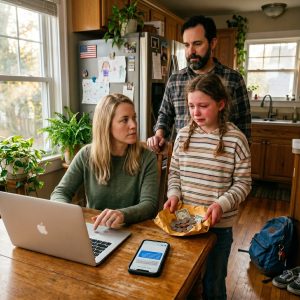
She held a little envelope in her hands, crumpled bills and coins inside.
“I counted,” she said quickly. “I have $90 now. Even with the 20, I still don’t have a hundred. I just need 10.”
My stomach clenched.
Mia’s voice got brighter, like she was trying to sell me on the plan.
“I’m going to go ask Mrs. Novak if she needs anything else cleaned,” she said. “Just a few more hours, then I’ll have it.”
She said it like it was normal.
Like it was reasonable.
Like it was her job to buy her place in the family.
I reached into my pocket and pulled out a $10 bill.
I didn’t make a speech.
I didn’t ask if she wanted it.
I just placed it in her hand.
Mia blinked at it, confused.
“Mom.”
Then I held her gaze.
“You’re not going,” I said.
Mia frowned.
“What do you mean I’m not going?”
“You’re not paying,” I said clearly. “You’re not going. And we’re not paying them a penny.”
Mia’s face shifted, confusion to panic in real time.
“But Grandma said…”
Her voice shook.
“Grandma said if I don’t pay…”
She stopped mid-sentence, as if saying it out loud was painful to her.
I crouched so I was eye level with her.
“Mia,” I said low and steady. “Listen to me. You don’t pay for love. You don’t pay for approval. If someone tells you your place in the family costs money, then that’s not love. That’s a transaction.”
Mia stared at me like she was trying to learn a new language.
“If they want you,” I continued, “they want you because you’re you, not because you scraped together $100.”
Mia’s fingers tightened around the 10.
“But what if they don’t?” she whispered.
I swallowed.
“Then that hurts. And it’s not your fault. And we don’t chase people who treat you like that.”
Mia’s eyes filled again.
“Everyone’s going to be mad.”
“Let them,” I said, and my voice didn’t shake. “If their love comes with a price tag, then it’s not love, and you’re not buying it.”
Mia stared down at the bill.
“Why did you give me the 10?” she asked, small.
“Because I want you to have it,” I said. “It’s yours. You can spend it on yourself. And because you don’t need to work yourself sick to keep adults happy.”
Behind her, Thomas didn’t speak.
He just stood there, solid, present, like a wall at my back.
I opened my phone and went to the family group chat, the one full of party chatter and emojis and people pretending everything was normal.
My fingers hovered for one second.
Then I typed.
I posted a clear message.
Mia would not attend Sophie’s birthday party because she was asked to pay $100 towards Sophie’s present, and I do not allow that.
We would not be coming.
Send.
The chat went quiet for exactly three seconds.
Then it started.
Message after message.
Calls.
More calls.
I set my phone down.
I didn’t answer.
The next day, I had 53 missed calls.
It was not over.
It was just the beginning.
A few days later, I went to pick Mia up from school.
I was tired, but it was the clean kind of tired.
The kind you feel after making a decision you should have made years ago.
I pulled into the pickup line, and my heart dropped before the car even stopped because I saw them.
My parents standing near the curb like they belonged there, like they had a right.
And Mia was with them, close to tears.
I hadn’t removed them from pickup permissions yet.
It hadn’t even occurred to me that they’d try this.
That they’d go around me.
I parked wrong.
I didn’t care.
I got out and walked fast.
“Mia,” I said, sharp with fear. “Hey, what’s going on?”
My mother turned with that familiar expression, concern arranged neatly on her face.
“Oh, Eleanor,” she said, like I’d interrupted something normal. “We just had to talk to her.”
My father stood beside her, quiet, watching, saying nothing as usual.
My hands curled into fists.
“Why are you talking to my child?”
My mother’s mouth tightened.
“Don’t make this harder than it has to be.”
That sentence.
Always that sentence.
Mia’s eyes were glassy.
Her face was strained like she’d been holding in sobs for the last 10 minutes.
“It’s nothing,” my mother said breezily. “We just wanted to clear things up.”
Then, like they were leaving a cafe, not a crime scene, they walked away, and Mia stood there shaking.
I knelt beside her immediately.
“Mia, what did they say?”
Mia’s face crumpled.
“It’s all my fault,” she whispered.
My blood went cold.
“What?”
“I destroyed the family,” Mia said, voice breaking. “Everyone’s mad, and it’s because of me.”
I stared at her, horrified.
“Mia, no.”
“I shouldn’t have told you,” she rushed, words spilling like panic. “I should have just paid. Then you wouldn’t be fighting with them. You’re not talking to them because of me.”
I felt sick.
I felt rage, hot and sharp, at my parents for putting this on a child.
And worse than the rage was the realization it had worked.
They’d found the one pressure point that could still move me.
Mia.
I took her face gently in my hands.
“Mia,” I said, slow and clear. “Look at me.”
She tried.
She was crying now.
“This is not your fault,” I said. “Not in any way.”
Mia shook her head like she didn’t know how to believe it.
“They said,” she sobbed. “They said I broke the family.”
I swallowed hard.
“No,” I said. “They did a long time ago. You just showed me.”
Mia’s breath hitched.
I stood up and took her hand.
“We’re going home.”
In the car, she kept wiping her face like she was embarrassed to be human.
When we got home, Thomas was there.
He saw Mia’s face, and his expression changed instantly.
“What happened?” he asked.
I didn’t answer right away.
I shut the door behind us with a careful click.
Then I said, “They cornered her at school.”
Thomas’s jaw tightened.
We sat with Mia at the kitchen table, the same table where this started, and we did something I should have done sooner.
We told her the truth.
Not in a dramatic speech.
Not in a lecture.
In a way a child could carry.
“Mia,” I said, “relationships aren’t supposed to feel like this. Love isn’t supposed to come with threats.”
Thomas leaned forward.
“Grown-ups don’t get to blame kids for grown-up choices.”
Mia’s voice was small.
“But they’re family.”
I nodded.
“They’re related to us. That’s not the same thing.”
And in that moment, I made the decision that changed everything.
It wasn’t just money anymore.
It wasn’t just a boundary.
It was safety.
They didn’t get access to my child.
Not ever again.
A few weeks passed.
I removed my parents from every pickup list, every contact list.
I took every administrative step required to make sure they couldn’t do an end run around me again.
It wasn’t dramatic.
It was paperwork.
Then a few weeks later, the doorbell rang.
I looked through the peephole, and there they were, my parents and Heather.
They stood on my porch like a committee that had come to audit my boundaries.
Thomas moved in behind me, quiet, solid, the human version of don’t try it.
I opened the door.
My mother smiled first.
She always smiled first.
Like if she smiled fast enough, she could skip the part where she’d done something wrong.
“We’re willing to let this go,” she said.
Heather nodded like she was signing off on a budget.
“Yeah, Mom says you’re still upset about the $100 thing.”
“The $100 thing,” I repeated.
My mother waved a hand.
“It was a misunderstanding.”
Heather snorted.
“Not even, just a bad idea. Fine, we hear you.”
That was their apology.
A shrug wearing lipstick.
My father stared past my shoulder into my house like he was checking whether the lights were still on, like my home had always belonged to him a little.
My mother took a breath, and her tone shifted into the real reason they’d come.
“Okay,” she said, bright. “So, we can put this behind us and go back to normal.”
Normal.
There it was again.
Normal.
I pay.
You pretend.
Heather’s voice went tight.
“Urgent, because I’m behind, Eleanor, and Mom and Dad are stressed. This isn’t cute anymore.”
I didn’t move.
I didn’t invite them in.
I didn’t offer water.
I just let the porch air do its job.
“No,” I said.
My mother blinked, offended by the concept.
“No, what?”
“No to normal,” I said. “No to payments. No to you showing up here like this is a negotiation.”
Heather laughed once, sharp and humorless.
“Are you seriously punishing everyone because Mom said something stupid?”
I looked at her.
“Heather, your definition of punishment is me not funding your life.”
My father finally spoke, soft and aggrieved.
“We’re family.”
“Yeah,” I said. “That’s the problem. You keep saying family and hearing ATM.”
My mother’s smile cracked.
“Eleanor, don’t be nasty.”
I tilted my head.
“I’m not being nasty. I’m being accurate.”
Heather lifted her chin.
“You make more than me. You can help. You’ve always helped.”
“And you’ve always taken,” I said.
No heat.
Just truth.
Heather’s eyes narrowed.
“Excuse me?”
I pointed with my chin, not my hand.
Small.
Controlled.
“When I was 12, I worked. I handed my money over. You didn’t. Leo didn’t. You all called it being the oldest when it was me and being young when it was you.”
My mother’s mouth tightened.
“We did our best.”
“You did what was convenient,” I said. “Then you got older, and you called it values.”
My father’s jaw flexed like he wanted to argue, but he didn’t have a clean place to stand.
Heather tried anyway.
“This is selfish. Sophie needs that camp.”
I cut in gently, which somehow made it sharper.
“No. Sophie wants that camp. Mia needs her family not to treat her like a bill collector.”
Heather’s face went red.
“Oh my God, you’re acting like we asked her to sell an organ.”
“You asked her to sell her peace,” I said. “For a horse camp.”
Silence landed.
Not dramatic.
Not cinematic.
Just the moment where the math finally showed on their faces.
My mother tried to regroup.
“Fine. Fine. Mia shouldn’t pay. You’re right. Happy?”
I waited because that wasn’t the point, and they knew it.
My father cleared his throat.
“So, what do you want?”
There it was.
Finally honest.
What do you want so we can get the money back?
“I want you off my daughter,” I said. “Forever.”
My mother stiffened.
“We are her grandparents.”
“And you used that to make her cry at school,” I said. “So, no, you don’t get that title anymore. Not in practice.”
Heather took a step forward, voice sharpening.
“You can’t keep her from us.”
Thomas moved just a half step closer behind me.
Not threatening.
Just present.
A reminder that I wasn’t alone.
I looked at Heather.
“Watch me.”
Heather opened her mouth, then closed it.
My mother tried for wounded.
“After everything.”
I didn’t let her build the speech.
“After everything, I learned something important.”
I turned my head slightly, not taking my eyes off them.
“Mia,” I called.
Mia appeared in the hallway, small and tense like she expected lightning.
Thomas shifted closer to her, still not touching, just anchoring.
My mother’s voice snapped.
“Eleanor, don’t drag her into this.”
I kept my tone level.
“I’m not dragging her. You already did.”
Mia’s eyes flicked to my parents, to Heather, then back to me.
I took a breath.
One.
And delivered it clean.
“She’s a child. You don’t get to put your problems on her, and you don’t get to use her to reach me.”
Mia’s shoulders dropped a fraction, like her body understood safety before her brain did.
Heather’s face went pale in a way that made her look younger, smaller.
My father stared at the porch boards like they might open up and swallow him.
My mother’s mouth worked open, closed, like she was searching for a word that wasn’t ugly.
She didn’t find one.
Heather recovered first because she always did.
“This is unbelievable.”
I nodded once.
“Yeah, it is.”
My mother’s voice went flat, icy.
“Fine.”
They turned and walked away with the stiff dignity of people who’d tried nothing and were all out of ideas.
I watched them reach the driveway.
Then I closed the door.
Click.
And that was it.
No speech.
No debate.
No encore.
Just the sound of an ending that didn’t need their permission.
Six months later, still no contact.
I don’t hear from them directly because I don’t answer, but somehow I still get updates from relatives who don’t want to get involved.
They always say that right before getting fully involved.
Leo’s travel ended early.
Apparently, self-discovery has a return policy when the money runs out.
Heather picked up longer hours and now looks permanently offended by reality.
She complains a lot, which is fair.
Paying your own bills is a bold new experience.
My parents are selling the house.
They’re calling it downsizing and going cozy.
Sure, cozy is one word for we can’t afford this anymore.
Meanwhile, our home is easy, quiet, light.
Mia doesn’t come home with sore hands.
I don’t wake up to guilt.
Our money stays in our life.
And we’re going places, actual trips, not apologies, not negotiations, just us.
So, what do you think?
Did I go too far or not far enough?
END!
If you came here from Facebook for this story, please go back to the Facebook post, tap like, and comment exactly “Respect” to support the storyteller. That small action means a lot and helps give the writer more motivation to keep bringing you more stories like this.