My 18-year-old daughter graduated first in her class. My parents offered to throw a graduation party for their granddaughter.
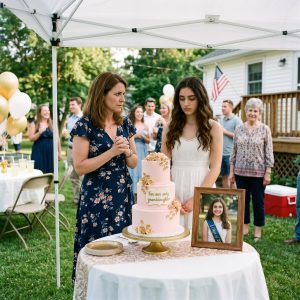
When we arrived, it was for my niece, who just finished 8th grade. The cake said, “For our only granddaughter.”
I didn’t yell. I did this. Three days later, they got a letter and started screaming.
Let me tell you about the last time I trusted my parents with anything that mattered. Actually, scratch that. Let me tell you about the last time I trusted them at all.
Because this wasn’t just another family slight. It wasn’t about forgetting a birthday or mispronouncing a name or calling my daughter by the dog’s name for the tenth time in a row.
No.
This was next level.
This was betrayal baked into buttercream and served on a folding table next to shrimp skewers and lies.
It started innocently enough. My mother called me on a Tuesday afternoon, light, casual tone. The kind she uses when she’s about to say something that’s going to ruin my day, but wants me to think it’s sweet.
“We were thinking of throwing a graduation party,” she said. “For our granddaughter.”
Just like that.
Our granddaughter.
I was loading groceries into the trunk and nearly dropped a bag of rice.
“Oh, yes,” she said. “Something small. Just family. We’d love to host.”
That was it.
I said, “Thank you.”
She sounded sincere. The kind of sincere that makes your shoulders drop just a little. The kind that makes you believe, against all better judgment, that maybe this time will be different.
I didn’t even think twice about who she meant.
My daughter Mia had just graduated high school. Valedictorian, thank you very much. After four years of sleepless nights, group projects with kids who didn’t do anything, and pushing through things no kid should ever have to deal with, she made it.
And now, finally, maybe my parents saw her the way I did.
I told Mia about it that night.
Her eyes lit up.
“Grandma and Grandpa?”
“Yep.”
She blinked. “Really?”
I nodded.
She didn’t say anything else, but I could tell.
That little spark of finally.
Like after years of showing up, being helpful, being good, someone had noticed.
If I could go back in time, I’d tell both of us not to get our hopes up.
The day of the party was hot. Not summer hot. Sticky-back-of-the-knees hot.
My husband Marcus couldn’t find the good shoes. Mia kept changing her earrings. I was sweating before we even got in the car.
The closer we got to my parents’ neighborhood, the quieter we all got.
“Remember,” I told them. “This is a nice thing. Let’s just smile and say thank you.”
I said that like a fool.
We turned the corner onto their street, and I nearly drove past the house.
At first glance, it didn’t look like a party. It looked like a small wedding.
White canopy tent in the yard. Dozens of folding chairs, streamers, gold tablecloths, even those little personalized signs stuck into the grass.
I felt my throat tighten.
“They really went all out,” Marcus said low.
Mia leaned forward. “Wow.”
We parked and got out. The second we stepped onto the lawn, we were in the middle of a crowd.
Hugs, air kisses, plastic cups of lemonade shoved into our hands. People I hadn’t seen since childhood. Family friends, cousins, my uncle’s ex-wife.
How did she get invited?
Then I saw the girl front and center, curls done, sash across her chest, glittery dress, practically glowing.
And I still, I swear, I still didn’t see it.
I just thought she was excited for Mia.
I smiled at her, waved.
Then I saw the cake.
Three tiers, pastel pink frosting, gold piping, a little edible graduation cap on top, and written across the front in careful cursive.
Congratulations to our only granddaughter, class of 2025.
I froze.
Only.
I blinked, rereading it.
That couldn’t be right.
There are two granddaughters. Mia and Kaye. Two.
Then I saw the banner. The colors, the logo from the middle school, and the framed photo next to the cake. Kaye holding a rolled-up certificate, wearing a sparkly white dress and a tiara like she just won a pageant.
It hit me all at once.
This wasn’t a party for Mia.
It never was.
Behind me, Mia was silent. Not frozen, not panicking, just still.
I looked at Marcus. He looked back at me.
No one spoke.
We stepped into the party like ghosts.
No one noticed anything.
Not yet.
People smiled, said things like, “You must be so proud.” And, “What a beautiful day.”
A few guests gave me confused looks when they realized Mia wasn’t wearing the sash. A few gave me those quiet, polite smiles people use when they’re not sure if they’ve made a mistake, or you have.
And then the gift table.
One by one, guests handed over wrapped boxes and cards. There were bows, envelopes, handmade signs, a personalized tumbler.
We brought nothing.
Why would we?
We thought this was for Mia.
A woman I barely knew gave me a strange look. Another whispered something and glanced at Mia. One cousin actually tilted her head and mouthed, “Where’s the gift?”
I wanted to sink into the lawn.
Then Heather stood up, glass of champagne in hand.
“Let’s all take a moment to celebrate our girl. She’s worked so hard. We couldn’t be more proud. Middle school is a huge milestone, and she’s handled it with grace, beauty, and intelligence.”
Cheers, laughter, applause.
Mia just stood there, not crying, not moving, just watching.
I waited until the toast ended, until people sat down, until the crowd thinned around the cake table.
Then I found my mother near the cooler, scooping ice.
“The cake says only granddaughter,” I said.
She smiled, distracted. “Oh, probably a mistake at the bakery.”
I didn’t move.
She shrugged. “Besides, Mia’s older. She’s not a child anymore. This was more of a milestone.”
I stared at her.
She went back to the cups.
Then my dad walked up holding a paper plate.
“Wait, did Mia graduate, too?”
I said nothing.
He blinked. “From what?”
I blinked back.
“High school.”
He laughed. “Oh, right. That’s right.”
I looked at my mother.
She didn’t say anything. She just smiled and turned back toward the buffet table.
We left.
No one stopped us. No one followed. No one even noticed, which somehow made it worse.
Mia got into the back seat and looked out the window.
I started the car.
Marcus sat in silence.
And as we pulled out of the driveway, I said, “We’re not doing this again.”
What we did next, let’s just say, three days later, they got a letter, and this time they were the ones left speechless.
There are things I didn’t notice when I was a kid. And there are things I did notice but talked myself out of.
That’s what growing up in a family like mine teaches you. How to gaslight yourself before anyone else gets the chance.
It wasn’t until the cake, the cake, that I looked back and realized, oh, this wasn’t just an oversight. This wasn’t a bakery typo.
This was the punchline to a joke they’ve been telling behind our backs for years.
And the joke was us.
I’ve always been described as easy. Not in the scandalous way, in the manageable-child kind of way.
I didn’t cry at bedtime. I organized my own lunchbox. I said thank you too often and wanted too little, which meant my parents treated me like furniture they liked having around but didn’t need to maintain.
My older brother was the thinker. My younger sister Heather was the little sparkle.
I was just there.
Middle child, middle of the road, middle of the conversation if I was lucky.
I didn’t realize it was odd that my mom would tell stories at dinner about my siblings’ spelling bee wins or school plays while I was sitting right there, having apparently attended none of my own life.
It’s not that they hated me.
It’s worse than that.
They didn’t notice me.
And you can survive that. But it leaves a bruise you don’t see until later.
The house they live in now, the scene of the cake, used to belong to my grandmother.
When she died, she left it to my mom, my brother, and me. I was four. Heather wasn’t born yet.
The first time my mom mentioned my name being on the deed, I laughed.
“You’re joking, right?”
She waved it off.
“You’re technically a co-owner. Just ignore that. It’s not a real thing.”
Right.
Just a legal share in a house they’ve lived in for decades. Silly of me.
But I did what I always did.
Smoothed it over.
Because that’s what I was trained to do.
When I had Mia, I expected something soft to unlock in them. I thought my mom would lean in and say, “You were like this once.” Or that my dad would cry holding her.
They did neither.
They said she was cute. They brought a bib. Then they asked how many hours of maternity leave I had left.
That should have been the giveaway, but you don’t want to see it when it’s your kid.
You want to believe they’ll come around.
They didn’t.
Mia didn’t have doting grandparents. She had people who sent birthday cards with $20 in them and forgot which grade she was in.
No sleepovers. No photo frames on the mantle. Just the occasional polite, “Tell us how school’s going, sweetheart,” while scrolling through their phones.
It wasn’t mean.
It was nothing.
And sometimes nothing hurts more than cruelty.
At least cruelty notices you.
Meanwhile, when Heather had Kaye four years later, there were balloons, hand-knitted sweaters, a silver rattle engraved with her initials.
Who gets that?
My dad learned how to use a photo printer. My mom joined a Facebook group for cool modern nanas.
They suddenly had time.
They suddenly had opinions.
They suddenly had an identity.
Grandparents, capital G.
For Mia, they were just older adults who shared a table with us twice a month.
We went to every dinner. We smiled. We brought food. We listened to long updates about Kaye’s piano recital and tooth fairy visits.
Mia even complimented her artwork, which was usually a few streaks of purple crayon and a triangle claiming to be a dolphin.
I think Mia knew what was happening, but she was trying.
She really, honestly was.
She’d offered to help clean up, set the table, laugh at Grandpa’s awful jokes. She showed them how to use the TV remote, how to send an email, how to save a contact in their phone.
I watched her type things in gently, like someone hoping good behavior might earn her something.
Not money, not gifts, just love.
Her other grandparents, my in-laws, live in Europe. She gets to see them maybe once a year, if that. So for her, this wasn’t just about Sunday dinners.
It was about having grandparents at all.
She wanted what other kids had. People who told embarrassing baby stories, pinched her cheeks, mailed her weird souvenirs from Florida.
She wanted to be a good granddaughter.
And she was.
But it didn’t work.
Not really.
They liked her. They appreciated her in the same way you appreciate a neighbor who brings your trash cans in.
Kind. Helpful. Forgettable.
Senior year, she worked her tail off.
Top of her class. Debate wins, volunteer hours. She did it all.
And I could see it in her, this growing hope that maybe the success would tip the scales.
She never said it out loud.
She didn’t need to.
She’d casually mention things like, “I think Grandpa likes history, too, right? I got full marks on that project.”
Or, “I wonder if Grandma saw the photo you posted.”
She wasn’t asking for a parade.
Just a nod.
A sign that she mattered to them beyond showing up and being useful.
I told them about her graduation weeks in advance.
Sent them the details twice.
They didn’t RSVP.
Three days before the ceremony, I got a text from my mom.
Sorry, not feeling 100%. Might sit this one out.
Sit this one out like it was a neighborhood barbecue.
Like it wasn’t the culmination of 18 years of work.
Mia didn’t say anything when I told her.
She just tied her shoes and asked if her speech sounded okay.
That was the worst part.
Not the silence.
The normalcy.
So when my parents called and said they wanted to throw a graduation party for our granddaughter, I didn’t hesitate. I didn’t overthink it. I didn’t ask.
Of course, I thought they meant Mia.
Who else could they mean?
They said our granddaughter.
And for once in my life, I let myself believe they meant us.
I told Mia.
She lit up.
It was quiet, that kind of smile. But I saw it.
That small flicker of maybe they’re trying.
She didn’t ask questions. She just nodded and said, “Okay.”
She picked out a dress. She even offered to bring one of her favorite teachers to say a few words.
She was nervous and excited and scared in that hopeful way that only teenagers are when they still think things can be different.
And honestly, so did I.
We were wrong.
I never thought I’d be the kind of person to send a letter like that.
Not a handwritten note. Not a Christmas card with best wishes scribbled in fake gold ink.
I mean, a letter letter.
One that makes people stop breathing for a second when they open it.
One you don’t respond to with words.
You respond with rage.
I didn’t even write it myself. Marcus did. He drafted it like it was nothing.
Calm, polite, lethal.
A surgeon’s cut.
I signed it without blinking.
Because I wasn’t doing this for me.
I was doing it for my daughter.
It didn’t feel triumphant. Not at first, just strange. Quiet, almost clinical.
We printed two copies, one for our records, one to drop off.
I didn’t mail it.
I delivered it by hand, folded once, tucked into a plain white envelope.
No return address, no note, just the words.
I intend to sell my one-third share of the property located at…
Clean, legal, non-negotiable.
They could theoretically buy me out, get a loan, scrape together their pension checks, and do whatever it is people do when they’re faced with the consequences of a decades-long power imbalance.
But I knew they wouldn’t, and I knew that wasn’t the point.
The point was they don’t get to own me anymore.
Heather called first.
I picked up because I wanted to hear how it would start.
“She opened it in front of Kaye,” she said, like that was the greatest crime committed all year.
I didn’t answer.
The story continues — don’t miss what happens next