“Mom screamed. Laura, like full volume. She nearly dropped her tea.”
“Should I apologize to the tea?”
Heather didn’t laugh.
She was sobbing.
“I thought someone died at first.”
“Did she read it out loud?” I asked.
“Yes. She said you’re trying to sell the house. Our house.”
“Correction,” I said. “A third of the house.”
“She was shaking.”
“She should hydrate.”
Heather made a strangled noise like she was deciding whether to hang up or scream.
“You’re destroying her,” she said finally.
“No,” I replied. “She did that to herself. I’m just making it official.”
Click.
Three hours later, my mom called.
Caller ID, no message, just persistence.
I picked up on the third ring.
“I’m going to pretend I misread that letter,” she said calmly, “and you’re going to tell me it was a mistake.”
I let the silence stretch.
Then I said, “It wasn’t.”
She sucked in a breath like the letter was one thing, but this, this confirmation, was somehow worse.
“You’re really going to sell your share of the house?”
“Yes.”
“Our home.”
“No,” I said. “My share of Grandma’s home.”
“You don’t even live there.”
“You don’t pay the taxes on it alone either.”
My mom was quiet for a moment.
Then, “This is vindictive.”
“No,” I said. “This is overdue.”
“You’re doing this because of that stupid party.”
“I’m doing this because my daughter’s future shouldn’t be tied to a house full of framed photos of someone else’s kid.”
She laughed, sharp and bitter.
“Oh, so it’s about Mia now.”
“Everything I do is about Mia.”
“You’re going to make us homeless.”
“No. You can buy me out. You can take a mortgage, sell your car, call Heather. You’ve got options.”
She didn’t respond to that.
She just said, “You want to be careful. You don’t want to burn every bridge.”
I smiled.
“Pretty sure you took care of that with a cake and a banner.”
And then I hung up.
That evening, Marcus found me sitting at the kitchen table, staring at a scratch in the wood I’d never noticed before.
He didn’t ask questions, just handed me tea.
“Do you feel guilty?” he asked finally.
“No,” I said. “I feel like I should. But I don’t.”
He nodded.
We sat like that for a while.
Then I said, “I’ve always made excuses for them. I know. Even after the party, I know. I think I thought they’d come around eventually.”
He looked at me over the rim of his mug.
“You don’t believe that anymore?”
I shook my head.
“They knew she got in. They knew we were scrambling to figure out how to pay for it. And they spent all that time celebrating someone else’s kid’s middle school certificate like it was a PhD.”
Marcus didn’t answer.
He didn’t need to.
The next few days were quiet in that way that feels more like a loaded gun than peace.
I stopped answering their calls, stopped running errands, no more filling prescriptions, no more checking their voicemail, no more “Can you help me log in?” texts.
Mia stopped, too.
She didn’t say anything dramatic.
She just opted out.
No more text support, no more Kaye birthday videos, no more late-night “Can you look at this email real quick?” requests.
She just quietly stepped back.
I asked her once how she felt.
She said, “Like I deleted a virus I didn’t know was running.”
Then four days later, Heather tried again.
“You don’t even know what you’ve done to Mom,” she said. “She’s walking around the house like a ghost.”
“I thought she was already doing that.”
“She keeps rereading the letter like it’s a death notice.”
“Maybe it is. For the version of herself that thought she’d get away with it forever.”
“She’s not eating.”
“She’s not listening either.”
Heather sighed.
“It’s not too late to fix this.”
“It is.”
“Just call her.”
“No.”
“Just talk to her, Laura.”
“I did. I sent a letter.”
And then I hung up again.
That night, Mia came into the kitchen as I was drying dishes.
She leaned against the counter, arms crossed.
“You ever feel like the bad guy?” she asked.
I paused.
“Yeah, all the time. Why?”
She smiled faintly.
“Just making sure I wasn’t the only one.”
I smiled back.
Then she said, “Do you think they’ll ever get it?”
“No,” I said. “But that’s not the point.”
“What is?”
“We don’t owe them understanding. Just boundaries.”
She nodded once, and we left it at that.
I thought the cake was the low point.
You know the one.
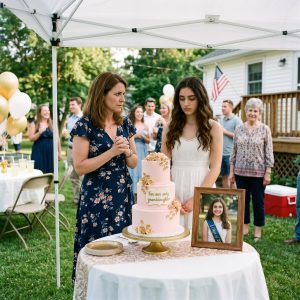
Congratulations to our only granddaughter in swirly pink frosting piped with such deliberate cruelty.
I’m surprised the bakery didn’t file a warning report.
But apparently, I was wrong.
Apparently, there are worse things than being erased from your own daughter’s graduation party.
Like finding out the same people who raised you tried to take away her entire future.
It started two weeks after the letter.
The letter Marcus helped me write. The one that said in lawyer-perfect language, “I’m selling my share of the house.”
No threats, no yelling, just facts.
Two weeks later, Mia walked in from dance class with that face. The one that looks normal if you don’t know her.
Shoulders straight, voice calm.
But I know better.
She told me what happened.
“They were waiting for me,” she said. “On the sidewalk.”
I blinked.
“Your grandparents?”
She nodded.
Apparently, they showed up outside her dance studio like two friendly ghosts, waved her over, acted like they just happened to be out on a walk.
They hadn’t shown that much interest in her hobbies in 18 years, but sure, now they’re coordinating with her class schedule.
She said they were nice at first. Too nice. Like stage actors doing dinner theater.
Then came the script.
“You’re really going to let your mom do this to us?”
“She’s making us homeless, sweetie. Talk to her. You’re the only one she listens to.”
I asked how she responded.
Mia shrugged.
“I told them no.”
No drama, no screaming, just no.
That’s when my mother looked her dead in the eye and said, “Fine. But choices have consequences.”
Mia turned and walked away.
I didn’t.
I stood in the kitchen for a while after she left, staring out the window like maybe the trees could tell me how not to scream into the wind.
Because here’s the thing. I expected guilt trips. I expected manipulation.
But dragging Mia into it, ambushing her near a dance class, making her the one who has to tell me to back off, that was new.
That was deliberate.
And I hadn’t even seen the worst of it yet.
Another two weeks passed.
We were finally breathing again, talking about dorm furniture, meal plans, the good kind of stress.
And then the letter arrived.
Big envelope, university logo.
Mia thought it was her housing packet. She opened it at the kitchen counter while I was rinsing a bowl.
I heard her breath catch.
Then she handed it to me.
It wasn’t housing.
It was a notice from the admissions office.
Her enrollment was under review.
An anonymous report had been submitted alleging omissions, inconsistencies, undisclosed legal entanglements.
The phrasing was so sterile it made me cold, like reading the autopsy of something that hadn’t died yet.
Mia didn’t speak.
Marcus took the letter. Read it once, twice, and then looked at me like someone had just kicked the front door open and lit a match.
I sat down hard.
It took me a full minute to process what I was seeing.
Not because I didn’t understand it.
Because I did.
This wasn’t petty.
This wasn’t family politics.
This was an attack.
And not on me.
On her.
I got in the car, didn’t even tell Marcus.
Just grabbed my coat and keys and drove straight across town.
I wasn’t afraid of what I’d say.
I was afraid of what I wouldn’t.
My father opened the door like he’d been watching through the blinds.
My mother appeared behind him, not surprised, just smug.
I didn’t say hello.
“Did you report Mia to the university?”
No blinking, no confusion, no what are you talking about?
Just stillness.
And then my mother said, “You think you can do what you did and not face consequences?”
I stepped inside.
“You tried to destroy her life.”
“She shouldn’t be there,” my mother said. “That school wasn’t meant for her.”
“She got in on her own.”
“You dragged your drama into it. What did you expect?”
“I expected you to be angry. I did not expect you to sabotage a child’s future just to get even.”
“She’s not a child. She’s part of this.”
I stared at her, and something inside me snapped.
Not in rage, not in tears, just a clean break like bone pulled from bone.
“You’re not just bad grandparents,” I said quietly. “You’re dangerous people.”
And then I turned around and walked out.
They didn’t see me hit record before I rang the doorbell.
That night, I posted three things to the family group chat.
No intro, no preamble, just a photo of the cake, a screenshot of the university letter, and an audio clip of my mother saying that school wasn’t meant for her.
Then I turned off my phone and made dinner.
The fallout was immediate.
Within an hour, the chat lit up like a Christmas tree on fire.
Cousins I hadn’t heard from in years chimed in with, “Wait, what?” And, “Is this real?”
One aunt texted me privately.
I had no idea. I’m so sorry.
Three people left the group silently.
Heather eventually jumped in with, “This is being blown out of proportion.”
No one answered her, not even Kaye.
Mia read it all, calm, methodical, like she was collecting evidence for something bigger than revenge.
When she reached the end, she looked at me and said, “I don’t think I ever want to see them again.”
I nodded.
She went back to her room like she’d just finished cleaning up someone else’s mess.
And in a way, she had.
A few days later, my phone rang.
It was my brother.
We hadn’t spoken since the party.
“They called me,” he said.
I didn’t respond.
“They want help buying you out. Said they’re desperate.”
Still, I stayed quiet.
Then he added, “I told them no. In fact, I want to sell my third, too.”
I felt something in my chest unclench.
“For Mia,” he said simply. “This crossed a line.”
That evening, Mia and I sat on the back porch.
The sun was just low enough to feel forgiving.
She stirred her tea with a spoon she’d bent accidentally months ago and never replaced.
Then she asked, “If they apologized, would you forgive them?”
I thought about it.
Really thought about it.
“No,” I said. “Not for this.”
She nodded.
“Good.”
Fast forward one year, the house sold.
Not quickly, but clean. Solid price.
My third covered everything Mia needed. Tuition, housing, the bills no one sees coming.
And there was money left after that. More than I expected.
We haven’t spoken to my parents since. No calls, no apologies, no weird letters slipped into the mailbox, nothing.
Far as I know, my brother hasn’t either.
He signed the paperwork, took his third, and ghosted.
Quietest exit I’ve ever seen him make.
Heather, still orbiting, but the glow’s gone.
I heard they had it out a few months back. She finally stopped defending what they tried to do to Mia. Said she needed space.
She got it.
My parents used their cut to buy a house, if you can call it that.
Tiny, rundown, far from town, bad street, worse neighbors, no mortgage. They couldn’t qualify, so they paid cash and settled for rot, leaks, and sirens at 2 a.m.
It’s theirs now.
Every cracked tile of it.
Mia, she’s steady, focused, sharp in all the right ways, and they’ll never get to take credit for a second of it.
But you tell me, did I go too far or not far enough?
Drop a comment and hit subscribe.
END!
If you came here from Facebook because of this story, please go back to the Facebook post, hit like, and comment exactly “Respect” to support the storyteller. That small action means more than it seems, especially for stories about standing up for family, and it helps motivate the writer to keep bringing more stories like this to readers.