The first thing I remember is the sound of the front door closing.
Not slamming.
Just clicking shut, neat and ordinary, like the kind of sound that belongs at the beginning of a normal afternoon.
My son Michael had kissed the top of his two-month-old baby’s head, told me they would not be long, and followed Sarah out to the driveway.
Their SUV backed out slowly past the mailbox, brake lights flashing red against the pale winter sun.
I stood in the living room with my grandson tucked against my shoulder and watched them go.
The house had that newborn smell to it.
Baby lotion.
Warm milk.
Laundry detergent.
A faint sourness from burp cloths that no amount of washing ever quite removes.
The dryer thumped from the laundry room, and a little American flag by the porch window tapped gently against the glass whenever the wind pushed through the front yard.
I told myself everything was fine.
Michael and Sarah were exhausted new parents.
They needed a break.
They needed groceries, diapers, a little time to walk through a store like ordinary adults instead of two people trapped in a cycle of bottles, burps, and two-hour stretches of sleep.
I had raised three children.
I could handle one afternoon with one tiny baby.
For the first few minutes, he slept.
His cheek rested against my sweater, warm and impossibly soft.
His fingers flexed once near my collarbone, then relaxed again.
I sat in the old recliner Michael had dragged from my house when Sarah was seven months pregnant because he said every nursery needed “one chair somebody already loved.”
That was Michael.
Practical.
Sentimental in ways he would deny if anyone teased him.
He had painted the nursery himself.
He had built the changing table from a box of parts and a set of instructions he pretended not to need.
He had called me three times that day, laughing and swearing under his breath, asking whether part C was supposed to face left or right.
Sarah had sat in the rocker with her swollen feet on a pillow, eating crackers and watching him make mistakes.
At the time, it had felt like the beginning of something good.
Not perfect.
No young family is perfect.
But good.
Then the baby woke up.
At first it was a little complaint, a thin sound rising from his throat.
I lifted him, patted his back, and whispered, “Grandma’s here.”
He cried harder.
I changed his position.
I checked his diaper.
I warmed the bottle Sarah had left in the fridge and tested it on the inside of my wrist.
It was perfect.
He would not take it.
His mouth opened, but instead of latching, he screamed.
The sound was not loud in the way grown-up loudness is loud.
It was worse because it was helpless.
A baby’s cry goes straight into the body of anyone who has ever cared for one.
You do not hear it only with your ears.
You feel it in your ribs.
I walked him through the living room.
I hummed.
I bounced gently.
I tried the old hallway trick, pacing from one end of the house to the other, because all my children had calmed down when their bodies felt movement.
He kept crying.
At 2:17 p.m., I checked the feeding notes Sarah had left beside the bassinet.
Last bottle: 1:05 p.m.
Four ounces.
Burped.
Nap after.
At 2:23, I changed his diaper again.
At 2:29, I took his temperature.
No fever.
At 2:34, I called Michael.
No answer.
I called Sarah.
Straight to voicemail.
I stood in the nursery, phone in one hand, baby in the other, and tried to swallow the first edge of fear.
Newborn parents miss calls.
Stores have bad reception.
People forget to turn the ringer back on.
Nothing about that had to mean anything.
Then my grandson’s body tightened.
His little knees pulled upward toward his stomach.
His face turned red, then almost purple with the effort of crying.
He made a sound that changed the temperature of the room.
That was when the old knowledge came back.
Not panic.
Knowledge.
Care has a sound.
So does danger.
A mother learns both, and a grandmother never really forgets.
I carried him to the changing table.
The nursery lamp was on, spreading a soft yellow circle across the pale blue walls.
A stuffed bear sat in the corner of the crib.
A stack of tiny folded onesies rested in a basket, each one washed and rolled with the care new parents put into objects before exhaustion teaches them shortcuts.
I laid him down and kept one hand on his chest.
“It’s okay,” I whispered.
He screamed as if it was not okay at all.
I unsnapped the onesie.
The fabric was warm from his body.
His belly rose and fell too fast under my fingertips.
I lifted the edge of the cloth above his diaper.
Then I stopped breathing.
There was a mark on his stomach.
Dark.
Wide.
Ugly against that soft newborn skin.
For one second, my mind tried to make it into something else.
A shadow.
A diaper crease.
A smear from the blanket.
Anything but what it looked like.
But it was not a rash.
It was not a birthmark.
It was not the kind of faint little red line babies get when clothing presses too hard.
It looked like a bruise.
My hands began to shake.
I leaned closer, careful not to press.
The baby cried harder.
Something in me went still in a way I had not felt since my own children were small and one of them went quiet after a fall.
There is a kind of fear that runs around the room looking for someone to blame.
There is another kind that picks up the keys.
I picked up the keys.
But before I did, I took pictures.
At 2:41 p.m., I photographed the mark with my phone.
The first picture blurred because my thumb trembled.
I took another.
Then another.
I did not know whether I would need them.
I only knew that if I ever had to explain what I saw, I wanted the truth saved somewhere outside my own memory.
I wrapped him in the gray blanket from the crib.
I grabbed the diaper bag.
I forgot my coat.
The driveway gravel crunched under my shoes as I hurried to the car.
Across the street, Mr. Ellis was pulling his trash bin back from the curb like any other Thursday afternoon.
A delivery truck rolled past.
Somewhere a dog barked.
The whole neighborhood kept moving as if my grandson’s tiny body had not just turned my world upside down.
I buckled him into the car seat with hands that would not steady.
Then I drove.
I did not wait for Michael to call back.
I did not try one more bottle.
I did not tell myself I was being dramatic.
By the time I reached the hospital, my grandson had cried himself into ragged hiccups.
At the intake desk, I heard my own voice from far away.
“He’s two months old,” I said.
The woman behind the counter looked up.
“He won’t stop crying,” I said.
She reached for a form.
“I found a bruise on his stomach.”
Her hand stopped.
That was the first moment I understood how serious it sounded outside my own head.
Within minutes, a pediatric nurse took us back.
She was kind, but she was not casual.
She clipped a tiny pulse monitor around his foot.
She asked for the baby’s full name.
She asked who I was.
She asked when his parents had left, what time I noticed the crying, what time I found the mark, whether he had fallen, whether anyone else had watched him, whether he had any known medical conditions.
I answered every question.
I gave her times.
I showed her the photos.
I watched her enter “visible abdominal bruising” into the hospital intake form.
Those words changed the room.
Visible.
Abdominal.
Bruising.
A thing can be terrifying in the body.
It becomes official when someone types it into a chart.
The doctor arrived at 3:08 p.m.
He introduced himself, washed his hands, and spoke to the baby before touching him.
That small kindness nearly broke me.
He examined my grandson with a gentleness that made the whole scene feel worse, because every careful movement meant he was looking for something he hoped not to find.
When he touched near the mark, my grandson screamed.
The nurse’s face tightened.
She placed one hand lightly on my shoulder.
No one said the word abuse.
No one needed to.
It hung in the air anyway, heavy and poisonous.
By 3:22, blood work had been ordered.
By 3:31, imaging was being discussed.
By 3:44, I heard the nurse outside the curtain say they needed to document everything.
I sat in a plastic chair with my purse on my lap and my phone in my hand.
Michael had not called back.
Sarah had not called back.
The baby lay on the narrow exam bed, exhausted, making tiny broken sounds between breaths.
I wanted to hold him.
I also did not want to move him.
That is what fear does to love.
It makes every choice feel dangerous.
At 3:52, Michael finally called.
“Mom?” he said.
His voice was distracted, maybe annoyed.
“We’re checking out now. Is everything okay?”
I looked at the baby’s wristband.
I looked at the curtain.
I looked at the nurse writing something on the clipboard.
“No,” I said.
The word came out flat.
“You need to come to the hospital.”
There was a pause.
Then Sarah’s voice rose in the background.
“Hospital? What do you mean hospital?”
I told them what I had found.
I told them he would not stop crying.
I told them the doctor was examining him.
I expected fear.
I expected Michael to say he was on his way before I finished speaking.
He did say it eventually.
But Sarah spoke first.
“You took him without calling us?”
The nurse looked up.
Something cold moved through my chest.
“Sarah,” I said, “he has a bruise on his stomach.”
“He didn’t have a bruise this morning,” Michael said quickly.
His voice cracked on the word bruise.
“I have pictures,” I said.
There was another silence.
Then Michael said, “We’re coming.”
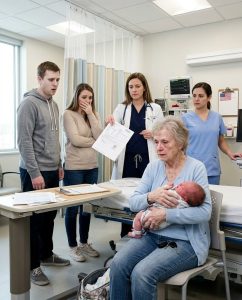
They arrived at 4:16 p.m.
Michael came through the ER doors first, pale and breathless, gray hoodie half-zipped, one shoelace untied.
Sarah was right behind him.
Her face was tight with anger before it softened into fear.
She pushed into the exam space and reached toward the baby.
“Give him to me.”
The nurse stepped between them.
It was not dramatic.
It was worse than dramatic.
It was professional.
“We need to finish the exam first,” she said.
Sarah stared at her.
“I’m his mother.”
“And right now,” the nurse said, “he is our patient.”
Michael looked at me like he did not know whether to be grateful or furious.
I could not blame him.
No parent walks into that room ready to understand it.
No grandmother does either.
The doctor came back with a clipboard.
Sarah crossed her arms.
“This is ridiculous,” she said.
Her voice was shaking under the anger.
“Babies bruise. He probably bumped himself.”
The doctor did not argue.
That frightened me more.
“Two-month-old babies do not usually bruise themselves in that location,” he said.
Michael closed his eyes.
Sarah’s mouth opened, then shut.
The doctor explained what they needed to do next.
The story continues — don’t miss what happens next