He said they needed to ask questions.
He said they needed to review history.
He said they needed to understand whether this was injury, illness, or something else.
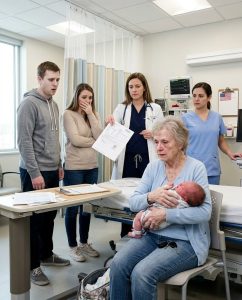
Those words mattered.
Injury.
Illness.
Something else.
Then a nurse stepped in carrying a printed lab sheet.
She handed it to the doctor without speaking.
He read it.
His face changed.
The whole room seemed to hold its breath.
He read the first line again.
“What is it?” Michael asked.
The doctor looked at the nurse.
“What time was the blood sample drawn?”
“3:28 p.m.,” she said.
“Documented under pediatric intake.”
Sarah’s arms dropped.
Michael took half a step toward the bed.
“Is he hurt?” he asked.
The doctor’s expression stayed serious.
“He is in pain,” he said.
Michael flinched.
“And the bruise is real,” the doctor continued.
Sarah whispered, “But?”
“But this blood work is showing something we have to take seriously before anyone jumps to conclusions.”
That sentence shifted the room in a way I had not expected.
It did not erase the fear.
It redirected it.
The nurse then brought in the diaper bag.
At first, I did not understand why.
She explained that she had checked it for feeding notes, medication cards, and discharge instructions from the birth hospital.
In the side pocket, tucked behind a pack of wipes, she had found a folded paper.
Sarah saw it before the rest of us did.
Her face collapsed.
Not in guilt exactly.
In recognition.
The doctor unfolded it.
It was a discharge paper from the hospital where the baby had been born.
A yellow sticky note was still attached to the top corner.
One line had been circled in black ink.
Follow-up required.
Michael stared at it.
“What is that?” he asked.
Sarah sat down hard in the visitor chair.
The legs scraped the floor.
“I forgot,” she whispered.
Michael turned to her slowly.
“What did you forget?”
Her eyes filled.
“They said we needed to call after the blood spot test,” she said.
Her voice broke.
“I thought it was routine. I thought if it was urgent, they would call again.”
The doctor lowered the paper.
“Newborn screening follow-ups are never something to ignore,” he said gently, but there was steel under the gentleness.
Sarah put both hands over her mouth.
Michael looked as if someone had struck him.
The doctor explained it in careful language.
He said the lab work suggested a possible bleeding disorder.
He said some infants can bruise more easily or bleed internally when their blood does not clot the way it should.
He said the mark still had to be fully evaluated, but the blood results made the missed follow-up extremely important.
Then he said the words that made Sarah sob.
“This may not be caused by someone hurting him,” he said.
Michael grabbed the edge of the counter.
The doctor did not let relief arrive too soon.
“But it is still serious,” he continued.
“We need imaging. We need additional labs. We need to contact the pediatrician and the birth hospital records department. And because there is bruising in a non-mobile infant, we are required to document and report the concern while we investigate.”
The room went quiet.
Sarah cried into her hands.
Michael stood frozen.
I sat there holding my own breath, feeling horror and relief twist together until I could not separate them.
No one had an easy way out.
That was the truth.
If someone had hurt the baby, our family would never be the same.
If no one had hurt him, our family would still never be the same, because something had been missed that should never have been missed.
The nurse prepared him for imaging.
Michael asked if he could touch his son.
This time, the nurse nodded.
He stepped to the bed and laid one finger against the baby’s tiny hand.
The baby’s fingers curled around him.
Michael broke.
He bent over the bed and cried without sound.
Sarah tried to stand, but her knees failed her.
The nurse helped her back into the chair.
“I didn’t know,” Sarah said.
No one answered right away.
Because sometimes “I didn’t know” is true.
Sometimes it is also not enough.
The next hours blurred into forms, tests, phone calls, and waiting.
A hospital social worker came in.
She introduced herself plainly.
She asked questions plainly.
She wrote down answers plainly.
That plainness was almost merciful.
Michael gave his timeline.
Sarah gave hers.
I gave mine again.
At 5:37 p.m., the pediatrician on call returned the hospital’s message.
At 6:12 p.m., records from the birth hospital confirmed that the newborn screening office had flagged a follow-up and mailed a notice.
At 6:40 p.m., Michael found the unopened envelope in a stack of mail on their kitchen counter because the social worker asked him to check while Sarah stayed at the hospital.
He sent a photo of it.
The envelope had been under a grocery flyer, a utility bill, and a coupon packet.
That image hurt me more than I expected.
Not because it proved malice.
Because it proved how easily disaster can hide under ordinary paper.
By nightfall, the doctors had a working answer.
The bruise was real.
The pain was real.
The danger was real.
But the first evidence pointed toward a medical problem that had gone unaddressed, not a simple story of one cruel hand.
That did not make everyone innocent of everything.
It made the truth more complicated.
Michael came back from the house with the envelope still in his hand.
He looked older than he had that morning.
He did not yell at Sarah.
He did not yell at me.
He stood beside the exam bed and whispered, “How did we miss this?”
Sarah kept crying.
“I was so tired,” she said.
Michael closed his eyes.
“So was I.”
That was the first honest thing either of them had said to each other in that room.
The baby was admitted for monitoring.
The hospital staff treated him.
They kept documenting.
They kept asking questions.
They kept explaining what they knew and what they did not know yet.
I stayed until a nurse told me I needed to eat something.
I bought a paper cup of coffee from the vending area and could not drink it.
The hospital waiting room was too bright.
The chairs were too hard.
A television played silently in the corner, showing weather maps no one watched.
Michael came out just after 9 p.m.
He sat beside me.
For a long time, he said nothing.
Then he took my hand.
“Thank you for bringing him,” he said.
His voice was rough.
I squeezed his fingers.
“I wish I had been wrong.”
He nodded.
“So do I.”
Sarah came out later.
Her eyes were swollen.
She looked at me like she wanted to apologize and defend herself at the same time.
In the end, she did neither.
She said, “I was mad at you.”
“I know.”
“I thought you were accusing me.”
“I was afraid,” I said.
She nodded, tears slipping down again.
“So was I.”
It took weeks for the full medical picture to settle.
There were more appointments.
More blood draws.
More instructions printed in careful black-and-white language.
There were calls from offices with names I had never wanted to know.
There were notes in charts, follow-up plans, and a new folder Michael kept on the kitchen counter labeled with the baby’s name.
He did not hide paperwork under mail anymore.
Sarah set alarms for every appointment.
Michael made copies of every document.
They learned the language of symptoms, bruising, clotting, monitoring, and emergency care.
They also learned something harder.
Love is not proved by saying you meant well.
Love is proved by what you do after you realize meaning well was not enough.
For a while, the family felt cracked.
Michael struggled with anger.
Sarah struggled with shame.
I struggled with the memory of that mark and the terrible thoughts I had allowed myself to think about my own son.
None of us came out clean.
But the baby got care.
That is the sentence I return to whenever guilt tries to rewrite the story.
The baby got care.
He grew.
Slowly, cautiously, with more appointments than any infant should need, but he grew.
The crying changed.
The house changed too.
The discharge papers were taped inside a cabinet now.
The pediatrician’s number was written on the fridge.
A small notebook stayed beside the bassinet, not because Sarah wanted to look perfect anymore, but because she understood that tired brains need systems.
Michael apologized to me one Sunday morning while fixing the loose hinge on my back door.
He did not make a speech.
He just stopped with the screwdriver in his hand and said, “I hated you for about ten minutes that day.”
“I know,” I said.
“Then I hated myself for needing you to be the one who noticed.”
That hurt because it was honest.
I told him the truth.
“I didn’t notice because I’m better than you. I noticed because I was the one holding him at the worst moment.”
He nodded.
Then he went back to fixing the hinge.
That is how our family healed.
Not all at once.
Not through one big forgiveness scene.
Through appointment reminders.
Through printed lab results.
Through Michael learning to ask questions twice.
Through Sarah crying in the car after checkups and still going to the next one.
Through me holding my grandson while his parents learned that love is not a feeling you can rely on when exhaustion gets dangerous.
It is a practice.
It is a system.
It is a hand on a car seat buckle at 2:43 p.m. when everything in you wants to believe you are overreacting.
The last time I watched him alone, he was almost eight months old.
He sat on a quilt in my living room, chewing the corner of a soft block and laughing at nothing.
The same little American flag tapped against the porch window.
The dryer thumped from the laundry room.
His bottle sat warm on the counter.
For a second, the ordinary sounds of the house brought me right back to that afternoon.
Then he looked up at me with milk on his chin and smiled.
I picked him up carefully.
I always pick him up carefully.
And I thought again about the moment I lifted his clothes and froze.
That mark had looked like the beginning of one kind of nightmare.
It became the beginning of another.
But it was also the beginning of him being saved.
The bruise was only the beginning of what had been hiding under my grandson’s clothes.
What came after taught all of us that sometimes the scariest truth is not that someone meant harm.
Sometimes it is that everyone meant love, and a baby still almost paid the price.
End!