“Please state your name and title for the record.”
For ten years, my name had been dragged through rooms I was not allowed to enter.
It had been lowered into whispers at church functions. Passed around at dinner tables with pitying looks. Used by my brother as a cautionary lesson about discipline and character. Repeated by my parents like a family wound they were too proud to bandage.
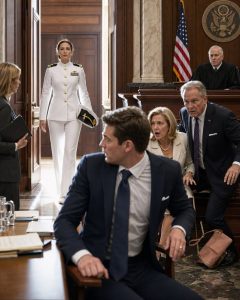
Lena Moore.
A failed daughter.
A disgrace.
A ghost.
But ghosts do not swear oaths in federal court.
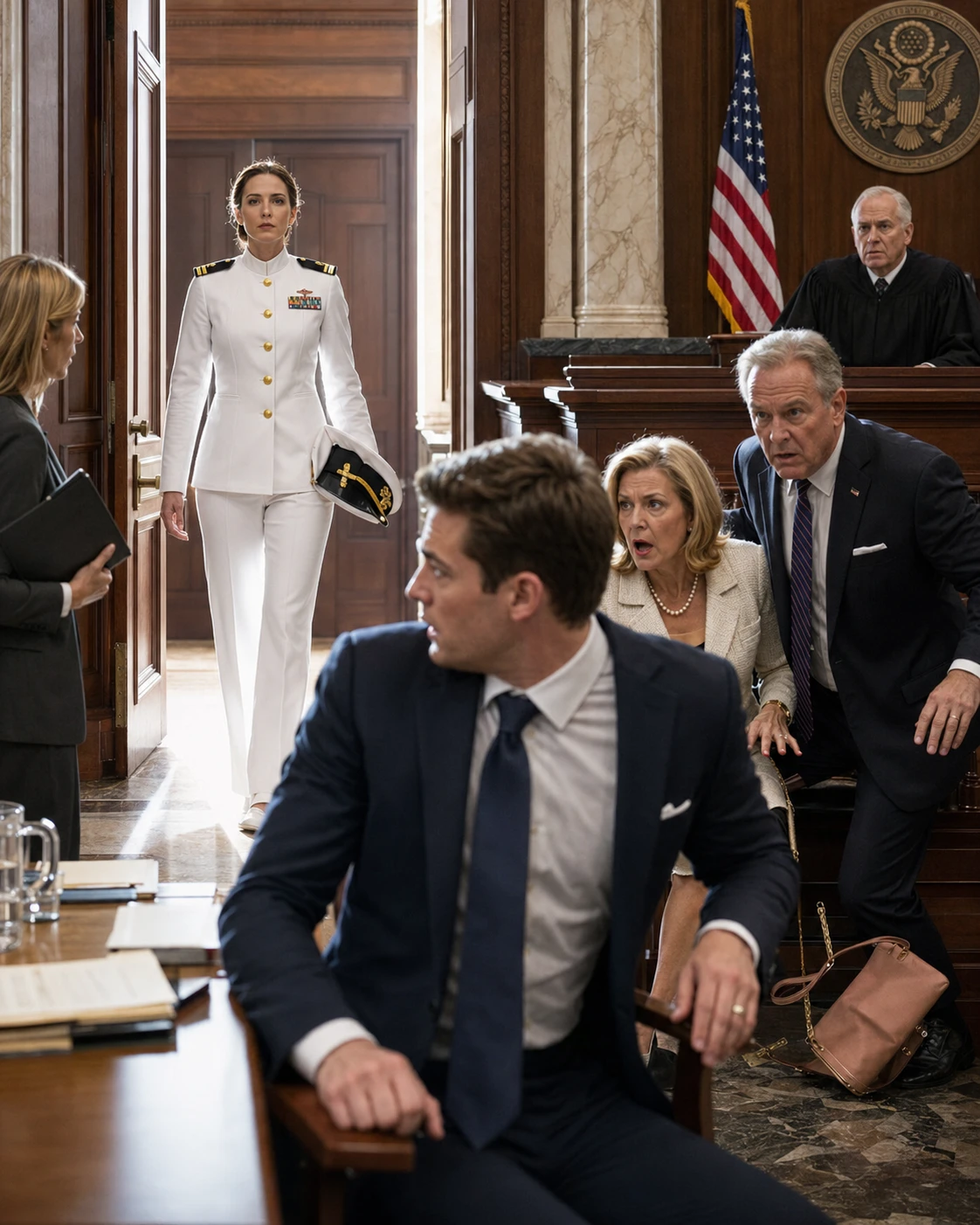
I stepped up to the witness stand, raised my right hand, and took the oath with a voice that did not tremble.
Then I sat, adjusted the white cuff of my ceremonial uniform, and looked straight ahead.
“My name is Commander Lena Elizabeth Moore, United States Navy.”
A sound moved through the courtroom.
Not a gasp exactly.
Something smaller.
Sharper.
Like the air itself had cracked.
My mother covered her mouth with both hands.
My father’s face turned the color of ash.
Grant did not move.
He stared at me as if I had walked out of a grave he personally dug and signed the death certificate for.
The prosecutor, Assistant United States Attorney Caleb Reeves, let the silence sit just long enough for every person in that room to feel its weight.
Then he approached the witness stand.
“Commander Moore, are you related to the defendant?”
“Yes.”
“How?”
“He is my older brother.”
Reeves nodded and turned slightly toward the jury.
“And are Warren and Judith Moore, seated behind the defendant, your parents?”
My throat tightened for the first time that morning.
Not from fear.
From memory.
“Yes.”
My mother flinched as if the word had struck her.
Reeves placed a file on the evidence monitor. A document appeared on the courtroom screen. It was familiar. I had seen it before in investigative packets, in briefing rooms, in the hands of federal agents who kept their voices gentle because they knew facts could cut deeper than accusations.
“Commander Moore,” Reeves said, “do you recognize this document?”
“Yes.”
“What is it?”
“A forged military separation document. It falsely states that I was discharged under dishonorable circumstances.”
“And is that document authentic?”
“No.”
“Did you ever receive a dishonorable discharge from the United States Navy?”
“No.”
“Did you ever fail out of training?”
“No.”
“Were you ever removed from service for misconduct?”
“No.”
Each answer landed like a hammer.
Simple.
Clean.
Undeniable.
Grant’s attorney, Martin Vale, sat stiffly at the defense table, one hand over his mouth, eyes narrowed in calculation. He had known I existed. Of course he had. But he had not expected this version of me. The version Grant described was supposed to be unstable, bitter, damaged beyond credibility.
He had prepared for a family scandal.
He had not prepared for a decorated officer.
Reeves clicked to the next exhibit.
A photograph appeared.
Me at twenty-three, standing on the deck of a ship beneath a hard white sun, face younger, eyes already older than they should have been.
“Is this you, Commander Moore?”
“Yes.”
“When was this taken?”
“During my second deployment.”
Another photo.
A promotion ceremony.
Another.
A commendation.
Another.
A formal portrait from a joint task force operation Grant had once claimed I had been too weak to complete.
The jury watched in silence.
Behind Grant, my mother began to cry.
Quietly at first.
Then with a broken little breath that made my chest ache despite everything.
I did not look at her.
Not yet.
Reeves turned back to me.
“Commander Moore, I want to discuss Harbor Shield Recovery. Before the federal investigation, had you ever heard of that company?”
“No.”
“When did you first become aware of it?”
“During a federal review of disaster recovery contracts. I was assigned to assist with verification of military service credentials connected to veteran-preference claims.”
“And what did you discover?”
I looked at Grant.
He had lowered his eyes.
That, more than anything, told me he understood.
The time for charm was over.
“I discovered that Harbor Shield Recovery had obtained government contracts by claiming veteran-owned status through service credentials belonging to me.”
Reeves let the sentence breathe.
“Did you authorize anyone to use your service record?”
“No.”
“Did you sign the veteran ownership certification for Harbor Shield Recovery?”
“No.”
“Did you benefit financially from Harbor Shield Recovery?”
“No.”
The prosecutor lifted another folder.
“Your Honor, the government offers Exhibit 42.”
The judge, a woman with silver hair and a voice as flat as stone, looked toward the defense.
“Objection?”
Vale stood.
“Your Honor, we maintain our continuing objection regarding foundation.”
“Noted. Overruled.”
The exhibit appeared.
My signature.
Or rather, what someone wanted the government to believe was my signature.
I stared at it on the screen.
It was close.
Almost graceful in its imitation.
But there was one thing Grant had never known.
One small detail.
When I was sixteen, I broke my right wrist falling from the old oak tree behind our house. After that, my handwriting changed. My L always leaned too far forward, like it was trying to outrun the rest of my name.
The forged signature did not.
Grant had copied my old school papers.
Not the woman I became afterward.
Reeves asked, “Is that your signature?”
“No.”
“How can you tell?”
I explained.
The broken wrist.
The changed handwriting.
The documents Grant could have accessed.
The federal handwriting expert who later confirmed the mismatch.
As I spoke, my father slowly sat back down.
Not because he was calm.
Because his legs had failed him.
For years he had trusted paper over his own daughter standing in front of him. Now paper was betraying him with the same coldness.
Reeves continued carefully, building the truth brick by brick.
The fake emails.
The false discharge papers.
The bank transfers.
The property guarantees.
The retirement accounts pledged as collateral for loans that funded Harbor Shield’s expansion.
Then came the part that made my mother lift her head.
“Commander Moore,” Reeves said, “were your parents aware that your identity and service credentials were being used?”
I felt every eye shift.
This was what they had come for.
This was the question that would decide whether Warren and Judith Moore were victims, accomplices, or something in between.
I could have destroyed them with anger.
There were days, years ago, when I wanted to.
Days when I stood alone in barracks showers and let hot water cover my face so no one would know I was crying. Days when birthdays passed with no call. When promotions were celebrated by strangers because my family had already buried me alive.
But revenge had a taste.
And truth had another.
I knew the difference now.
“I don’t believe they knew at first,” I said.
My mother sobbed once.
My father closed his eyes.
Grant turned sharply toward me, confused.
Reeves watched me carefully.
“At first?” he asked.
“Yes.”
“What changed?”
I took a slow breath.
“In 2018, I came home on leave. I had learned that false stories were being spread about my service. I brought official documentation with me. My father had forged documents on his desk, documents my brother had given him. I showed them my identification. My orders. My active service records.”
My voice tightened.
“And they chose not to believe me.”
The courtroom was utterly still.
Reeves softened his tone.
“What happened after that?”
“My brother told them I was unstable. He said I had stolen or fabricated my credentials. He said I was trying to ruin him because I was jealous. My father ordered me to leave. My mother asked whether I needed money.”
My mother bent forward as if physically struck.
I finally looked at her.
Her face had collapsed with grief, but grief is not the same as innocence.
For a moment, I saw her as she had been that night.
Standing in the hallway with one hand on the banister, her pearls still on from some charity dinner, looking at me like I was a stranger who had arrived with bad manners and inconvenient truths.
Then I saw her now.
Older.
Smaller.
Haunted by the knowledge that she had mistaken cruelty for loyalty.
Reeves asked, “After that visit, did anyone in your family contact you to verify your claims?”
“No.”
“Did anyone apologize?”
“No.”
“Did anyone inform authorities that there might be forged military documents connected to your name?”
“No.”
“Did Harbor Shield Recovery continue receiving contracts after that date?”
“Yes.”
“And did your parents continue supporting the defendant publicly?”
“Yes.”
Grant’s jaw clenched.
It was the smallest movement, but I caught it.
He hated that I was not screaming.
He hated that I had not arrived broken.
He had written a role for me.
I had refused to play it.
When Reeves finished his direct examination, the room seemed to exhale for the first time in nearly an hour.
Then Martin Vale stood.
His suit cost more than my first car. His smile was smooth and bloodless.
“Commander Moore,” he said, approaching with a folder in hand, “you’ve had a long and distinguished career, correct?”
“I’ve served for several years, yes.”
“Very admirable. Very impressive.”
I said nothing.
He tilted his head.
“But service does not make a person incapable of resentment, does it?”
“No.”
“And families are complicated.”
“Yes.”
“You and your brother had tension growing up, didn’t you?”
“We were different people.”
“That wasn’t my question.”
The judge looked over her glasses.
“Answer if you can, Commander.”
I met Vale’s eyes.
“Yes. We had tension.”
“Grant was successful in school, wasn’t he?”
“Yes.”
“Popular?”
“Yes.”
“Your parents were proud of him?”
“Yes.”
“And you resented that?”
“No.”
Vale smiled slightly.
“No?”
“I resented being lied about. That came later.”
A few jurors looked down, hiding reactions.
Vale’s smile thinned.
He changed direction.
“Commander Moore, isn’t it true that you cut off contact with your family?”
“Yes.”
“So for many years, you had no direct knowledge of what happened inside the Moore household.”
“That’s correct.”
“You do not know every conversation my client had with your parents.”
“No.”
“You do not know what your parents believed.”
“I know what they were shown. I know what I showed them. I know what they chose afterward.”
Vale paused.
Then he lifted a page.
“Let’s talk about emotional motive. You were humiliated by your family’s rejection, weren’t you?”
“Yes.”
“Angry?”
“Yes.”
“Heartbroken?”
I looked past him, toward the people who had given me my name and then helped bury it.
“Yes.”
“So when federal investigators approached you, you had every reason to want to punish Grant.”
“No.”
“No?”
“They didn’t approach me first. I flagged the discrepancy.”
Vale’s eyes flickered.
Just once.
“You reported your own brother to federal investigators.”
“I reported the unlawful use of military credentials in federal contracting.”
“And the person involved happened to be your brother.”
“Yes.”
“That must have been satisfying.”
The judge’s expression hardened.
“Counsel.”
Vale raised a hand.
“Withdrawn.”
But the word had already done what he wanted.
He wanted the jury to see me as vindictive.
A daughter returned from exile with polished medals and a sharpened knife.
I leaned slightly toward the microphone.
“May I clarify something, Your Honor?”
The judge studied me.
“You may answer the last proper question only.”
Vale looked displeased.
I continued, “There was nothing satisfying about discovering that my name had been used to steal from the public, deceive federal agencies, and involve my parents’ assets in criminal activity. There was nothing satisfying about learning that the lie that destroyed my place in my family had also funded my brother’s company. I would have preferred never to be here.”
The jury listened.
This time, no one looked away.
Vale’s cross-examination lasted another forty minutes.
He tried to suggest memory gaps.
He tried to imply ambition.
He tried to paint my return as a carefully staged performance.
“Why wear the ceremonial uniform today?” he asked.
“Because I was instructed to appear in formal uniform as part of my official testimony concerning military credentials.”
“Not to impress the jury?”
“No.”
“Not to shame your family?”
“My existence seems to be doing that without assistance.”
For the first time, Grant looked up.
His eyes burned.
There he was.
The brother I remembered.
Not the charming businessman.
Not the community hero.
The boy who used to smile when I was punished for things he had done.
Vale finally sat.
Reeves stood for redirect.
Only one question.
“Commander Moore, why did you continue with this case after learning your parents might also face financial ruin?”
I swallowed.
This was the question I had asked myself at two in the morning more times than I could count.
“Because truth does not become less necessary when it becomes painful.”
No one spoke.
The judge nodded.
“You may step down.”
I rose.
For a moment, I thought I would walk back through those doors without looking at them.
That had been my plan.
Clean testimony.
Clean exit.
No drama beyond what the facts required.
But as I stepped down, my father stood.
“Lena.”
The judge’s gavel cracked instantly.
“Mr. Moore. Sit down.”
But the damage was done.
My name had left his mouth.
Not as an accusation.
Not as a burden.
As a plea.
I turned.
My father’s eyes were wet. I had seen Warren Moore angry, proud, cold, disappointed. I had never seen him afraid of me.
Not afraid that I would harm him.
Afraid that I would not care.
He opened his mouth again, but the judge warned him sharply, and a marshal stepped closer.
I said nothing.
There are apologies that arrive too late to be gifts.
Some are only evidence.
I walked out of the courtroom without giving him one more piece of me.
In the hallway, the noise returned all at once.
Reporters whispered behind barriers. Agents spoke into radios. Shoes scraped across marble. Somewhere, a coffee machine hissed like it was angry at the building itself.
I had just reached a quiet alcove near the tall windows when someone called my name.
“Commander Moore.”
I turned.
A woman stood a few feet away, clutching a leather folder against her chest. She was in her late thirties, maybe early forties, with tired eyes and a gray blazer that looked slept in.
I recognized her from the courtroom.
She had been sitting two rows behind my parents.
“You don’t know me,” she said.
“That’s usually how these conversations begin.”
Her mouth twitched, but she did not smile.
“My name is Elise Carter. I was Harbor Shield’s compliance director.”
That made me still.
“I’m not allowed to discuss testimony outside proper channels.”
“I know,” she said quickly. “I already spoke to the FBI. I’m cooperating.”
“Then why are you talking to me?”
She glanced toward the courtroom doors.
“Because what they presented today is not the whole case.”
Cold moved through me.
“What does that mean?”
Elise stepped closer and lowered her voice.
“Grant didn’t build Harbor Shield alone.”
“I know. There were investors, subcontractors—”
“No.” She shook her head. “I mean the identity fraud. The veteran status. The forged credentials. The first certification package existed before Harbor Shield was even incorporated.”
“That’s impossible.”
“I saw the archived files.”
I stared at her.
“My brother started Harbor Shield eight years ago.”
“The earliest draft I found was twelve years old.”
For a second, the marble hallway seemed to tilt beneath my feet.
Twelve years.
Before my final fight with my parents.
Before the forged discharge papers appeared on my father’s desk.
Before Grant’s company.
Before the lie became public.
Elise opened her folder with shaking hands and pulled out a photocopied page.
“I was afraid to turn this over at first,” she said. “Because I didn’t understand what it meant.”
She handed it to me.
At the top was an old internal family trust document.
Moore Legacy Holdings.
My grandfather’s trust.
I had not seen that name in years.
Below it, stapled to the back, was a preliminary veteran enterprise registration form.
The applicant name was not Grant Moore.
It was not Harbor Shield.
It was a shell entity I did not recognize.
But my service details were there.
My birth date.
My Social Security number.
My early enlistment documentation.
And at the bottom was an authorization signature.
Not mine.
Not Grant’s.
My fingers went numb.
Because I knew that handwriting.
The careful loops.
The sharp downward stroke of the J.
Judith Moore.
My mother.
For several seconds, I could not hear anything except my own pulse.
Elise watched my face.
“You didn’t know,” she whispered.
I folded the page slowly.
“No.”
“I’m sorry.”
I almost laughed.
Not because it was funny.
Because the world had a cruel talent for revealing that the floor beneath you was not the floor. It was only another trapdoor.
Behind us, the courtroom doors opened.
People began spilling into the hallway.
Agents.
Attorneys.
Observers.
Then my mother stepped out, supported by my father.
She looked wrecked.
But when her eyes found the paper in my hand, something changed.
The grief vanished.
Not completely.
But enough.
A shadow passed over her face.
Recognition.
Fear.
And then something worse.
Calculation.
My father noticed it too.
He looked from her to me.
“Judith?” he said.
She gripped his arm hard.
Too hard.
Grant emerged behind them with his attorney.
He scanned the hallway, irritated and pale.
Then he saw Elise.
Then the folder.
Then me.
For the first time all day, he did not look like a cornered man.
He looked relieved.
As if a secret had finally stepped into the light, but not the one everyone expected.
My mother lifted her chin.
And in that instant, I understood.
Grant had not created the first lie.
He had inherited it.
The courtroom had been built around the wrong villain.
The prosecutor’s voice echoed behind me, calling for agents, but I barely heard him.
Because my mother was staring at me with the eyes of a woman who had not erased her daughter out of weakness.
She had erased me to protect something much older than Grant.
Something buried inside the Moore family long before my brother learned how to forge a signature.
And as the federal marshal stepped between us, my mother spoke one sentence so quietly only I could hear it.
“You should have stayed gone, Lena.”