**“You should have stayed gone, Lena.”**
My mother’s whisper sliced deeper than Grant’s lies ever had.
For ten years, I had believed my brother was the architect of my destruction. I had imagined him alone at a desk, forging documents, inventing shame, stealing my name piece by piece until nothing remained but a ghost with my face.
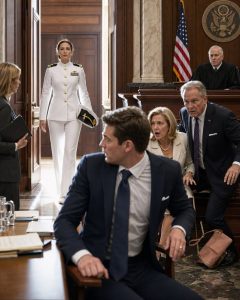
But now, standing beneath the cold lights of a federal courthouse, holding a document signed by **Judith Moore herself**, I realized something far worse.
**Grant had not erased me first.**
My mother had.
The hallway seemed to close around us. Reporters shouted questions. Marshals moved closer. My father stared at Judith as though he had woken beside a stranger.
“What did you do?” Warren asked, his voice hollow.
Judith’s fingers tightened around his sleeve.
“Not here,” she said.
But it was too late.
Assistant U.S. Attorney Caleb Reeves stepped between us, eyes fixed on the paper in my hand.
“Commander Moore,” he said carefully, “where did you get that?”
I handed it to him.
He read it once.
Then again.
His expression changed.
Not shock. Prosecutors train themselves not to show shock.
But his silence told me enough.
Elise Carter stood trembling beside me. “There are more,” she said. “Archived trust files. Hidden registration packets. Old wire transfers. They go back years before Harbor Shield.”
Grant laughed softly.
Everyone turned.
It was not the laugh of a man trapped.
It was the laugh of a man who had been waiting for someone else to be exposed.
“You finally found Mother’s little masterpiece,” he said.
Judith turned on him. “Grant.”
“No,” he said, rising despite his attorney’s hand on his arm. “You don’t get to look betrayed. Not today.”
My father stepped back from them both.
“What is he talking about?”
Judith’s eyes darted toward the marshals, toward Reeves, toward me.
For the first time in my life, my mother looked afraid not of losing her reputation.
She looked afraid of losing control.
Reeves turned to an agent. “Secure that folder. Now.”
Then he looked at Judith.
“Mrs. Moore, do not leave the courthouse.”
Her lips parted.
“I am not under arrest.”
“No,” Reeves said. “Not yet.”
**Not yet.**
The words landed like thunder.
Grant’s attorney immediately demanded a recess. The judge granted it. The jury was removed. The courtroom emptied into chaos.
But I stayed still.
Because my mother was still looking at me with the same coldness from ten years ago.
Only now I understood.
That night, when I came home with proof, she had not been confused.
She had not believed Grant because he was charming.
**She had believed Grant because the truth would have exposed her first.**
“Why?” I asked.
The word came out smaller than I wanted.
Judith’s face hardened.
“You were never supposed to be involved.”
“My name was on everything.”
“You were useful.”
My father made a broken sound.
Useful.
One word.
A mother’s explanation for a daughter’s ruin.
Grant smiled bitterly. “She needed a veteran identity for the family trust’s first disaster recovery venture. Lena had enlisted. Perfect timing. Perfect paperwork. Perfect daughter to sacrifice.”
Judith slapped him.
The sound cracked across the hallway.
Grant barely reacted.
“You taught me how to do it,” he said. “You don’t get to hate the student for becoming better than the teacher.”
My father looked like his bones had disappeared.
“Judith,” he whispered. “Tell me this isn’t true.”
She did not answer.
And that was the answer.
Reeves stepped closer to me.
“Commander, we need a formal statement.”
I nodded, but my eyes stayed on my mother.
For ten years, I had imagined the moment my family learned the truth.
I thought there would be apologies.
Tears.
Regret.
Maybe even love, cracked but still alive beneath the wreckage.
Instead, I found a second lie buried under the first.
And under that second lie, something darker still.
Because if Judith had started this twelve years ago, then Grant was not only protecting himself.
He was protecting the Moore family fortune.
And if my father truly knew nothing, then he had not just lost a daughter.
He had spent years sleeping beside the person who destroyed her.
As federal agents escorted Judith into a private conference room, she paused beside me.
Her perfume was the same as I remembered.
Lilies and smoke.
“You think you’ve won,” she said.
I looked at the woman who gave birth to me and made a weapon of my life.
“No,” I said. “I think I finally know where to start.”
For the first time, Judith Moore flinched.
—
## **PART 4 — THE TRUST FUND BUILT ON A DAUGHTER’S GRAVE**
By evening, the trial was no longer just about Grant.
It had become about **Moore Legacy Holdings**, a private family trust founded by my grandfather and controlled for decades by people who believed wealth was not inherited.
It was defended.
Hidden.
Sanitized.
Protected at any cost.
Federal agents worked through the night. Elise Carter gave them passwords, archive keys, and names of accountants who had disappeared from company directories years earlier.
I sat in a government conference room with a paper cup of coffee cooling in front of me, watching strangers uncover the anatomy of my family.
Caleb Reeves placed a timeline across the table.
“Twelve years ago,” he said, pointing to the first entry, “your mother authorized a preliminary veteran-owned entity using your early enlistment documents.”
I stared at the date.
I had been nineteen.
Still learning how to fold uniforms correctly.
Still believing my family was disappointed, but not dangerous.
“Why would she do that?” I asked.
Reeves hesitated.
Elise answered instead.
“Because your grandfather’s trust was collapsing.”
I looked at her.
She opened another file. “Bad investments. Lawsuits. Failed real estate deals. Your family’s public image was wealthier than the actual numbers. They needed access to preferential federal contracts. Disaster recovery. Infrastructure. Emergency rebuilding grants.”
“And I was the key.”
Elise lowered her eyes.
“Yes.”
The room went quiet.
I thought of all the years my parents hosted charity dinners in rooms full of crystal and candlelight. All those speeches about duty. Family. Service.
Meanwhile, my service had been reduced to a credential in a folder.
My father entered the conference room an hour later.
He looked twenty years older.
No lawyer.
No anger.
Just a man carrying the weight of every moment he had refused to see.
“Lena,” he said.
I did not stand.
He sat across from me, hands clasped so tightly his knuckles whitened.
“I didn’t know.”
I believed him.
That was the terrible part.
He had not known because he had not wanted to know.
Because trusting Judith and Grant had been easier than trusting the daughter who stood in his study with proof in her shaking hands.
“You didn’t know at first,” I said.
His eyes filled.
“No.”
“But I told you.”
His face crumpled.
“Yes.”
Those three letters held ten years of absence.
“I showed you everything,” I said. “You looked at my uniform like it was a costume.”
He bowed his head.
“I was ashamed.”
“Of me?”
“No.” His voice broke. “Of being wrong. And Grant knew that. Judith knew that. They knew I would defend the story because admitting the truth meant admitting I had failed you.”
I wanted to hate him cleanly.
It would have been easier.
But grief is rarely clean.
“You did fail me,” I said.
He nodded. “I know.”
Then he reached into his coat and pulled out a small envelope.
“I found this in Judith’s safe.”
Reeves stepped forward immediately. “Mr. Moore—”
“I already gave copies to Agent Nolan,” my father said. “This one is for Lena.”
He slid it across the table.
Inside was a photograph.
Me at eighteen, in the backyard, wearing a faded blue hoodie, smiling with one hand raised against the sun.
On the back, in my mother’s handwriting, were four words.
**She will ruin everything.**
I stared until the words blurred.
My father whispered, “I don’t know what it means.”
But I did.
I had always been the child who asked questions.
Grant charmed people.
I watched them.
Judith had seen my enlistment not as pride, but as danger. A daughter entering federal systems. A daughter whose records would be verifiable. A daughter who might someday notice what had been done in her name.
So she destroyed my credibility before I could become a threat.
**She buried me before I even knew there was a grave.**
That night, Reeves received an emergency warrant.
By dawn, agents had raided Moore Legacy Holdings.
They found offshore ledgers.
Fake veteran certifications.
Shell corporations.
And one sealed file labeled simply:
**LENA — CONTINGENCY.**
Inside was a plan.
If I ever came forward, I was to be portrayed as unstable, financially desperate, emotionally vindictive, and dishonorably discharged.
Grant had not improvised his lies.
He had followed instructions.
At the bottom of the file was one final document.
A life insurance policy taken out in my name when I was nineteen.
Beneficiary: Moore Legacy Holdings.
I felt the room disappear around me.
Reeves read it silently, then looked up.
“Commander,” he said carefully, “this suggests they may have expected you not to survive.”
My father gripped the back of a chair.
“No.”
But I remembered then.
A training accident during my first year.
A faulty harness.
A fall that should have been impossible.
The investigation had called it equipment failure.
For years, I had accepted that.
Now I was not sure of anything.
And somewhere in federal custody, my mother began refusing to speak.
—
## **PART 5 — GRANT’S CONFESSION CAME WITH A KNIFE**
Grant asked to see me two days later.
My first answer was no.
My second answer was also no.
The third time, Reeves said, “He’s offering a proffer. He claims he’ll testify against Judith, but only if he speaks with you first.”
I almost laughed.
Even in defeat, Grant wanted a stage.
We met in a secured interview room, separated by a table, two agents, and ten years of rot.
He wore no tie. Without the armor of expensive suits, he looked less like a villain and more like a boy who had spent his whole life being rewarded for becoming one.
“You look satisfied,” he said.
“I look tired.”
“You always did have that talent. Making people feel guilty without raising your voice.”
“No, Grant. That was conscience. You just weren’t familiar with it.”
His mouth twitched.
For a moment, we were children again.
Then the moment died.
He leaned forward.
“Mother started it. But I kept it alive.”
“I know.”
“No,” he said. “You don’t.”
He glanced at the agents.
“I want immunity considerations on the attempted murder issue.”
The room went still.
Even Reeves, watching from behind the glass, must have frozen.
I felt my pulse slow.
“What attempted murder issue?”
Grant looked at me.
“The harness.”
There it was.
A memory I had buried beneath discipline and survival.
Wind.
Metal.
A sudden snap.
The sky spinning.
Men shouting my name.
Pain blooming white-hot down my side.
“You?” I asked.
“No.” He swallowed. “Mother.”
Something inside me cracked.
“She paid someone?”
“She asked me to find someone. I refused.”
“You refused?”
“I was twenty-two, Lena. I was cruel. I was jealous. I was not ready to kill you.”
“But ready to destroy me.”
He looked down.
“Yes.”
The honesty was uglier than denial.
“After the accident failed,” he continued, “Mother changed strategy. Said dead daughters create investigations. Disgraced daughters disappear on their own.”
One of the agents shifted.
I did not move.
Grant’s voice dropped.
“She made me help build the story. At first I thought it was just reputation. Then money. Then contracts. By the time Harbor Shield started, I was already in too deep.”
“You expect sympathy?”
“No.”
“Then what do you want?”
He looked up, and for the first time, I saw something real in him.
Fear.
Not of prison.
Of Judith.
“She has another file.”
“On me?”
“On everyone.”
Grant leaned closer.
“Father. Elise. Reeves. Judges. Contractors. Senators. Mother has spent twenty years collecting sins. If she goes down, she won’t go alone.”
“Why tell me?”
“Because she still thinks she can beat the government. But she can’t beat you.”
I stared at him.
“You don’t know me anymore.”
Grant gave a faint smile.
“I know exactly one thing about you. When someone tells you to stay gone, you don’t.”
Before I could answer, the door opened.
Reeves entered, face grim.
“We have a problem.”
He placed a tablet on the table.
A news broadcast played silently at first, then the volume rose.
A reporter stood outside the courthouse.
“Breaking tonight: decorated Navy Commander Lena Moore, central witness in the Harbor Shield fraud trial, is now facing questions after anonymous records suggest possible misconduct during her early military career…”
The screen showed documents.
Forged.
Old.
But convincing enough for television.
Grant closed his eyes.
“She released the contingency file.”
Reeves cursed under his breath.
My mother, locked in custody, had still found a way to strike.
My phone buzzed.
Once.
Twice.
Then dozens of times.
Messages from unknown numbers.
Traitor.
Fraud.
Stolen valor.
Liar.
The old lie had returned, dressed in new headlines.
For a moment, my chest tightened the way it had ten years ago.
Then I stood.
Grant looked up.
“What are you doing?”
I buttoned my jacket.
“What I should have done the first time.”
Reeves frowned. “Commander?”
I looked at the tablet, at my face on the news, at the lie trying once more to crawl into my life.
“I’m going on record.”
Grant stared.
“And I’m not going alone.”
—
## **PART 6 — THE DAUGHTER WHO PUT HER WHOLE FAMILY ON TRIAL**
The press conference was supposed to last six minutes.
It lasted forty-three.
By noon, every camera outside the courthouse had turned toward the federal steps. Reporters expected a denial. A polished statement. Maybe a wounded daughter begging the public to believe her.
They did not expect me to walk out with Caleb Reeves, Elise Carter, three federal agents, and my father.
Warren Moore looked terrified.
But he walked beside me.
That mattered.
The microphones erupted.
“Commander Moore!”
“Did you falsify your record?”
“Were you dishonorably discharged?”
“Is your family accusing you of fraud?”
I stepped to the podium.
The wind tugged at my uniform. Somewhere above us, the courthouse flag snapped sharply against a pale sky.
“My name is Commander Lena Elizabeth Moore,” I said. “And for the second time in my life, forged documents are being used to erase the truth.”
The crowd quieted.
I continued.
“The records circulating this morning are false. They are part of a prepared smear campaign created years ago by individuals now under federal investigation.”
Then I stepped aside.
My father approached the microphone.
His hands shook.
For Warren Moore, reputation had always been oxygen. Public confession was a kind of death.
But he spoke.
“My daughter told me the truth ten years ago,” he said, voice breaking. “I chose not to believe her. I allowed my pride, my fear, and my trust in the wrong people to make me cruel. The documents attacking her are lies. I saw the originals. I ignored them.”
The cameras flashed wildly.
He turned toward me.
“I erased my daughter because admitting she was innocent meant admitting I was guilty.”
My throat burned.
“And I am guilty,” he said. “Not of forging those records. But of abandoning my child when she needed me most.”
A reporter shouted, “Are you accusing your wife?”
My father closed his eyes.
“Yes.”
That single word detonated across the steps.
Within hours, public opinion shifted.
By evening, Grant entered formal cooperation.
By midnight, Judith Moore was charged with conspiracy, identity theft, obstruction, financial fraud, witness intimidation, and attempted murder-for-hire related to my training accident.
But Judith did not collapse.
She did what powerful people do when cornered.
She opened her vault.
Names began leaking.
A contractor in Virginia.
A state official in Maryland.
A retired procurement officer.
A judge’s brother-in-law.
The Moore scandal became a national story.
But buried beneath all the corruption, one question remained.
Why me?
Why had Judith feared her own daughter so much that she built a machine to destroy me?
The answer came from the last person I expected.
My father called me two nights before Judith’s plea hearing.
“Lena,” he said, voice raw. “There’s something about your grandfather’s trust you need to know.”
I sat on the edge of my hotel bed.
“What?”
“The trust wasn’t supposed to go to Grant.”
Silence.
“It wasn’t supposed to go to me either,” he continued. “My father changed it before he died. Judith contested it quietly. I thought it was about taxes. It wasn’t.”
My hand tightened around the phone.
“Who was the beneficiary?”
He exhaled shakily.
“You.”
The room went still.
My grandfather, stern and distant, had barely seemed to notice me when I was young. But he had watched. Maybe he had seen the same thing Judith saw.
Not weakness.
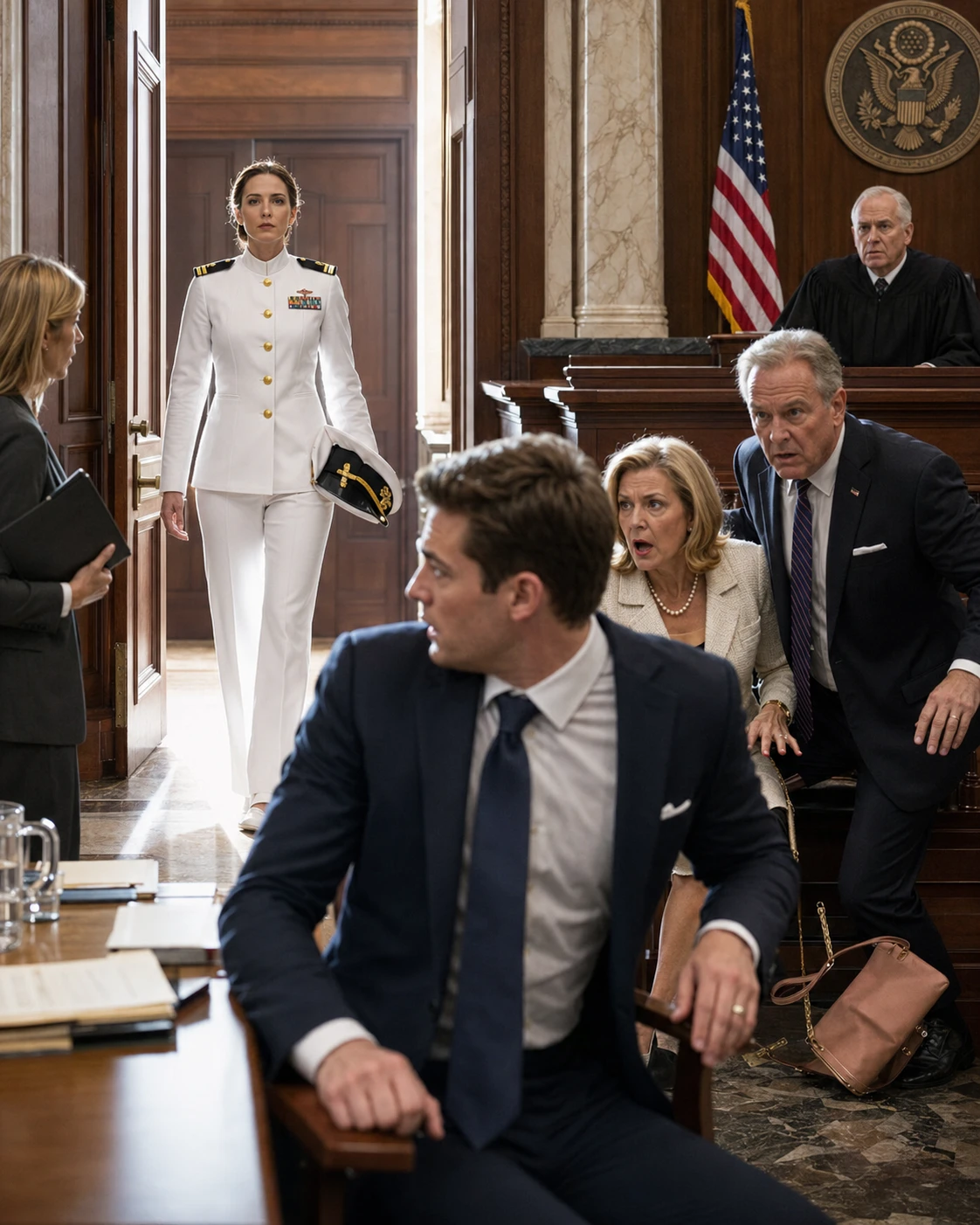
Not disgrace.
A threat to the family’s corruption.
“He left Moore Legacy Holdings to me?”
“Controlling interest,” my father said. “Effective upon your twenty-fifth birthday or verified federal service completion.”
I closed my eyes.
At twenty-five, I had been deployed.
At twenty-five, my family had already declared me disgraced.
At twenty-five, Judith had needed me legally dead, ruined, or discredited.
Because if I returned clean, I would inherit everything.
My phone nearly slipped from my hand.
My mother had not erased me because I was useless.
**She erased me because I was the rightful heir.**
—
## **PART 7 — JUDITH MOORE’S FINAL PERFORMANCE**
Judith’s plea hearing drew more cameras than Grant’s trial.
She entered court in a navy dress, pearls at her throat, silver hair perfect, chin lifted.
Even in chains, my mother looked like she was arriving to chair a charity gala.
I sat behind the prosecution table.
Not as a witness this time.
As the daughter she had failed to bury.
Grant sat three rows away under guard, pale and silent. My father sat beside me, though we did not touch.
The judge asked Judith how she pleaded.
Judith stood.
“Not guilty.”
Her attorney froze.
Reeves looked up sharply.
A murmur swept the courtroom.
This was not the plan.
Judith turned, and her eyes found mine.
Then she smiled.
The kind of smile that had once warned me to behave at dinner parties.
“Your Honor,” she said, “before entering any plea, I request to make a statement concerning the mental state and credibility of Commander Lena Moore.”
Reeves rose instantly.
“Objection.”
Judith’s attorney whispered urgently, but she ignored him.
The judge’s eyes hardened. “Mrs. Moore, this is not a trial.”
“No,” Judith said. “But it should be. Because my daughter has manipulated this entire investigation.”
A ripple moved through the room.
There it was.
The final performance.
The mother martyring herself before the public, turning guilt into elegance, poison into perfume.
“She was always unstable,” Judith continued. “Ambitious. Resentful. My son made mistakes, yes, but Lena—”
“Enough,” the judge snapped.
But Judith raised her voice.
“She came back for money. She always knew about the trust. She planned this.”
My father stood.
“That’s a lie.”
Judith turned on him.
“You weak, sentimental fool.”
The courtroom froze.
At last, the mask slipped completely.
Judith’s face twisted with rage.
“I saved this family,” she hissed. “Your father built an empire and left it to a girl who would have given it away to auditors and lawyers and ethics boards. Grant understood legacy. Lena understood rules.”
I rose slowly.
Judith looked at me.
“You think rules make you righteous?”
“No,” I said. “They make people like you nervous.”
Her smile vanished.
Reeves stepped forward.
“Your Honor, the government has new evidence relevant to Mrs. Moore’s statements.”
The judge allowed it.
A screen lowered.
Judith went still.
On the monitor appeared a video.
Old security footage from Moore Legacy Holdings.
Twelve years ago.
Judith stood in an office with a younger Grant.
Her voice filled the courtroom.
“Lena will not come back credible. By the time she’s useful, she’ll already be ruined.”
Young Grant asked, “And if she proves it?”
Judith answered, calm as winter.
“Then we make sure she never reaches a courtroom.”
My mother’s face emptied.
Not from guilt.
From surprise.
She had not known Elise copied the archive.
The courtroom erupted.
The judge ordered silence.
But I heard nothing.
I was watching the younger version of my mother discuss my destruction with the mild irritation of someone rescheduling a luncheon.
Then the video continued.
A third person entered the frame.
An older man with a cane.
My grandfather.
I stopped breathing.
He looked frail, but furious.
“You will do no such thing,” he said.
Judith turned. “This family cannot survive your decision.”
“My decision is final,” he replied. “Lena inherits because she is the only one who won’t sell her soul to keep the Moore name polished.”
Judith stepped closer.
“You’ll destroy us.”
He looked directly toward the camera, though he could not have known I would one day watch.
“No,” he said. “She’ll save what’s left.”
The footage ended.
The courtroom faded behind my tears.
All my life, I thought no one in that house had seen me.
But someone had.
Someone had known.
Judith sat down slowly.
For the first time, she looked defeated.
The judge denied bail.
As marshals moved toward her, she turned to me one last time.
“I gave you life,” she said.
I wiped my face.
“And then you tried to take it back.”
She had no answer.
—
## **PART 8 — THE NAME THEY COULD NOT ERASE**
Judith Moore pleaded guilty three weeks later.
Not because she was sorry.
Because the evidence left her nowhere to stand.
Grant testified against her and received a reduced sentence, though not freedom. He wrote me one letter from custody. I did not open it for six months.
When I finally did, it contained only five words.
**You were always the stronger one.**
I folded it back into the envelope.
Some truths arrive too late to heal anything.
But they can still close a door.
My father lost the house.
The cars.
The club memberships.
The carefully curated life he had mistaken for honor.
He moved into a small apartment near the river and began attending every public hearing related to the victims of Moore Legacy Holdings.
He did not ask me for forgiveness.
That was why, eventually, I began speaking to him.
Not often.
Not warmly at first.
But honestly.
And honesty, after a lifetime of performance, felt almost like love learning to walk again.
As for Moore Legacy Holdings, the courts confirmed what Judith had spent twelve years trying to bury.
My grandfather’s final trust amendment was valid.
The controlling interest belonged to me.
Reporters called it poetic justice.
They were wrong.
Justice was not poetic.
Justice was paperwork, testimony, sleepless nights, and the courage to keep speaking when silence would be easier.
I could have sold everything.
Many advised me to.
Instead, I dissolved Moore Legacy Holdings and used the recovered assets to create something new.
**The Lena Moore Veterans Recovery Foundation.**
Not named because I wanted my name on a building.
Named because for ten years, that name had been dragged through dirt.
Now it would be carved into stone above a door where people came for help.
The foundation supported veterans whose identities had been stolen, whose benefits had been exploited, whose service had been turned into profit by people in better suits.
Elise Carter became its first compliance director.
Caleb Reeves attended the opening ceremony quietly, standing in the back with his hands folded.
My father came too.
He stood near the door, uncertain whether he belonged.
For a long time, neither of us spoke.
Then he looked at the bronze plaque on the wall.
Commander Lena Elizabeth Moore.
Founder.
His eyes filled.
“I should have said your name like that years ago.”
I looked at him.
“Yes,” I said. “You should have.”
He nodded.
“I know.”
And for once, that was enough.
The ceremony ended at sunset. Guests drifted away. The building grew quiet.
I walked alone through the main hall, past framed photographs of men and women in uniform, past rooms where lawyers and counselors would sit with people who had been told their pain was too complicated to fix.
At the end of the hall was a small office.
On the desk sat one item from my grandfather’s estate.
A sealed wooden box.
It had been found after Judith’s conviction, locked inside a storage vault no one knew existed.
The inscription read:
**For Lena, when the truth costs everything.**
My hands trembled as I opened it.
Inside was a letter.
The paper smelled faintly of cedar and age.
Lena,
If you are reading this, then the people I feared most have shown you who they are.
I am sorry I did not live long enough to protect you openly.
But I protected what I could.
The trust was never the inheritance.
It was the test.
If Judith destroyed herself trying to steal it, the courts would expose her.
If Warren chose pride over truth, he would lose what pride built.
If Grant followed greed, greed would cage him.
And you, my child, would have the only thing worth inheriting.
Your name.
Use it well.
I sat there until the words blurred.
Then I laughed.
Softly at first.
Then through tears.
My grandfather had not left me an empire.
He had left me a trap for the people who thought an empire mattered more than a soul.
And somehow, impossibly, out of all that wreckage, something good had survived.
Months later, on the first anniversary of my testimony, I returned to the federal courthouse.
Not for trial.
Not for revenge.
For a ceremony honoring whistleblowers and public servants.
As I climbed the marble steps, a young woman in uniform stopped me.
“Commander Moore?”
“Yes?”
She swallowed nervously.
“I read about your case. I almost didn’t report what happened to me. But then I saw what you did.”
Her voice shook.
“So I told the truth.”
The wind moved between us.
For a moment, I saw myself at nineteen. Afraid. Proud. Unaware of the storm ahead.
I smiled.
“Good,” I said. “Then they don’t get to erase you either.”
Inside, sunlight spilled across the courthouse floor.
The same marble.
The same echo.
But I was not walking into battle this time.
I was walking forward.
Behind me lay the family that buried my name.
Before me stood all the lives that might be saved because I had taken it back.
And for the first time in ten years, when someone called me Lena Moore, I did not hear disgrace.
I heard survival.
I heard truth.
I heard home.
**the end**