Part 1 – My Son Took $600,000 – Then I Heard His Secret Plan.
After transferring $600,000 to my son, I forgot to hang up the call.
Right then, I heard my son and his wife insulting me.
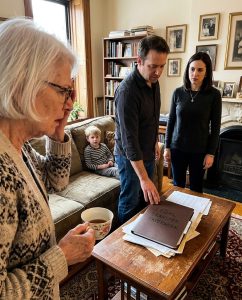
I was furious, feeling like my chest was going to explode, but suddenly I heard an even bigger secret.
I had been standing by the kitchen counter when I made the transfer, double-checking every digit because my hands were not as steady as they used to be.
The amount looked unreal on the screen.
Six hundred thousand dollars.
It had taken me years to build that savings account, years of teaching, years of scraping by after retirement, years of telling myself no so that one day I could say yes to my son.
Levi had told me he needed the money quickly.
He said it was for an investment opportunity, something that would secure the family’s future, something that would eventually help Nathan with school and help them finally stop renting.
He had sounded hopeful, almost emotional.
He had thanked me three times before I even entered my password.
I wanted to believe him.
Maybe that was my first mistake.
When the transfer went through, I called him immediately.
He answered on the second ring, full of gratitude.
Cynthia got on the line too, sounding sweet for once, telling me I was generous, telling me they would never forget this.
I said I was happy to help.
I told them family should be there for one another.
Then I set the phone down on the counter, thinking the call had ended.
It had not.
Cynthia’s voice sliced through the kitchen.
“How stingy is this old lady? Why did she give so little?”
For a second, I truly thought I had heard wrong.
But then Levi laughed under his breath and said, “Mom is definitely tight-fisted…
only six hundred thousand dollars is nothing to her.”
I gripped the counter so hard that my fingers hurt.
There was a buzzing in my ears, but not enough to drown them out.
I listened because I could not seem to do anything else.
Cynthia lowered her voice.
“Leave it be.
That old woman isn’t going to last much longer anyway.
And don’t forget about the brownstone in Manhattan.”
The brownstone.
My grandfather’s house.
In that instant, all the warmth drained from my body.
I was no longer listening to two selfish people complain about money.
I was listening to a plan.
A patient, ugly plan built around my death.
The phone slipped from my hand and cracked against the floor.
A second later, Levi sent a text.
Mom, I got the money.
Thanks.
With a smiley face.
I stared at it until the words blurred.
Then I looked up at the black-and-white portrait of my husband, Leonard, hanging in the hallway.
He had been dead for eleven years, and I still talked to him sometimes when the house got too quiet.
That day I looked at his photograph and whispered, “Our son is waiting for me to die.”
The sentence sounded impossible.
Then it sounded true.
When Levi called back, asking whether I was all right, I forced myself to answer calmly.
Cynthia took over and suggested they come visit that weekend with pastries.
I agreed, because by then my grief had turned into something sharper.
They thought I was,
old.
They thought I was lonely.
They thought I was easy.
They had forgotten who I had been before widowhood and age hollowed out my reflection.
For thirty-five years I had taught seventh graders.
I knew what lying looked like.
I knew how children shifted their eyes when they cheated.
I knew how adults thought softness meant weakness.
And most of all, I knew one thing with absolute certainty.
No one was taking my family’s house while I was still breathing.
That night I hardly slept.
I walked from room to room, touching the banister, the old dining table, the brass doorknobs my grandfather refused to replace because he said old metal had more character than new money.
I remembered being a little girl and racing down that hallway in socks.
I remembered my mother humming while she mended curtains.
I remembered Leonard painting the nursery when I was pregnant with Levi.
Every board in that house had held part of my life.
By morning, I had made three decisions.
First, I would not tell Levi and Cynthia what I knew.
Second, I would not sign a single piece of paper they brought into my home.
Third, I would call the one person I still trusted completely.
My daughter, Anya.
Anya lived in Connecticut with her partner and worked in hospital administration.
She had always been the practical one, the child who saw what others refused to see.
Levi used to call her cold when they were younger, but she was not cold.
She was careful.
When she answered, I said only, “Can you come today? Don’t tell your brother.”
She did not ask questions.
“I’m leaving now,” she said.
When she arrived three hours later, I told her everything from the transfer to the phone call to the planned visit.
She did not interrupt me.
She only sat very still, her jaw tightening more with each sentence.
When I finished, she exhaled slowly and said, “Mom, I need you to listen to me very carefully.
Do not sign anything.
Do not drink anything they hand you if you don’t open it yourself.
And let me handle the legal part.”
The calmness in her voice frightened me more than anger would have.
“You believe me?” I asked.
Anya looked offended by the question.
“I know you.
And I know Levi.”
That answer hurt, because it meant she had seen things I had chosen not to see.
By noon, she had contacted an attorney she knew through work, a sharp older woman named Marlene Bishop who specialized in estate and elder law.
Marlene came to the house that same afternoon.
She listened to the story, made notes, and asked very specific questions about the property title, my will, my bank accounts, and whether anyone besides me had access to the house documents.
When I finished, she folded her hands and said, “Susan, you have two separate problems.
One is emotional betrayal.
The other is potential financial exploitation.
We can address both, but we need to move quickly and carefully.”
She advised me to change my banking passwords immediately and place alerts on my accounts.
She also suggested I update my will, create a durable power of attorney naming someone I trusted other than Levi, and record any future conversations if state,