For a moment, I forgot how to move.
The captain stood in the narrow aisle beside my economy seat, his posture rigid, his salute precise. Around us, the cabin had fallen so silent I could hear the faint hum of the air vents overhead.
Passengers stared.
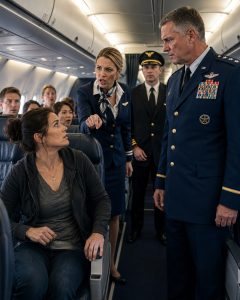
A child two rows ahead twisted around in his seat, wide-eyed.
Across the aisle, an older man slowly lowered his newspaper.
And at the front of the plane, Vanessa Harrison stood frozen beside the first-class curtain, her face drained of every trace of confidence.
The captain lowered his hand.
“Ma’am,” he said again, gently this time. “General Whitaker would be honored if you accepted his seat.”
General Whitaker.
The name struck something deep in my memory.
Thomas Whitaker.
Four-star general.
Former commander of Air Mobility Command.
A man whose name had once passed through briefings like weather: important, distant, untouchable.
I had never met him.
At least, I didn’t think I had.
I gripped the armrest and stood slowly. Pain shot through my lower back, bright and familiar. I kept my face still. Years of practice had taught me how to hide pain from rooms full of people.
But the general saw it from the front of the cabin.
His expression changed.
Not with pity.
With recognition.
I took one step into the aisle.
Then another.
The passengers watched as I walked forward, my limp suddenly impossible to hide.
Vanessa moved to block the entrance to first class.
“Captain, this is highly irregular,” she said, her voice thin but sharp.
The captain looked at her.
“Ms. Harrison, step aside.”
Her mouth opened.
“Now,” he added.
She stepped back.
I passed her without looking at her.
But I felt her stare on me like a blade.
General Whitaker stood beside seat 2A—my original seat. Tall despite his age, silver-haired, broad-shouldered, wearing a dark civilian suit that still somehow looked like a uniform. His eyes were steady, blue-gray, and far more tired than any official portrait had ever shown.
When I reached him, he did something I did not expect.
He saluted too.
Not casually.
Not for show.
With full respect.
“Technical Sergeant Danielle Carter,” he said quietly. “It has been too long.”
A murmur rolled through the cabin.
My throat tightened.
“Sir,” I said. “I’m sorry, but have we met?”
His eyes softened.
“No. But I have owed you a debt for eleven years.”
The words landed between us with a weight I did not understand.
Behind me, Vanessa whispered, “Technical Sergeant?”
The general heard her.
He turned his head slightly.
“Yes,” he said. “Technical Sergeant Carter. Silver Star recipient. Combat rescue survivor. The woman who kept twelve Americans alive after a crash that should have killed them all.”
The cabin changed again.
The whispers became something else.
A shifting, stunned respect.
I looked down.
I hated this part.
Not respect.
The exposure.
I had spent years trying to become ordinary. A woman in a jacket, boarding a flight quietly, carrying one small bag and too much history in her spine.
General Whitaker gestured toward the seat.
“Please.”
“I can’t take your seat, sir.”
“You already paid for it.”
“I was moved.”
His eyes flicked toward Vanessa.
“So I heard.”
The captain’s jaw tightened.
Vanessa looked like she wanted the floor to open beneath her.
General Whitaker lowered his voice so only I could hear.
“I am asking as someone who was never able to say thank you properly.”
I knew that tone.
Not command.
Not request.
Something more dangerous.
A man asking forgiveness.
I sat.
The relief was immediate and humiliating. My back eased against the wider seat. My legs finally had space. The pain did not disappear, but it stopped screaming.
General Whitaker turned to the captain.
“I’ll take the economy seat.”
The captain shook his head. “Sir, we have arranged another seat.”
“Captain—”
“With respect, General, not today.”
A first-class passenger in row three stood.
A man in a business suit, maybe fifty.
“General, take mine.”
Then a woman across the aisle stood too.
“No, take mine.”
Within seconds, several people were offering seats.
The general looked around, surprised.
Then he gave a small, weary smile.
“Seems the matter is settled.”
Vanessa remained by the galley, pale and rigid.
The captain turned toward her.
“Ms. Harrison, after takeoff you will remain in the aft galley unless called forward. Another crew member will cover first class.”
Her eyes widened. “Captain—”
“That is not a request.”
Her face flushed red now.
“Yes, Captain.”
As she walked away, the woman seated behind me muttered loudly, “A soldier’s place is in the back, huh?”
A few passengers applauded.
Not loudly at first.
Then more joined.
The sound filled the cabin, awkward and sincere and unbearable.
I stared out the window until it stopped.
General Whitaker took a seat across the aisle in 2C after another passenger insisted on moving. He buckled in slowly, then looked at me.
“You don’t enjoy attention.”
“No, sir.”
“I remember reading that in your file.”
I turned toward him.
“My file?”
He did not answer immediately.
The plane finally began to move.
As we taxied away from the gate, the general folded his hands over his knee.
“Do you know why Walter Harrison asked for you?”
I stiffened.
“You know Walter?”
“Yes.”
“How?”
The engines grew louder.
The general looked out toward the runway.
“Walter Harrison saved my career once. More importantly, he saved my conscience.”
That was not the answer I expected.
Walter had been many things to me—kind, stubborn, funny, sharp even in old age. But he had never mentioned knowing a four-star general.
“What does Walter have to do with this?” I asked.
General Whitaker turned back to me.
“Everything, I suspect.”
The plane lifted from the runway.
San Antonio fell away beneath us, sun flashing over rooftops and highways. I pressed one hand lightly against my side and breathed through the climb.
The general noticed.
“Your back?”
“Old injury.”
“Kandahar.”
I looked at him sharply.
He nodded.
“I know.”
That phrase irritated me more than it should have.
People always said they knew.
They read summaries. Citations. Medical notes. After-action reports cleaned of blood and screaming.
They knew the version that fit in a folder.
They did not know the smell of burning fuel.
They did not know the weight of a dying airman’s hand gripping your sleeve.
They did not know what it was like to keep pressure on someone else’s wound while ignoring your own broken ribs because there were still voices in the dark.
General Whitaker seemed to read the change in my face.
“I know the report,” he said softly. “Not the cost.”
That made me look away.
For several minutes, we said nothing.
The seat belt sign remained on. The plane cut through a layer of clouds, then steadied into bright blue air.
A flight attendant named Marcy brought water to me quietly.
“Ma’am,” she said, “I’m sorry for what happened.”
I accepted the glass. “You didn’t do it.”
“No,” she said. “But I saw it.”
That mattered.
More than she knew.
Across the cabin, Vanessa remained hidden behind the curtain.
General Whitaker waited until Marcy left before speaking again.
“I was at Bagram the night your aircraft went down.”
My hand tightened around the glass.
“I don’t remember you.”
“You wouldn’t. I wasn’t on the ground with you. I was on the command line.”
I said nothing.
His voice grew heavier.
“The first report said no survivors were expected.”
I remembered that night in fragments.
The sudden alarm.
The shudder through the fuselage.
The pilot shouting.
Metal screaming.
The world breaking open.
Then dust.
Fire.
Darkness.
Voices calling for mothers, medics, God.
“We were carrying medical evacuation personnel and two intelligence couriers,” he said. “The official rescue window was considered impossible because of enemy movement.”
“Yes,” I said. “They told us no extraction until morning.”
The general’s mouth tightened.
“That was the order.”
I turned toward him.
His eyes held mine.
“I gave it.”
The hum of the engines seemed to vanish.
For a moment, I was not in first class.
I was back in the wreckage, smoke tearing my throat, my back on fire, my hands slick with blood.
“You ordered them to leave us there?”
His face did not flinch.
“Yes.”
The honesty was so blunt it stunned me.
“Why are you telling me this?”
“Because Walter told me if I ever had the chance to face you, I should begin with the truth.”
My pulse thudded once.
Walter.
Always Walter.
I set the glass down carefully.
“Explain.”
General Whitaker looked older suddenly.
“The situation on the ground was unstable. Intelligence believed the crash site was being watched. We were told any rescue attempt before daylight would risk losing more people.”
“So you left us.”
“Yes.”
The word came out like punishment.
I looked out the window.
Clouds stretched beneath us like white desert.
“I spent eleven years telling myself command had no choice,” I said.
“We had choices,” he replied. “Bad ones. But choices.”
I turned back.
“Then why am I alive?”
“Because Walter Harrison overrode me.”
That sentence made no sense.
“Walter was a civilian.”
“He was also special counsel to a defense oversight committee at the time. He had access to channels most civilians never see. Your crash involved personnel connected to an investigation he was quietly supervising.”
I frowned.
“Investigation into what?”
General Whitaker’s expression sharpened.
Before he could answer, Vanessa stepped through the curtain holding a tray.
“Would either of you like coffee?” she asked.
Her voice was polite.
Too polite.
General Whitaker looked at her.
“No.”
I watched her hands. Perfect nails. Perfect grip. But the tray trembled slightly.
She looked at me.
“Danielle?”
“No.”
She lingered half a second too long.
The general noticed.
“Ms. Harrison,” he said. “That will be all.”
Her smile tightened.
She disappeared again.
I leaned closer.
“She’s listening.”
“Yes,” he said.
“Why?”
“Because she may know more than she should.”
That sent a cold line through me.
Vanessa was cruel. Petty. Ambitious in the exhausting way of people who mistake proximity to wealth for importance.
But dangerous?
I had never considered it.
The general lowered his voice.
“Walter asked me to be on this flight.”
My breath caught.
“What?”
“He knew Vanessa was assigned to it. He knew you would be here. He suspected she would try something.”
I stared at him.
“Walter is dying.”
“Yes.”
“And still playing chess.”
A faint smile crossed the general’s face.
“Walter has always played chess.”
I sat back slowly.
The flight suddenly felt smaller.
The passengers, the first-class curtain, the quiet movement of crew—all of it seemed part of something I had boarded without understanding.
“Why would Walter care where I sat?”
“Because humiliation makes people react. Walter wanted to see who would reveal themselves.”
I almost laughed.
“By using me?”
The general’s expression tightened with regret.
“I believe he trusted you to endure what others would not.”
“That is not the compliment people think it is.”
“No,” he said. “It isn’t.”
For the first time, I saw something in him besides rank.
Shame.
Old, disciplined, permanent.
He continued, “Walter asked for you because he wants to give you something before he dies.”
“What?”
“A file.”
My skin went cold.
I had spent enough time around classified work to hate that word.
“What kind of file?”
“The kind people have been trying to bury since Kandahar.”
Before I could ask more, a commotion rose from economy.
A man’s voice shouted, “Hey, she just took that woman’s bag!”
The curtain snapped open.
Vanessa hurried forward, carrying my small black carry-on.
My carry-on.
I stood too fast. Pain tore up my spine, but anger carried me through it.
“Vanessa.”
She froze.
The captain emerged from the cockpit almost immediately.
“What is going on?”
Vanessa’s eyes darted from me to the general.
“This bag was improperly stored,” she said.
“It was above my original seat,” I replied.
“I was relocating it.”
“To where?”
She said nothing.
General Whitaker stood slowly.
“Open it.”
Vanessa stiffened. “Sir, passenger privacy—”
“Open it,” he repeated.
The captain stepped forward.
“Ms. Harrison, place the bag on the counter.”
Her jaw clenched. For one moment, I thought she might refuse.
Then she set it down.
The captain unzipped it.
Inside were my clothes, medication, a book, Walter’s hospice address written on a folded note.
And a small sealed envelope I had never seen before.
The captain looked at me.
“Is this yours?”
I stared at it.
“No.”
General Whitaker’s face hardened.
“Do not touch it barehanded.”
The captain paused.
The cabin had gone silent again.
Vanessa said quickly, “Maybe she forgot she packed it.”
I looked at her.
“What’s inside?”
No one moved.
General Whitaker took a napkin from the galley, used it to lift the envelope, and held it to the light.
There was something rectangular inside.
A card.
Maybe a key.
Maybe a drive.
On the front, in block letters, someone had written:
CARTER STOLE IT.
My stomach turned.
The captain looked at Vanessa.
Her face had gone white.
“That is not mine,” she whispered.
“No one said it was,” I replied.
She swallowed.
The general’s voice turned ice-cold.
“Captain, document this. Photograph the bag, the envelope, the location, and every crew member present. No one handles it until law enforcement meets the aircraft.”
Vanessa took a step back.
“Law enforcement?”
The captain turned to her.
“You are relieved from duty for the remainder of the flight. Sit in the jumpseat in the rear galley. Do not touch passenger belongings again.”
Her eyes filled with panic.
“You can’t do that.”
“I just did.”
She looked at me then.
Not with contempt.
With fear.
And something else.
Warning.
As she passed me, she whispered so softly only I could hear.
“You should have stayed away from Walter.”
Then she walked to the back.
My blood chilled.
General Whitaker heard enough to understand.
“What did she say?”
I repeated it.
His face became grim.
“Then Walter was right.”
“About what?”
He looked toward the sealed envelope.
“That they would try to frame you before you reached him.”
The rest of the flight stretched like a wire pulled too tight.
The captain radioed ahead. General Whitaker made two calls using the aircraft communications system. Marcy sat near the front galley, watching my bag as if it were evidence in a murder case.
Vanessa did not come forward again.
But I felt her presence from the back of the plane.
I thought about Walter.
His voice on the phone last Christmas, thin but amused.
“Dani girl, some people age into wisdom. Others just age into better hiding places.”
I had laughed then.
Now the words felt like a warning.
When we landed in Florida, the aircraft did not taxi to a normal gate.
Instead, it stopped near a secure area of the airport.
Two airport police officers boarded first.
Then a federal agent in a navy suit.
Then a military liaison with colonel’s eagles on his collar.
The passengers whispered as officers moved down the aisle.
Vanessa was escorted forward from the rear.
Her makeup had smudged slightly beneath one eye.
She avoided looking at me.
The federal agent introduced herself as Special Agent Ramirez.
She examined the envelope without opening it and took statements from the captain, Marcy, the passenger who had seen Vanessa take my bag, General Whitaker, and finally me.
When she asked Vanessa why she had removed my carry-on, Vanessa repeated the same answer.
“Improper storage.”
“Why did you not notify the passenger?”
“I was busy.”
“Why was the envelope inside?”
“I don’t know.”
“Why did the envelope say Ms. Carter stole it?”
“I don’t know.”
Her voice became smaller each time.
Agent Ramirez watched her carefully.
“Who told you Ms. Carter would be on this flight?”
Vanessa’s eyes flicked toward me.
“No one.”
Ramirez wrote something down.
“Interesting. Because you were recorded telling a crew member before boarding that an unwanted family member was in first class.”
Vanessa’s lips parted.
The captain’s face darkened.
Ramirez continued, “You also accessed Ms. Carter’s passenger record before boarding, including her medical accommodation.”
Vanessa said nothing.
I had known she was cruel.
Now there was proof.
The agent turned to me.
“Ms. Carter, you are free to leave for now. We may need to speak with you again.”
General Whitaker stepped closer.
“She’s going to see Walter Harrison.”
Ramirez nodded. “Then I suggest she gets there quickly.”
Something in her tone made me look up.
“Why?”
The agent hesitated.
Then she said, “There was an incident at the Harrison residence this morning.”
My chest tightened.
“What kind of incident?”
“An attempted break-in.”
General Whitaker cursed under his breath.
“Is Walter safe?” I asked.
“For now,” Ramirez said. “But he has been asking for you.”
Within twenty minutes, General Whitaker and I were in a black government SUV leaving the airport.
Florida sunlight flashed through the windows. Palm trees blurred past. My back throbbed from the stress of the flight, but I barely noticed.
“Tell me the truth,” I said.
The general looked ahead.
“I’ve told you part of it.”
“Tell me the rest.”
He was quiet for a long moment.
“The crash outside Kandahar was not random. Your aircraft was carrying evidence of defense contract fraud, weapons diversion, and unauthorized payments routed through humanitarian supply channels.”
I stared at him.
“We were a transport crew.”
“You were cover.”
The word struck like a slap.
“Did my commander know?”
“Some did. Some didn’t.”
“Did I?”
“No.”
That mattered.