My mom was sentenced to die for killing my dad, and for six years, no one believed she was innocent.
The word execution never sounded real when spoken aloud.
It felt like something reserved for old crimes and distant strangers, not my mother.
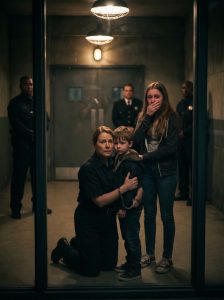
But minutes before the execution, my little brother hugged her and whispered:
“Mom… I know who hid the knife under your bed.”
Many of them. Quietly at first. Then louder. Then furiously.
The voices erupted behind the glass, beyond the locked door, beyond the room where time was about to end.
—”I am not going to carry out an execution if there is physical evidence yet to be located,” he said over the phone.
“Yes, I understand the time. Yes, I understand the order. I also understand that a minor has just pointed to the victim’s primary financial beneficiary.”
Financial beneficiary.
That phrase hit me harder than anything else that day.
It wasn’t emotional.
It was cold, precise, and devastating.
My uncle hadn’t just kept the house.
He also kept my dad’s auto shop, the truck, the accounts—everything he had supposedly “managed” for us because I was a minor and Matthew was a baby.
He always said:
“Your mother ruined us. I’m doing enough just supporting you.”
But he was the one who had ruined us.
I was seventeen when she was found guilty.
Too young to understand manipulation, old enough to absorb blame.
My dad was found dead in the kitchen.
The knife was under my mom’s bed.
There was blood on her robe.
And everyone said the same thing:
—”It was her.”
I doubted her too.
That was my sin.
For six years, my mom wrote letters from prison.
“I didn’t kill him, sweetheart.”
I never knew how to answer her.
At 6:37 PM, the call came.
The warden closed his eyes as he listened.
Then he said:
—”Yes, Judge. It is stayed.”
My mom let out a moan.
It wasn’t a cry.
It was as if her soul suddenly rushed back into her body.
Matthew hugged her tighter.
I stood paralyzed.
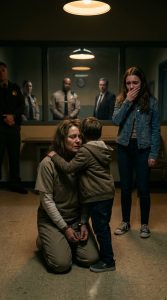
Stayed.
Not free.
Not acquitted.
But alive.
My mom wasn’t going to die tonight.
I crossed the room and fell to my knees in front of her.
—”Mom…”
I didn’t know what to say.
There were six years between us.
Six years of unanswered letters.
Six years of short visits.
Six years of seeing her through glass, handcuffs, and shame.
—”Forgive me,” I said.
My mom closed her eyes.
—”Oh, sweetheart.”
—”Forgive me for doubting.”
She touched my face with her cuffed hands.
—”You were a child.”
—”I wasn’t that young.”
—”They broke your life. Yours too.”
I cried like I hadn’t even at my dad’s funeral.
Because at the funeral I was too busy trying to understand if my mother was a murderer, if my family was a lie, if my brother would remember her, or if I had to hate her to survive.
That afternoon, for the first time, I could cry for what had really happened.
We had both been robbed.
My dad with a knife.
My mom with a sentence.
And us with a lie.
Two patrol cars headed to the house with Matthew’s key, the prosecutor, the lawyer, and an urgent search warrant.
I wanted to go, but they wouldn’t let me.
During those hours, my mom told us what we could never hear.
—”That night,” she said, “your dad and Ray argued. I had taken some tea Ray made me because my head hurt. It made me very sleepy. I woke up to screams, police, blood on my robe, and your dad dead.”
“When I asked about you, Ray told me you were with a neighbor. Then he whispered in my ear in the patrol car: ‘If you open your mouth about the accounts, your children will be left with no one.’”
—”What accounts?” I asked.
My mom looked at me sadly.
—”Your dad had discovered Ray was using the shop to move money for dangerous people. Fake parts, invented invoices, loans. I don’t know everything. I only know your dad found documents.”
“That afternoon he said he was going to report him.”
The photo.
The man in the photo.
—”Did Dad go to report someone that night?”
Mom nodded.
—”He said he was going to see an internal affairs commander. He came back very nervous. He hid something in the wardrobe.”
“He told me: ‘If anything happens to me, don’t trust my brother.’”
“I told him not to talk like that. We argued. I got angry. I went to sleep. And when I woke up, he had been killed.”
I remembered an image then that I had buried.
My dad coming into my room the night of the murder.
I was half-asleep.
He kissed my forehead and said:
“Take care of your mom, Val.”
I thought it was just a regular phrase.
It wasn’t.
It was a goodbye.
At 9:20 PM, the prosecutor returned.
He had a hard expression.
In his hands, he carried an evidence box.
Ray stood up.
—”This is illegal. That house is in my name.”
The prosecutor looked at him.
—”We’re going to look into that, too.”
My heart raced.
—”Did you find it?”
The prosecutor placed the box on the table.
—”We found the secret drawer. Behind the false bottom, there were documents, a USB drive, a notebook, and photographs.”
My mom stopped breathing.
—”And the photo?”
The prosecutor opened a clear bag.
Inside was the photograph.
A man with a mustache, a white shirt, and a hat, standing next to a black SUV.
Next to him was my Uncle Ray.
Behind them, my dad appeared half-hidden, as if he had taken the photo without the others realizing.
On the back, in my dad’s handwriting, it said:
“If I turn up dead, it wasn’t Teresa.”
I felt the floor vanish.
The prosecutor continued:
—”The USB drive contains videos from a camera in the shop. It shows Mr. Ray receiving money.”
“There are also audios.”
“One of them records a threat.”
—”What does the audio say?” I asked.
The prosecutor hesitated.
—”It is not recommended for the minor to hear it.”
Matthew clung to Mom.
—”I want to know.”
Mom shook her head.
—”No, my love. You’ve been brave enough.”
When Matthew left, the audio played.
My dad’s voice.
Agitated. Alive.
—”If something happens to me, Teresa knows.”
The recording cut off.
The prosecutor closed the file.
—”With this evidence and the minor’s statement, the case will be formally reopened.”
An arrest warrant was issued.
Ray screamed.
—”Lie!”
I looked at him.
—”My mom was an hour away from dying, Uncle.”
“When did she plant a drive in a house you kept locked for six years?”
He went silent.
The guards handcuffed him.
For years, the metal had lived on my mother’s wrists.
Tonight, it changed sides.
Ray looked at me.
—”There are deaths that are necessary.”
No one spoke.
He had just confessed without confessing.