“I never got them.”
“I know,” David said. “Because the office call was rerouted. Someone changed the forwarding rule for twenty-six minutes that night.”
Michael stood so fast his chair rolled back into the credenza.
“Who?”
“I’m still tracing that. But there’s more. The hospital intake record was removed from the active system three days later. Someone paid a records clerk in cash.”
Michael gripped the edge of the desk.
Paperwork is cold until it proves a human being was left alone.
Then every line becomes a hand you failed to hold.
David sent the scan.
Michael opened it.
Emily’s name appeared at the top.
Her signature at the bottom was shaky.
Under emergency contact, there was his full name.
Michael Miller.
His office number.
His old house line.
His relationship to patient.
Husband.
He stared at that word until it blurred.
In the next file, David had marked the payment stamp.
The record removal fee was not official.
It had been disguised as a records correction request.
Beside it was an authorization number tied to an access card from Michael’s own household account.
The same access level Ashley had been given after she moved into the guest wing during the divorce because she claimed reporters were bothering her.
Michael remembered handing her that access card.
He had called it practical.
Emily had called it strange.
He had told Emily not to be jealous.
Now the word jealous tasted obscene.
David kept digging.
By 8:12 p.m., he had the first crack in the wire transfers.
They had not been initiated from Emily’s laptop.
They had been initiated from an administrative tablet that was usually kept in the house office.
The device had logged in at 11:09 p.m. on the night Emily was supposedly at the hotel.
But the hotel photos had metadata from 9:42 p.m., and the security gate had scanned Emily’s car at 9:47 p.m. entering their own driveway.
The woman in the photos had not been Emily.
The angle had hidden the face.
The coat had been Emily’s.
The hair was close enough.
Close enough had ruined her life.
At 8:44 p.m., David sent the necklace report.
The security safe had been opened with Michael’s master code at 1:03 a.m.
Michael had been out of state that night.
Only two people knew the backup code.
Emily and Ashley.
Emily had been locked out of the house security system at 10:18 p.m. after Michael revoked her access during their argument.
Ashley’s guest code remained active.
Michael put his hand over his mouth.
He did not trust himself to speak.
At 9:06 p.m., his phone buzzed with a text from Ashley.
Dinner tomorrow? Wear the navy suit. I want us to look perfect.
Michael stared at the message.
Then he typed back one word.
Sure.
He hated himself for it, but he needed her unworried.
He needed one more day.
David found Emily the next morning.
Not through a shelter.
Not through a credit card.
Through a recycling center receipt stamped 7:22 a.m. with a signature that looked like someone had written while holding a baby.
She was staying in a small apartment above a laundromat with a woman from a church pantry who let her pay what she could.
There was no formal lease.
No crib receipts.
No bank account with more than forty dollars in it.
There was a hospital discharge paper for twins.
No father listed.
The babies’ names were Noah and Ethan.
Michael read the names three times.
He sat in his office with both hands pressed flat to the desk because some grief is too heavy to hold standing up.
He had sons.
For almost a year, he had had sons.
And Emily had carried them through hunger, heat, sleepless nights, and humiliation because he had trusted a woman who smiled while throwing money at them in the dirt.
David urged him not to rush.
“You need proof before confrontation,” he said. “Not because you owe Ashley fairness, but because Emily deserves more than another emotional explosion.”
Michael knew he was right.
So he began where he should have begun a year earlier.
He documented.
He had David preserve the intake form.
He had the hospital call logs certified.
He had the household access reports pulled from the security vendor.
He had the wire transfer ledger copied and timestamped.
He had the necklace safe logs matched against Ashley’s access card.
He had the hotel photo metadata reviewed by an independent analyst.
At 10:30 a.m., he called his attorney.
Not the divorce attorney who had helped him remove Emily from the house.
A different one.
“I need to reopen a divorce settlement,” Michael said. “And I need to establish paternity for twins. Quietly. Today.”
His attorney did not waste time asking why.
By noon, Michael was parked across from the laundromat apartment.
He did not go in.
He saw Emily come down the narrow stairs with one baby in a sling and the other in a secondhand stroller whose front wheel wobbled.
She had a diaper bag over one shoulder and a paper grocery bag hooked over the handle.
She moved like someone whose body had been tired for so long that tired had become normal.
Michael could have stepped out then.
He could have said her name.
He could have fallen apart on the sidewalk.
But he had already done enough harm by making his feelings the center of her life.
This time, he waited.
He asked the attorney to contact her through a neutral advocate.
Emily refused the first call.
Michael did not blame her.
She refused the second.
He did not blame her for that either.
On the third call, the advocate told her only one thing.
“He knows about the hospital record. He knows someone blocked your calls. He is asking permission to meet you in a public place, with your advocate present.”
Emily agreed to twenty minutes.
They met in a diner off a main road, because Emily wanted witnesses and Michael deserved that condition.
A small American flag sat in a cup near the register.
A waitress poured coffee without asking questions.
Emily arrived with the twins in their stroller, her face pale and guarded.
Michael stood when she entered.
Then he sat back down because the look in her eyes told him not to perform remorse where strangers could see it.
“I’m not here to ask you to forgive me,” he said.
Emily’s jaw tightened.
“Good.”
The word was quiet.
It still cut clean through him.
He slid the hospital intake copy across the table.
Then the call log.
Then the security access report.
Emily did not touch them at first.
She looked at the papers like they might bite.
“I called you,” she said.
Michael’s throat closed.
“I know.”
“I called from the hospital. I called when they said both heartbeats were there. I called when they told me I might need to stay overnight. I called when I had nowhere to go.”
Michael lowered his eyes.
“I know.”
“No,” Emily said, and now her voice shook. “You don’t get to say that like knowing now repairs not knowing then.”
He nodded once.
“You’re right.”
One of the babies stirred.
Emily reached down automatically, her hand gentle before she even looked.
That small motion broke him more than any accusation could have.
Care had become her reflex.
His had become suspicion.
“Are they mine?” he asked.
Emily looked at him for a long moment.
“Yes.”
He pressed his lips together.
He had imagined that answer on the drive over.
Still, hearing it made the diner tilt.
“I’ll take the legal test if you need it,” Emily said. “Not because I owe you proof. Because they deserve every protection they can get.”
“I’ll pay for it,” he said.
“You’ll do more than pay,” she replied.
There was no cruelty in her voice.
Only a line.
A boundary drawn by a woman who had learned that love without protection is only another place to be hurt.
Michael accepted every condition.
No private meetings without her consent.
No showing up unannounced.
No using money to pressure her.
No contact with the babies until Emily and her advocate agreed it was safe.
Immediate temporary support through her attorney, not cash handed across a table.
A written apology, not for social media, not for his reputation, but for the legal record.
He signed the first authorization that afternoon.
The paternity test came back five days later.
Probability of paternity: 99.99 percent.
Michael did not cry when the email opened.
He sat completely still.
Not anger.
Not relief.
Something heavier.
The kind of truth that arrives late and still expects you to answer for where you were.
Ashley found out because guilty people watch doors.
She noticed Michael canceling dinners.
She noticed the attorney’s car outside his office.
She noticed David in the lobby and turned white before anyone said a word.
At 4:05 p.m. the next Friday, Michael asked Ashley to come to his office.
He did not raise his voice.
He did not accuse her first.
He let the documents do what he should have let evidence do a year earlier.
The hospital intake form.
The call reroute log.
The access card record.
The wire transfer metadata.
The safe report.
The hotel photo analysis.
Ashley stood beside the conference table, one hand on the back of a chair, her face losing color one page at a time.
“This is insane,” she said.
David placed one more photograph on the table.
Emily outside the hospital doors eleven months earlier, pregnant, holding a cracked phone.
Ashley’s white SUV was visible near the curb.
The license plate was clear enough.
Ashley looked at the photo.
Then at Michael.
For the first time since he had known her, she had no performance ready.
“You don’t understand,” she whispered.
Michael almost laughed.
Not because anything was funny.
Because that was the sentence every liar reaches for when the truth finally becomes organized.
“I understand enough,” he said.
His attorney handled the rest.
The engagement ended before sunset.
Ashley’s access to every property, account, card, and household system was revoked.
The evidence went where it needed to go, through lawyers, auditors, and the proper reports.
Michael did not need a dramatic scene.
He needed a clean record.
Emily needed safety.
The twins needed stability.
And the lie needed to be unable to dress itself up again.
Rebuilding did not look like a movie.
It looked like direct deposits arranged through counsel.
It looked like rent paid six months ahead on an apartment Emily chose herself.
It looked like a new stroller delivered by the advocate, not by Michael standing at her door hoping gratitude would soften her.
It looked like pediatric appointments where he sat in the waiting room until Emily said he could come in.
It looked like Michael learning which baby liked being bounced and which one startled at loud noises.
Noah grabbed his finger first.
Ethan watched him with solemn eyes for three visits before finally smiling.
Michael went home that night and sat on the kitchen floor because he had no idea what to do with joy that arrived wrapped in guilt.
Emily did not forgive him quickly.
She did not forgive him because he paid bills.
She did not forgive him because he exposed Ashley.
She did not forgive him because he cried once in the parking lot and said he was sorry until his voice cracked.
She built a different life first.
That mattered more.
She got her own lease.
She kept her own bank account.
She found part-time bookkeeping work through the same church pantry woman who had given her a room above the laundromat.
She kept the twins on her insurance paperwork and made Michael go through the court-approved parenting plan like any other father who had missed the beginning.
He did not fight it.
He had fought the wrong person once.
He would not do it again.
Months later, there was a hearing in a family court hallway with beige walls, vending machines, and a flag near the clerk’s window.
Michael saw Emily standing with the twins in a double stroller, wearing a pale blue sweater and the guarded expression he had earned.
He walked over slowly.
“Do you need coffee?” he asked.
Emily looked at him.
Then at the paper cup in his hand.
“Is it too strong?” she asked.
The question was small.
It carried a whole marriage inside it.
“Probably,” he said. “You always said I made it like motor oil.”
For the first time in over a year, Emily almost smiled.
Almost was enough for that day.
The court order established paternity, support, medical responsibilities, and supervised transition visits.
It did not repair the past.
Paper cannot do that.
But paper can stop a lie from moving freely through someone’s life.
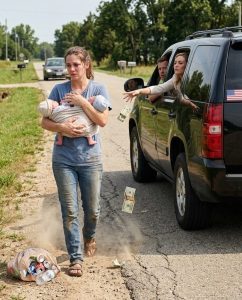
When Michael later drove past the same stretch of rural road, he pulled onto the shoulder and stopped.
The dust rose around the SUV again.
There were no crushed cans there now.
No crumpled bill.
No Emily walking away with two babies in the heat.
Still, he sat with both hands on the wheel and remembered the way she had looked at him that day.
Not with hatred.
With pity.
As if he were the one lost.
He had been.
The richest man on that road had been the poorest in truth.
And the woman he had left with nothing had been carrying everything that mattered.
A year earlier, he had believed proof because it came on paper.
Now he knew better.
Proof is not the same as truth when the person holding the folder wants your eyes closed.
The day he saw Emily on the roadside, he thought he had found his ex-wife in the dust.
What he had really found was the life he had thrown away, still breathing, still walking, still protecting his sons with both hands while he sat behind glass and finally learned what betrayal looked like.
It had not started on the street.
It had lived under his roof.
And this time, he opened every door.