It was not crying.
It was the sound of a man realizing the person who raised him might have taught him to ignore danger in the name of family.
Janice said, “That’s impossible.”
The doctor said, “No. It is documented.”
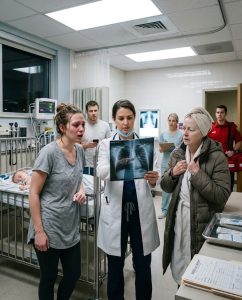
Then the nurse brought in the paramedic run sheet.
The note was time-stamped 2:16 a.m.
It recorded Janice’s own words.
Child was being corrected for crying.
Corrected.
That word sat on the page like a confession trying to dress itself as parenting.
Janice reached for the paper.
The nurse moved it away.
“Please don’t touch the chart,” she said.
It was the first time anyone had denied Janice something that night, and she looked more offended by that than by the condition of the child in the crib.
Then my phone buzzed.
I almost ignored it.
My hands were shaking too badly to read anything.
But I looked down and saw a notification from the nursery monitor app.
We had bought the camera when Harper was six months old because I was terrified of blankets, sleep sacks, fevers, and everything the internet tells new mothers can go wrong in the dark.
I had forgotten that it saved short audio clips when motion triggered the sensor.
The clip was labeled 1:58 a.m.
I played it for the doctor.
At first, there was only Harper crying.
Then Janice’s voice came through, low and sharp.
“That is enough.”
Harper cried harder.
Then came the thud.
Then Janice again.
“Now maybe you’ll learn.”
Nobody spoke.
The nurse covered her mouth.
Ethan backed into the wall like his legs had stopped knowing how to hold him.
Janice whispered, “That’s not what it sounds like.”
But for the first time, her voice was not controlled.
It shook.
The doctor took the phone gently from my hand and asked whether he had permission to preserve the recording for the chart and for the mandated report.
I said yes.
That one word felt like stepping out of a burning house.
From there, things moved in pieces.
A social worker came.
Then a hospital security officer.
Then police.
Janice tried to leave once, but a security guard stepped into the doorway and asked her to remain available for questions.
She looked at Ethan then.
Not at me.
Not at Harper.
At Ethan.
She expected rescue from the son she had trained for decades to soften her consequences.
He stared at the floor.
When she said his name, he flinched.
That flinch told me how long this had been happening in smaller forms.
Not to Harper.
To him.
A lifetime of corrections.
A lifetime of being told he was dramatic, ungrateful, disloyal, weak.
That night, the vocabulary finally showed its shape.
Harper was transferred for further evaluation.
The scans confirmed trauma.
The older mark led to more questions, more imaging, more careful examinations, and more horror than my mind could hold at once.
I kept thinking of every time Janice had asked to rock Harper alone.
Every time she had told me to rest.
Every time I had stood outside the nursery door and heard Harper fuss, then settle.
I wanted to rewind my whole life one choice at a time.
The social worker stopped me when I started spiraling.
“She is here because you heard her,” she said.
I held onto that sentence for months.
The police interviewed us separately.
I told them about the key, the Thanksgiving tears, the comments about weak mothers, the way Janice had insisted Harper needed discipline before she could walk.
Ethan told them things he had never told me.
He told them about being locked in a dark laundry room as a child for “talking back.”
He told them about cold showers.
He told them about being grabbed hard enough to bruise and then being told he had bruised easily because he was delicate.
He cried when he said the word delicate.
Not loudly.
Not dramatically.
Just with tears sliding down a face that looked ten years old for a moment.
Janice denied everything.
Then she adjusted.
She admitted she had gone into the nursery.
She admitted she had picked Harper up.
She admitted she had “set her down firmly.”
Then she admitted Harper “may have bumped” the crib rail.
Each version was smaller than the damage.
Each version changed when evidence pushed against it.
That is how lies behave under light.
They do not vanish.
They rearrange.
By morning, police had taken the recording, the paramedic notes, the intake form, the imaging reports, and photographs of the nursery.
They took the crib sheet.
They photographed the rail.
They collected the moon nightlight because the cord and position helped establish where Janice had been standing.
Forensic work is not glamorous.
It is not one dramatic speech in a courtroom.
It is a red bag on a floor, a time stamp on a form, a baby monitor clip, a doctor who refuses to let “discipline” replace injury.
Janice was not allowed near Harper.
The emergency protective order came first.
The charges came later.
I remember the officer reading the paperwork while Ethan sat beside me in the hospital room with his hands clasped so tightly his knuckles had gone white.
He did not defend her.
That was the first brave thing he did.
The second was calling a locksmith before sunrise.
By the time we brought Harper home, Janice’s key no longer fit our door.
Harper survived.
I need to say that plainly because every part of this story tightens around that question.
She survived.
The seizures stopped after treatment.
There were follow-up appointments, neurological checks, sleepless nights, and months of watching every movement she made with a terror I would not wish on anyone.
There were good signs.
Then better ones.
She reached for my hair again.
She laughed at the dog again.
She learned to stack blocks and knock them over with a look of such serious satisfaction that Ethan cried the first time he saw it.
Healing did not arrive like a sunrise.
It came like little receipts.
A normal scan.
A steady step.
A night without me standing over the crib counting breaths.
A therapist telling Ethan that protecting his daughter also meant grieving the mother he wished he had.
The court process was slower than rage wanted it to be.
Janice’s attorney tried to paint it as a tragic misunderstanding by an overwhelmed grandmother.
The prosecutor played the audio.
The courtroom heard Harper crying.
The courtroom heard Janice say, “That is enough.”
The courtroom heard the thud.
Then the courtroom heard, “Now maybe you’ll learn.”
I watched Janice close her eyes when her own voice filled the room.
Not from remorse.
From exposure.
There is a difference.
The doctor testified about what the injuries showed and what they did not show.
The paramedic testified about Janice’s statement.
The nurse testified about the chart note.
Ethan testified too.
That was the hardest day for him.
He did not perform anger.
He simply told the truth.
He said his mother had taught him that pain was obedience and obedience was love, and that he had mistaken fear for respect for most of his life.
When he stepped down, he walked straight past Janice.
She reached for his sleeve.
He moved his arm away.
The plea came before a full trial finished.
I did not feel satisfaction when it happened.
I felt tired.
I felt relieved.
I felt angry that relief had to be built from paperwork, prosecutors, scans, and a recording of my child being hurt.
Janice lost access to Harper permanently.
There were penalties, supervision requirements, treatment orders, and a sentence that many people argued about afterward as either too much or not enough.
For me, no sentence could rewind the sound of that thud.
But the legal outcome did one thing I needed.
It named what happened.
Not discipline.
Not grandmotherly concern.
Not a scare.
Abuse.
Ethan has not spoken to Janice since the sentencing.
People still send messages sometimes.
Family members who were nowhere in the ER suddenly have opinions about forgiveness.
They say Janice is old.
They say prison changed her.
They say anger poisons the person who carries it.
I used to answer.
Now I do not.
My daughter’s peace is not a family discussion.
Our home is quieter now, but not in the frightening way it was that night.
The quiet is ours.
The locks are ours.
The nursery is Harper’s again.
The moon nightlight still sits on the dresser, though I moved it away from the crib because for months I could not bear the amber glow under the door.
Harper is older now.
She does not remember Janice.
Sometimes I envy that.
Sometimes I pray it stays true forever.
Ethan remembers enough for both of them.
So do I.
When people ask what finally shattered Janice Caldwell’s lies, they expect me to say it was the doctor.
Or the X-ray.
Or the baby monitor.
They are not wrong.
But the first thing that shattered the lie was smaller than all of that.
It was the part of me that heard a soft thud in the dark and refused to explain it away.
A key. A room. A baby.
That was what I gave her.
The rest of my life is what I took back.