My mom was sentenced to die for killing my dad, and for six years, no one believed she was innocent.
The word die felt unreal the first time I heard it in a courtroom.
It sounded like something that happened in history books, not in my family.
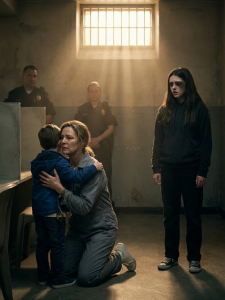
But minutes before the execution, my little brother hugged her and whispered:
“Mom… I know who hid the knife under your bed.”
The room froze in a way I will never forget.
Not loud.
Not dramatic.
Just suddenly too quiet to breathe.
“Don’t cry for me,” my mom said, her hands in cuffs and her voice weary.
The metal circled her wrists like punctuation marks at the end of her life.
“Just take care of Matthew.”
I was seventeen when she was found guilty.
Old enough to understand what death meant, but young enough to believe the adults around me knew better.
My dad was found dead in the kitchen.
The house still smelled like dish soap and burned toast when the police arrived.
The ordinary details made the scene feel cruel.
The knife was under my mom’s bed.
Tucked carefully beneath folded sheets, as if someone wanted it to be found.
There was blood on her robe.
Dark, unmistakable, and louder than her screams.
And everyone said the same thing:
-“It was her.”
Neighbors whispered it in driveways.
Reporters wrote it in headlines.
Even family members avoided saying her name out loud.
I doubted her too.
That was my sin.
I remember sitting in the courtroom, my legs swinging because they didn’t reach the floor properly.
I watched my mom look smaller each day, as if guilt—or the assumption of it—was shrinking her.
The evidence felt simple to everyone else.
Motive. Opportunity. Weapon.
I wanted to believe there was a mistake.
But believing her meant fighting the entire world alone.
For six years, my mom wrote letters from prison.
Every envelope smelled faintly of disinfectant and old paper.
“I didn’t kill him, sweetheart.”
She wrote it the same way every time.
Not defensive.
Not angry.
Just tired.
I never knew how to answer her.
What do you write back to someone waiting to die?
I told myself silence was safer than false hope.
I told myself doubt was practical.
I told myself I was protecting Matthew.
Matthew was too young to understand why Mom couldn’t come home.
He only knew that she called every Sunday and asked about his drawings.
The years moved forward anyway.
School. Graduation. Jobs.
Execution dates postponed and then reset.
Each delay felt like borrowed air.
Each reschedule felt like theft.
The morning of the execution, the sky was painfully blue.
The kind of day that should have belonged to birthdays or picnics.
They allowed her to say goodbye to Matthew.
A small mercy wrapped in cruelty.
My little brother was eight years old.
He wore a shirt with a dinosaur on it because he thought it might make her smile.
I held his hand as we walked down the corridor.
The walls were too white.
The floor too clean.
My mom knelt when she saw him.
Chains clinked softly as she moved.
She brushed his hair back with fingers that trembled.
She tried to memorize his face.
I stood a few feet away, afraid my voice would break something fragile.
I had not hugged her in years.
Matthew pressed his face into her shoulder.
His small body shook once.
Then he pulled back and whispered it.
Soft. Certain.
“Mom… I know who hid the knife under your bed.”
My breath stopped.
Her eyes widened, not in fear, but in recognition.
Like something buried had just been unearthed.
“What did you say?” I asked, my voice cracking.
Matthew looked up at me, confused by the sudden tension.
“I saw it. That night. I thought it was a game.”
The guards shifted uncomfortably.
One of them cleared his throat.
He explained slowly, the way children do when they want to be understood.
Our dad’s brother.
The argument.
The knife.
How he had been told not to tell.
How he had been promised ice cream.
I felt sick.
The past rearranged itself violently in my mind.
Every memory snapping into place like broken glass.
My mom grabbed Matthew’s face gently.
Not pleading.
Not frantic.
Just relieved.
The room erupted into chaos after that.
Phones rang. Papers shuffled. Voices rose.
But all I could hear was my own heart, pounding with the weight of six wasted years.
I had doubted her.
That was my sin.
They stopped the execution.
Not immediately with justice, but with hesitation.
It took months to unravel what should have been obvious.
But the truth has a way of surviving, even buried.
I still carry the guilt of my silence.
The letters I never answered.
The faith I never gave.
My mom walks free now.
But freedom does not erase time.
Sometimes she touches her wrists absentmindedly.
Sometimes I wake up hearing chains.
Matthew sleeps peacefully, unaware of how close he came to losing her forever.
Children forgive faster than adults.
I am still learning how.