“Commander… are you ready to testify?”
The folder felt heavier than it should have.
Black cover. No markings.
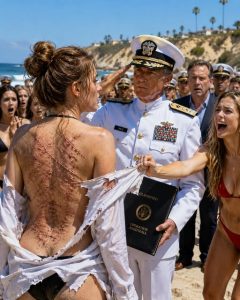
No seal visible to anyone watching. But I knew the weight of that kind of folder.
I had carried secrets like that across oceans, into bunkers, through rooms where men spoke in acronyms because the full words would have made them sound too human.
For five years, I had imagined someone asking me that question.
In nightmares.
In hospital rooms.
In the dark at three in the morning, when my scars burned and my right hand forgot how to stop shaking.
Are you ready to testify?
I looked at Admiral Thomas Hale.
His face had aged since I last saw him. Deeper lines beside his mouth. More silver in his hair. But his eyes were the same: sharp, steady, impossible to lie to.
Behind him, the beach remained frozen.
Vanessa stood barefoot in the sand, her mouth slightly open, designer sunglasses pushed into her hair. Her friends stared at me as if I had transformed into someone else in front of them.
My father had not moved.
Colonel Harrison Reed, retired Marine, a man who once told me shame was something weak people invented to avoid responsibility, looked suddenly very old.
“Commander Reed?” the Admiral asked.
My throat tightened.
Nobody had called me that in five years.
Not out loud.
Not with respect.
My family had stopped using my rank the moment the rumors began. Vanessa called me “the dropout.” My cousins whispered that I “couldn’t handle deployment.” My father said nothing, which was worse because silence from him always felt official.
I looked down at the black folder.
Then at my torn shirt, still loose around my shoulder, the scarred skin visible where Vanessa had yanked it open for entertainment.
Something inside me settled.
“Yes, sir,” I said. “I’m ready.”
A whisper moved through the crowd.
The Admiral nodded once.
“Then we need to leave.”
Vanessa blinked hard, as if waking from a dream she had not approved.
“Wait,” she said, stepping forward. “What is going on?”
No one answered her.
She laughed nervously and looked at the junior officers beside her. “Seriously, what is this? Some kind of military reunion thing?”
The officers did not laugh.
One of them, a lieutenant who had been smiling at her five minutes earlier, now stared at the sand like he wished it would swallow him.
My father finally spoke.
“Admiral Hale.”
His voice carried the clipped authority that once made recruits stand straighter.
The Admiral turned slightly. “Colonel Reed.”
They knew each other.
Of course they did.
Men like them always knew each other. Rank traveled in circles even after retirement. Golf tournaments. Memorial dinners. Veterans’ boards. Quiet rooms where old decisions were cleaned up and renamed history.
My father looked from the folder to me.
“What does my daughter have to do with Operation Nightfall?”
My daughter.
Not Commander.
Not Maya.
My daughter.
As if possession could replace all the years he had spent refusing to ask where I went when I came home broken.
Admiral Hale’s jaw tightened.
“More than you were told.”
My father stiffened. “I was briefed after the incident.”
“No,” the Admiral said. “You were managed after the incident.”
The words struck the beach like a gunshot.
My father’s face darkened.
Vanessa let out a small, disbelieving laugh. “Managed? What does that mean?”
“It means,” I said quietly, “that somebody lied.”
Every head turned to me.
For five years, I had carried my silence like a second skin. It had protected people who did not deserve protection. It had protected my family from embarrassment, the Navy from scandal, and powerful men from consequences.
It had never protected me.
Vanessa’s eyes flicked toward my scars, then away.
“You never said anything,” she muttered.
I looked at her.
“You never asked.”
Color rose in her cheeks, but she said nothing.
The Admiral stepped closer, lowering his voice. “Commander, we have a secure transport waiting.”
My father took one step forward. “I’m coming.”
“No,” I said.
He stopped.
For the first time in my life, I saw confusion cross his face at being denied by me.
“Maya.”
“No,” I repeated. “You don’t get to walk beside me now because an Admiral showed up.”
His mouth tightened. “I am your father.”
“You were my father on this beach ten minutes ago too.”
Silence.
The words landed harder than I expected.
His eyes moved to my torn collar, to the scars Vanessa had exposed while he stood and watched.
Something like shame flickered across his face.
Too late.
Admiral Hale looked toward two uniformed officers near the SUV. “Escort Commander Reed.”
I walked across the sand without looking back.
But I heard Vanessa behind me.
“Dad,” she whispered, suddenly sounding younger. “What did I just do?”
No one answered her.
The SUV smelled like leather, salt, and air-conditioning turned too high.
I sat in the back beside Admiral Hale while the vehicle pulled away from the beach. Through the tinted window, I saw my family getting smaller behind us. Vanessa stood motionless near the catering table. My father remained at the edge of the sand, shoulders rigid, staring after me like he had finally noticed I was leaving.
I placed the folder on my lap but did not open it.
Not yet.
The Admiral waited until we passed through the private gate before speaking.
“You should know I didn’t come to the beach by coincidence.”
“I assumed.”
“We were told you would be there.”
I turned to him. “By who?”
He hesitated.
“An anonymous source.”
I almost laughed.
“Convenient.”
“Very.”
“Do you trust it?”
“I trust the evidence it provided.”
My hand tightened on the folder.
“What evidence?”
Admiral Hale looked at me for a long moment.
“The missing drone feed from Nightfall.”
The air left my lungs.
For five years, the official record stated the drone feed had been corrupted during the strike. Conveniently corrupted. Permanently unrecoverable. Without that feed, the chain of command became fog. Blame scattered. Reports used phrases like communication failure, hostile ambiguity, operational confusion.
I had been the only surviving officer on the ground who knew it was a lie.
“You found it?” I asked.
“We didn’t. Someone sent it to Naval Criminal Investigative Service three days ago.”
“And?”
His face hardened.
“And it confirms your after-action statement was accurate.”
My after-action statement.
The one I gave from a burn unit with tubes in my arms and half my back dressed in grafts. The one that vanished from the official file. The one my father later told me must have been “trauma confusion” because no command would knowingly strike its own extraction corridor.
I closed my eyes.
For one second, I was back there.
Not on the beach.
Not in the SUV.
In Syria, five years earlier, under a moonless sky split open by fire.
Operation Nightfall had started as a rescue.
A joint intelligence team had gone dark after uncovering evidence that an American contractor was selling weapons routing data to hostile militias. My unit was sent to extract them before the militia moved the hostages across the border.
I was Lieutenant Commander Maya Reed then.
Thirty-one years old.
Decorated.
Trusted.
Still foolish enough to believe competence protected you from politics.
We reached the compound at 0214. Three hostages alive. One dead. Data drives secured. Enemy movement approaching from the east.
At 0231, we requested extraction.
At 0237, new orders came through an unauthorized channel.
Hold position.
At 0242, another order.
Destroy recovered materials.
I refused.
The intel proved corruption at a level too high to disappear in the sand. I had two wounded operators, three civilians, and hard evidence in my pack. I ordered my team toward the extraction corridor.
At 0250, the sky opened.
Not enemy mortar fire.
Not militia rockets.
A precision strike.
American.
I remembered the sound before impact. That terrible tearing shriek. The brief, impossible thought that someone had made a mistake.
Then heat.
Pressure.
Darkness.
When I woke, my back was burning and Petty Officer Collins was screaming beside me with no legs below the knee. I crawled through fire dragging one civilian by her collar while ammunition cooked off around us. I remembered my hands melting into the sand. I remembered Lieutenant Sayeed pushing the data drive into my vest and telling me, “Don’t let them bury this.”
Then he died with his eyes open.
Only four of us made it out.
Two died before dawn.
By the time I reached Germany, the first version of the story had already been written.
Miscommunication.
Compromised comms.
Enemy confusion.
Acceptable tragedy.
Then came the visitors.
Men without names.
A medical officer who told me memory was unreliable after blast trauma.
A legal advisor who said my statement could destabilize active operations.
My father, standing beside my hospital bed, saying, “Maya, don’t destroy your career chasing ghosts.”
But the ghosts had names.
Collins.
Sayeed.
Torres.
Dr. Emil Grant.
Amira Haddad.
People who had trusted me to get them out.
People who burned because someone wanted evidence erased.
The SUV turned onto the highway.
I opened my eyes.
“Who gave the strike order?” I asked.
Admiral Hale was silent for too long.
My pulse slowed.
“Sir.”
He looked out the window.
“The authorization code traces back to Rear Admiral Victor Kessler.”
The name struck like ice water.
Kessler.
Deputy Director of Strategic Naval Operations at the time.
Now retired.
Now a defense lobbyist.
Now a man who sat on three advisory boards with my father.
I swallowed.
“Does my father know?”
“We don’t know.”
“That’s not an answer.”
“No,” Hale said. “It isn’t.”
The SUV exited toward a secure federal facility near the naval base. My reflection stared back at me from the tinted glass: short dark hair, sun-browned face, eyes too still, collar torn enough for one pale scar to show.
“You said testify,” I said. “To whom?”
“Closed congressional military oversight hearing tomorrow morning. Followed by a grand jury if the Attorney General’s office accepts the referral.”
I turned sharply. “Tomorrow?”
“Once the drone feed surfaced, we moved fast.”
“Why now?”
The Admiral hesitated again.
I hated every pause.
“Because Kessler is being nominated for Secretary of the Navy.”
For a moment, I could not speak.
Of course.
Power did not vanish after crimes. It matured. It polished itself. It gave speeches about sacrifice.
“He’s going to be confirmed?” I asked.
“Not if your testimony stands.”
If your testimony stands.
Not if your testimony is true.
Truth was not enough in rooms like that. Truth had to survive lawyers, committees, reputation, money, and men who called murder an operational decision.
“What about the others?” I asked. “The surviving witnesses?”
Admiral Hale looked down.
My stomach tightened.
“Collins?”
“Dead,” he said.
I turned toward him slowly.
“No.”
“Two years ago. Officially accidental overdose.”
My throat closed.
Collins had survived the strike. Lost both legs. Sent me one message after I disappeared from the hospital system.
They’re watching us.
I never answered because I thought silence protected him.
It had not.
“And Dr. Nadir?” I asked.
“Missing.”
“Since when?”
“Eighteen months.”
I stared at the floor of the SUV.
There had been four of us alive after Nightfall.
Now there was me.
Only me.
The Admiral’s voice softened. “Commander, that is why we came personally.”
I understood.
This wasn’t just testimony.
It was survival.
When we reached the secure facility, they took me through a side entrance into a windowless conference room. Two Navy lawyers waited inside, along with a woman from the Department of Justice and an NCIS special agent named Park.
Coffee sat untouched on the table.
So did a laptop.
So did a sealed evidence drive in a clear plastic pouch.
Everyone stood when I entered.
That unsettled me more than the beach had.
For five years, people had looked away from me.
Now they stood.
The DOJ attorney introduced herself as Elaine Mercer. She was precise, silver-haired, and spoke like every word had been weighed before release.
“Commander Reed, before we begin, I need to confirm you are willing to provide sworn testimony regarding Operation Nightfall.”
“I am.”
“You understand there may be personal risk.”
“I understood that when an American strike hit my team.”
No one spoke.
Agent Park opened the laptop. “We need you to watch the recovered footage.”
My body reacted before my mind did.
My palms went cold. My scars tightened. Somewhere under the table, my right leg began to bounce once, twice, before I forced it still.
Admiral Hale noticed but said nothing.
The screen lit.
Grainy aerial footage appeared.
Desert compound. White-hot figures moving in thermal view. A timestamp in the corner.
I watched my team enter.
Watched us clear the courtyard.
Watched two hostages emerge.
Watched myself, a small pale shape on the screen, waving everyone toward the north wall.
My breathing became shallow.
Then audio clicked on.
Static.
Radio traffic.
My own voice came through, distorted but recognizable.
“Package secured. Three survivors. One KIA. Request immediate extraction.”
Another voice answered.
“Nightfall Actual, hold position.”
I whispered, “That wasn’t command.”
Agent Park nodded. “Keep watching.”
The feed continued.
Militia vehicles gathered east.
My team moved west.
Then came the second voice.
Cold. Male. Controlled.
“Nightfall Actual, destroy recovered materials before extraction.”
My recorded voice answered instantly.
“Negative. Materials are mission-critical evidence. We are extracting.”
A pause.
Then the cold voice said, “Commander Reed, you are ordered to comply.”
I remembered that moment.
Standing in the dark with blood on my sleeve, knowing the voice was wrong but not yet knowing how wrong.
On screen, the team moved into the extraction corridor.
A new transmission entered the channel.
“Strike authorized. Grid confirmed.”
My hands curled into fists.
The DOJ attorney leaned forward.
Agent Park froze the image.
“Commander Reed, do you recognize that voice?”
The room waited.
I had heard that voice in briefings. Ceremonies. Televised panels. My father’s retirement dinner.
“Rear Admiral Victor Kessler,” I said.
Elaine Mercer wrote something down.
Agent Park resumed the footage.
The strike came.
Even muted by recording, the explosion made my body jerk.
Fire bloomed white across the screen.
Thermal shapes disappeared.
One remained crawling.
Me.
I watched myself drag someone through flame until the drone feed abruptly cut.
Not corrupted.
Cut.
Deliberately.
The room was silent when the video ended.
I stared at the black screen.
No one offered comfort.
Good.
Comfort would have made me break.
Elaine Mercer slid a tissue box across the table anyway.
I ignored it.
“What happened to the data drives?” I asked.
Agent Park glanced at Hale.
The Admiral answered. “One was destroyed. One vanished in transit. One was recovered from Lieutenant Sayeed’s effects.”
I looked up sharply.
“Sayeed saved it?”
“Yes.”
“Where is it?”
Mercer folded her hands.
“That is the second reason we need you.”
Of course it was.
I sat back slowly.
“You don’t have it.”
“We had it,” she said. “It was logged into evidence five years ago, then reclassified and transferred under sealed order.”
“By Kessler.”
“By Kessler’s office.”
“And now?”
“Gone.”
I laughed once, quietly.
Five years.
Burned bodies. Dead witnesses. Missing evidence.
And the machine still had holes big enough for powerful men to walk through clean.
“What did the drive contain?” Mercer asked.
I looked at the black folder.
“Contracts. Routing schedules. Payment confirmations between Danton Meridian Security and militia intermediaries. Names of officials who protected the transfer chain.”
Mercer’s gaze sharpened. “Do you remember the names?”
“Some.”
“Was Kessler one of them?”
“No.”
The room shifted with disappointment.
I continued, “But his brother-in-law was.”
Admiral Hale’s face hardened.
“Graham Vale,” I said. “Chief financial officer of Danton Meridian.”
Mercer wrote quickly.
Agent Park asked, “Why didn’t you include that in your original statement?”
“I did.”
No one spoke.
“I named him from the burn unit,” I said. “I named the company. I named the unauthorized channel. I named Kessler’s voice.”
Mercer’s pen stopped.
“My statement was recorded by a JAG officer named Commander Willis Trent.”
Admiral Hale looked at Park.
Park typed something fast.
Mercer’s voice dropped. “Commander Reed, there is no Commander Willis Trent listed as having interviewed you.”
I smiled without humor.
“Well. That’s a problem, considering he sat beside my bed for forty minutes and told me I might be charged with insubordination if I kept talking.”
Agent Park turned the laptop toward us.
“No Willis Trent in JAG records. But there is a William Trent. Civilian intelligence contractor. Formerly attached to Danton Meridian.”
The room went cold.
I closed my eyes.
They had sent the contractor to take my statement.
They had taken my words before I even knew the war had moved into the hospital.
A knock sounded at the door.
One of the officers stepped out, then returned with a grim expression.
“Admiral, Colonel Reed is outside.”
My father.
Of course he was.
Admiral Hale looked at me. “Do you want him removed?”
I should have said yes.
Every logical part of me wanted him gone.
But the beach was still burning in my mind. The way he had stood silent while Vanessa laughed. The way he asked what I had to do with Nightfall, as if my scars had been decorative all along.
“No,” I said. “Let him in.”
My father entered without Vanessa.
He had changed clothes. Gone was the linen beach shirt. Now he wore a pressed navy polo and slacks, his posture controlled, his expression unreadable.
But his eyes went first to the laptop.
Then to the black folder.
Then to me.
“Maya.”
“Colonel.”
The formal address landed between us like a locked gate.
He flinched, barely.
Admiral Hale stood. “This is an active federal inquiry. You are not authorized to be here.”
My father looked at him. “I was told my daughter may be testifying against Victor Kessler.”
“By whom?” Mercer asked immediately.
He glanced at her.
That hesitation told me everything.
I stood slowly.
“Dad.”
His jaw tightened.
“Who called you?”
He did not answer.
My voice hardened. “Who?”
“Kessler.”
The room seemed to still.
Agent Park stepped closer to the table.
“When?” Mercer asked.
“An hour ago.”
“And what did he say?” Admiral Hale demanded.
My father’s eyes stayed on me.
“He said Maya was being used by men with political motives. He said reopening Nightfall would destroy reputations and damage national security.”
I laughed softly.
“There it is.”
“Maya—”
“No. Let me guess. He told you my memories were unreliable. That I was traumatized. That good people made hard calls.”
My father’s face shifted.
Yes.
He had said exactly that.
For five years, my father had believed a man protecting himself over his own daughter.
“Did you know?” I asked.
The question came out quieter than I expected.
His brow furrowed. “Know what?”
“That they struck us on purpose.”
“No.”
“Did you know I reported it?”
He looked away.
My stomach dropped.
“You did.”
“I knew you made allegations while heavily medicated.”
“I was lucid.”
“That is not what I was told.”
“By Kessler.”
His silence answered.
The room around us disappeared. For a moment, I was not Commander Reed in a federal facility. I was fifteen again, standing in our kitchen with a report card full of A’s, waiting for my father to look up from his phone.
Waiting.
Always waiting.
“You let them call me unstable,” I said. “You let Vanessa call me a failure. You let everyone think I washed out.”
His voice roughened. “I thought I was protecting you.”
I almost smiled.
Men loved that phrase.
It covered every cowardice.
“From what?”
“From going to war with people too powerful to fight.”
“I was already at war.”
“No,” he snapped, suddenly angry. “You were burned over half your back. You woke screaming every night. You couldn’t stand in direct sunlight. You flinched when doors closed. And every time you spoke about Nightfall, men came to the house. Men I knew were dangerous.”
That stopped me.
“What men?”
His mouth tightened.
“Kessler sent them?”
My father did not answer.
“Dad. What men?”
He looked suddenly exhausted.
“I don’t know who sent them. They came two weeks after you were discharged. Said if you kept making accusations, your medical record would be reviewed. Your conduct. Your fitness. They said your pension could disappear. Your care could be delayed. They said accidents happened to unstable veterans.”
My throat tightened.