The auditorium smelled like floor wax, warm paper programs, and coffee that had been sitting too long in a metal urn near the lobby doors.
Every folding chair squeaked when a parent shifted.
Every whisper seemed to bounce off the gym walls.
The air-conditioning hummed too loudly above us, like even the building knew something was wrong.
I stood beneath the red EXIT sign with both hands wrapped around my son’s graduation program.
The paper was already bent at the corners.
I was not reading it.
I had read it twice in the parking lot before walking inside.
I knew the ceremony order.
I knew when the choir would sing.
I knew when the scholarship awards would be announced.
I knew exactly where Michael’s name appeared.
Valedictorian Address.
10:42 a.m.
The school office had printed it neatly on thick white paper, and when the woman at the front door handed it to me, she smiled the way people smile at mothers on days like that.
Proud.
Busy.
A little teary without knowing your story.
I had smiled back because I was trying to be normal.
I had tried to be normal from the moment I woke up that morning.
I had ironed my blouse twice because the first time I left one sleeve wrinkled.
I had stood in my small bathroom with the steam from the shower still on the mirror, trying to make my hair look like I had not worked a double shift two nights before.
I had driven to the school early because Michael had asked me to.
“Mom,” he had said in the parking lot at 8:18 that morning, his black graduation gown wrinkled at the shoulders. “Second row. I saved you the best seat.”
He tried to say it casually.
He was eighteen, which meant he still believed he could hide tenderness by looking annoyed.
But his ears had gone pink.
He hugged me fast, then longer than he meant to, and when I started crying, he laughed under his breath.
“Don’t do that yet,” he whispered. “I haven’t even graduated.”
I wiped my eyes with the heel of my hand and told him I was fine.
I was not fine.
I had watched him walk into that building with his honor cords swinging against his gown, and for one second I saw all of him at once.
The five-year-old with a backpack too big for his shoulders.
The nine-year-old asleep at the kitchen table beside a half-finished science project.
The twelve-year-old pretending not to be scared when our rent was late.
The fifteen-year-old making ramen at 11:30 at night because I had gotten called in for another shift.
The eighteen-year-old who still turned around in the school parking lot to make sure I was watching.
Then I saw him stop at row B.
He bent over one chair and smoothed a white place card flat with his palm.
I could not read it from where I stood near the aisle, but I knew the shape of my own last name in his handwriting.
Evans.
That was the seat he saved for me.
And now, less than two hours later, I was standing at the back of the auditorium while another woman sat in it.
The usher was a boy named Brandon.
His bow tie was crooked, and his white shirt looked too stiff around his neck.
He held a clipboard against his chest like it might protect him from the adult mess he had been handed.
“Ma’am,” he said quietly, “I’m sorry. Those seats up front are taken now. You’ll need to stand back here.”
He was polite.
That almost made it worse.
Because he was not the one who had done it.
He was just the one being forced to say it.
From the back wall, I could still see row B.
Two chairs were reserved.
Two place cards had been there.
One was still upright.
The other was ripped clean down the middle and kicked beneath the front row.
A metal chair leg pinned it to the floor.
Not hidden well enough.
Not hidden at all.
Just treated like trash.
I could read the last part of the name.
Evans.
My son’s handwriting.
My sister Claire stood beside me, her jaw so tight I could see a muscle move near her cheek.
“Sarah,” she said under her breath. “That is your seat.”
“I know.”
“She moved it.”
“I know.”
“She tore your name card.”
“I know.”
Claire turned her head slowly toward row B.
I did not have to follow her eyes.
I already knew where they had landed.
My ex-husband David sat in the second row with his shoulders squared and his program open in both hands.
He had that stillness he used whenever he wanted to disappear without actually leaving.
His eyes were on the page.
They were not reading.
I knew David well enough to know when he was pretending.
He did not turn around.
He did not ask where I was supposed to sit.
He did not look at the torn place card under the chair in front of him.
He did nothing.
Beside him sat Chloe.
Bright blue dress.
Perfect curls.
Phone already out.
Smile too small for anyone else to notice and too sharp for me to misunderstand.
She sat in my son’s reserved seat like she had earned it by wanting it badly enough.
Then she lifted her phone.
For one second, I thought she was checking her makeup.
Then I saw the angle.
The lens was pointed toward me.
She was filming me standing beneath the EXIT sign at my own son’s graduation.
A person can be humiliated quietly.
That is what people who have never been publicly erased do not understand.
Humiliation does not always need shouting.
Sometimes it is a woman in your chair holding up a phone.
Sometimes it is your ex-husband staring at a program he is not reading.
Sometimes it is a teenage usher trying not to look at the torn evidence on the floor.
Claire leaned toward me.
“Let me handle this.”
“No.”
“Sarah.”
“No.”
I could hear the danger in her voice.
Claire had been there for the years David missed.
She had picked up Michael from school when my shift ran late.
She had sat in our kitchen helping him cut poster board for history projects while I packed lunch for the next day.
She had brought groceries once and left them on the porch because she knew I was too proud to take them face-to-face.
She had earned the right to be angry.
But Chloe wanted that anger.
She wanted a scene.
She wanted me walking down the aisle, shaking, crying, pointing, demanding my seat back in front of six hundred people.
She wanted me loud.
She wanted me ugly.
She wanted a video she could crop down to thirty seconds and send around with whatever caption made her look innocent.
Look how bitter Sarah is.
Look how jealous.
Look how unstable.
Look how she ruined Michael’s big day.
I knew the game because I had been surviving it for years.
So I swallowed it.
I swallowed eighteen years of gas station coffee at 5:12 in the morning.
I swallowed double shifts that left my ankles swollen and my wrists smelling like cleaner.
I swallowed thrift-store winter coats, school lunch forms, unpaid electric bills, and the county clerk envelope I once filed alone because David said he was too busy to come to the support modification hearing.
I swallowed the hospital intake desk at 2:06 a.m. when Michael’s fever hit 104 and David did not answer his phone.
I swallowed parent-teacher conferences where I arrived in scrubs and smiled like I had not cried in the car.
I swallowed birthdays David forgot until Facebook reminded him.
I swallowed math competition weekends in a car that coughed at every red light.
A child does not become steady by accident.
Somebody stands behind him when nobody is clapping yet.
For Michael, that somebody had been me.
The school band began to play.
The first notes scraped through the speakers, then settled into something almost pretty.
Parents lifted their phones.
A little girl two rows ahead of me stood on tiptoe to see over her grandmother’s shoulder.
The principal moved near the stage steps with a folder tucked under one arm.
A teacher in a navy dress checked a seating list on a clipboard, looked toward row B, frowned, and then looked away.
That tiny movement almost broke me.
Because she knew.
Maybe not the whole story.
But enough.
Enough to know a reserved seat had been changed.
Enough to know a torn place card did not tear itself.
Enough to know I was standing where I should not have been standing.
But people are careful around family drama when it is not their own.
They look away and call it staying neutral.
Claire’s fingers brushed my elbow.
“You don’t have to take this.”
For one ugly heartbeat, I imagined walking down that aisle.
I imagined picking up the torn place card.
I imagined placing both halves in Chloe’s lap while every parent in the auditorium watched her smile fall apart.
I imagined David finally having to choose a side where everyone could see him.
Then I looked at the stage.
Michael was standing near the curtain.
He looked taller than I remembered.
His cap sat a little crooked.
His honor cords were bright against the black gown.
He scanned the front rows first.
That was where I was supposed to be.
His eyes paused on row B.
I saw the moment he noticed David.
I saw the moment he noticed Chloe.
I saw the moment he did not see me.
His face tightened, but he kept looking.
Past row B.
Past the teachers.
Past the phones.
Past the crowd of people pretending this was only a graduation ceremony.
Then he found me.
Under the EXIT sign.
His face changed.
I cannot explain exactly how.
It was not childish shock.
It was not panic.
It was something quieter.
Something older.
Like he had just understood a language he had been hearing his whole life.
The principal stepped to the microphone.
“And now,” she said, smiling into the bright room, “please welcome this year’s valedictorian, Michael Evans.”
The applause rose around me.
Warm.
Full.
Completely wrong.
Chloe lifted her phone higher.
David finally looked up, but only toward the stage.
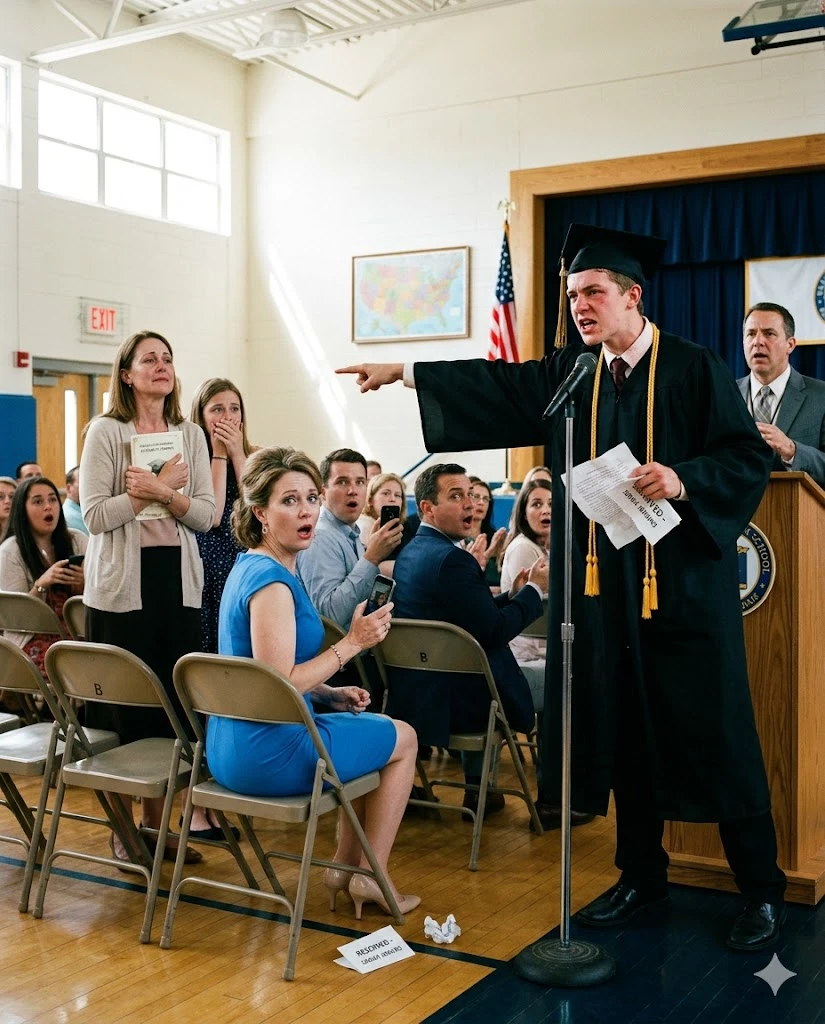
Michael walked to the podium.
He did not smile.
That was when the room began to change.
At first, only I noticed.
Mothers notice the smallest things.
The way a shoulder sets.
The way a jaw locks.
The way a boy who used to ask you to check under his bed suddenly looks like a man standing in front of a room that has disappointed him.
Michael pulled a folded speech from his pocket.
He looked down at it for one long second.
Then he folded it again.
The paper crackled near the microphone.
A tiny sound.
Sharp enough that the first two rows went quiet.
The principal glanced at him.
Chloe’s phone remained in the air.
David shifted in his chair.
Michael raised his eyes.
He looked straight at Chloe.
Then he pointed.
No one breathed.
His hand did not shake.
For the first time all morning, Chloe’s smile disappeared.
Michael leaned toward the microphone.
“That seat was for my mother.”
The words carried cleanly through the auditorium.
Not shouted.
Not dramatic.
Steady.
That steadiness did more damage than anger ever could.
A rustle moved across the room.
Programs lowered.
Phones hovered in midair.
Somewhere near the front, a woman whispered, “Oh my God.”
Chloe’s phone dropped an inch.
David’s head snapped toward her, then toward me, then back to Michael as if he could rearrange the scene by looking at it in a different order.
Michael did not look at him.
“At 8:18 this morning,” he said, “I put her name on that chair myself.”
My throat closed.
Claire’s hand found mine.
“I asked the school office for two reserved cards,” Michael continued. “One for my dad. One for my mom.”
He reached into the pocket of his gown.
For a second I thought he was pulling out his speech again.
Instead, he pulled out a small white envelope.
My name was written across the front in blue marker.
Sarah Evans.
The same handwriting as the torn card under row B.
Brandon, the usher, looked down.
Then, with the careful horror of someone realizing he had been standing beside the truth the whole time, he bent and picked up the ripped half from the floor.
He held it in his hand.
The auditorium saw it.
Chloe saw it.
David saw it.
Michael saw it.
There are moments when a lie does not need to be argued with.
It only needs to be held up to the light.
The principal stepped closer to the microphone, then stopped.
Maybe she wanted to interrupt.
Maybe she knew she should not.
Michael opened the envelope.
Inside was a single page.
He unfolded it.
David stood halfway.
“Michael,” he said, low but audible because the room had gone so still. “Don’t do this here.”
Michael finally looked at him.
For one second, I saw my little boy again.
Not weak.
Not small.
Just hurt.
“Dad,” he said, “you already did.”
David’s face changed.
Chloe whispered something I could not hear.
The principal took one slow step backward.
Michael looked down at the page in his hand.
“This was supposed to be the dedication page,” he said. “I wrote it last night. I wasn’t going to read it out loud because Mom hates attention.”
A few people turned toward me.
I wanted the floor to open.
I wanted to disappear.
I also wanted to hear every word.
Michael swallowed.
“The first line says, ‘For my mother, who sat in the back of every room so I could stand in the front of one.'”
Claire made a broken sound beside me and covered her mouth.
I could not move.
The program in my hands bent deeper.
Michael kept reading.
“It says, ‘For every shift she took when she was already tired. For every school project she helped me finish after midnight. For every bill she hid from me until I was old enough to understand what hiding it cost her.'”
A teacher near the aisle wiped her cheek.
Chloe stared straight ahead now.
Her phone was no longer raised.
Michael lifted the page slightly.
“I was going to read this to her at dinner tonight,” he said. “Not here.”
Then he turned his face toward row B.
“But someone decided she should watch from the back.”
The words did not accuse.
They landed anyway.
David’s mouth opened.
Nothing came out.
That silence was familiar.
It had filled hospital rooms.
It had filled birthdays.
It had filled court hallways.
It had filled every place where he should have stood up and chose instead to make absence look like peace.
Michael looked at the principal.
“May I ask my mother to take the seat I saved for her?”
The principal did not hesitate then.
“Yes,” she said, her voice thick. “Of course.”
Brandon moved first.
He stepped into the aisle, holding the torn place card like an apology.
Claire squeezed my hand so hard it hurt.
“Go,” she whispered.
I could not feel my legs at first.
Then I walked.
Past the back row.
Past parents whose faces had gone soft with embarrassment and sympathy.
Past phones slowly lowering.
Past the teacher with the clipboard.
Every step sounded too loud.
Chloe did not move until I reached row B.
She looked at David.
David looked at the floor.
That was his final answer.
Not a word.
Not a hand.
Not even now.
Chloe stood.
Her chair scraped the gym floor.
The sound echoed.
She gathered her purse with shaking fingers.
The blue dress that had looked so bright from the back of the room suddenly looked harsh under the lights.
I did not look at her for long.
There was nothing I needed from her face.
Brandon placed the repaired halves of the card on the chair beside the envelope.
He did not know what to say.
So he said the only thing that mattered.
“I’m sorry, ma’am.”
I nodded because my voice would not work.
Then I sat in the seat my son had saved for me.
Second row.
Close enough to see the scratch on the podium.
Close enough to see Michael’s hands.
Close enough for him to look down and find me exactly where he had put me.
The room remained silent for another beat.
Then someone began clapping.
It was a woman on the left side of the auditorium.
Then another parent.
Then a teacher.
Then the whole room rose into applause that did not sound like the first applause.
This one was not polite.
This one had weight.
Michael closed his eyes for half a second.
When he opened them, he looked at me.
I nodded.
That was all I could do.
He nodded back.
Then he unfolded his original speech.
“My prepared remarks are about leadership,” he said, and a small, sad smile touched his mouth. “I guess I should start by saying I learned the most about leadership from someone who never had a title.”
People sat down slowly.
Chloe stood at the end of the row, frozen, as if leaving would make her guilt louder and staying would make it disappear.
David stayed seated.
His program lay unopened in his lap.
Michael began again.
He talked about teachers.
He talked about classmates.
He talked about showing up when it was hard.
He talked about responsibility without saying his father’s name.
He talked about sacrifice without making me sound like a saint.
That was my son.
Even then, he protected me from being turned into a symbol.
He made me human.
He made me seen.
When the ceremony ended, people crowded the aisles with flowers and balloons and camera straps.
I stayed seated for a moment because I was afraid my knees would not hold.
David approached first.
Of course he did.
He always came after the hard part was over.
“Sarah,” he said, rubbing one hand over his mouth. “That got out of hand.”
I looked at him.
For years, I had imagined all the things I might say if he ever stood in front of me after failing us one time too many.
I had imagined anger.
I had imagined a speech.
I had imagined finally making him understand.
But when the moment came, I was just tired.
“No,” I said. “It got honest.”
His face tightened.
Chloe stood behind him, pale and furious and embarrassed in equal measure.
She looked like she wanted to blame me but could not find a version of the story where I had done anything but stand quietly in the back.
Michael reached us before David could answer.
He still had his cap on.
It was still crooked.
For some reason, that nearly broke me again.
He stepped between me and his father without raising his voice.
“I want pictures with Mom first,” he said.
David blinked.
“Michael—”
“Mom first,” Michael repeated.
Not cruel.
Not loud.
Final.
Claire appeared at my side with wet eyes and a smile she was trying to control.
“Come on,” she said. “We are getting every picture.”
So we did.
We took one by the stage.
One near the school banner.
One outside by the brick wall with the small American flag moving in the warm breeze.
Michael put one arm around my shoulders and bent his head toward mine the way he had when he was little and wanted to tell me a secret.
“I’m sorry,” he whispered.
I pulled back.
“For what?”
“For not seeing sooner.”
That was when I cried.
Not because of Chloe.
Not because of David.
Not because of the seat.
Because my son thought love meant he should have protected me from something I had spent his whole life trying to keep off his shoulders.
I held his face in both hands.
“You were the child,” I said. “I was the mother. And I would do all of it again.”
His eyes filled.
“I know.”
“No,” I said. “You don’t. Not yet. But someday, when life asks you to show up for someone even when you’re tired, you’ll understand. And when you do, I hope you remember this part too.”
“What part?”
“The part where you don’t have to humiliate someone to tell the truth.”
He looked back toward the auditorium doors.
Chloe was gone.
David stood alone near the entrance, holding his program like it had become evidence against him.
Michael nodded slowly.
“I tried not to.”
“I know.”
He looked at me again.
“But I couldn’t let her sit there.”
I smiled through tears.
“Good.”
That made him laugh once, watery and small.
Later, at dinner, Michael gave me the dedication page.
The original one.
Not the one the auditorium heard.
There were more lines on it.
Lines about the science fair volcano that never erupted until the parking lot.
Lines about the time I drove through a thunderstorm to get him to a scholarship interview.
Lines about the night he found me asleep at the kitchen table with an unpaid bill under my hand and quietly washed the dishes without waking me.
At the bottom, he had written one sentence I still keep folded in my wallet.
She never had the best seat, so I saved her mine.
I have unfolded that page many times since graduation day.
Not when I want to remember what Chloe did.
Not when I want to be angry at David.
I unfold it when I forget that quiet years still count.
I unfold it when I need to remember that children see more than we think, but they also remember more love than pain.
That day did not fix everything.
Real life rarely works that cleanly.
David did not become a different man because six hundred people watched him fail to stand up.
Chloe did not apologize in some beautiful hallway scene with tears in her eyes.
She sent one stiff text two days later saying the seating had been a misunderstanding.
I did not answer.
Some lies are too small to deserve your breath.
Michael left for college that fall.
I cried in the parking lot after moving him into his dorm because I am still me, and he still laughed because he is still him.
Before he walked away, he hugged me hard.
“Mom,” he said, “you know where you’re sitting at graduation next time, right?”
I wiped my face.
“Where?”
He grinned.
“Wherever you want.”
And for the first time in a long time, I believed him.