Part 2/1
My phone buzzed at 3:47 on a Tuesday afternoon, and the sound cut through my office like a small alarm no one else could hear.
I was standing at the glass wall overlooking the city, watching traffic crawl between towers of steel and sunlight, when the screen lit up with a name I had not seen in eight months.
Dad.
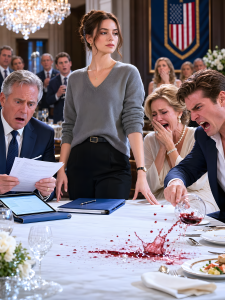
For a moment, I did not move. My assistant was outside my office. My CFO was waiting on the final acquisition memo. My company’s legal team had three contracts sitting in my inbox, all marked urgent, all worth more money than my father had ever believed I could touch. Yet the sight of that one name pulled me backward so fast it almost made me dizzy.
The message was short.
Family celebration tonight. Important news about the expansion. Don’t be late.
I read it once. Then again. Then a third time, slower, as if another meaning might reveal itself between the words. There was no hello. No apology. No “How have you been?” No mention of the eight months of silence that had stretched between us like a locked gate.
Eight months without a birthday call. Eight months without a holiday invitation. Eight months without my mother sending me a picture of her new curtains or my brothers asking me to fix their laptops or my father pretending to need my opinion just long enough to dismiss it. They had not missed me. They had not worried. They had simply erased me.
Until that morning.
At eight o’clock, Forbes had published its business feature, and my face had appeared beside a headline about my company, Meridian Route, and one number my family could understand even if they understood nothing else about what I had built.
$92 million.
Not revenue. Not profit. Not cash sitting in a vault with my name on it. A valuation. A belief from investors that the logistics platform I had built from sleepless nights, humiliating pitches, and years of being told I was too serious, too plain, too ambitious, too much and never enough, was now worth ninety-two million dollars.
My family did not know the difference between valuation and liquidity. They knew only the number. They knew only that the daughter they had treated like background noise had suddenly appeared in a magazine with money attached to her name.
I used to imagine receiving a message like that from my father. Not this one, not a demand disguised as an invitation, but a message that said he had seen me. A message that said he was proud. When I was younger, I used to rehearse what I would say if he ever noticed my work. I would be calm, grateful, graceful. I would forgive everything in one bright, foolish second.
But standing there in my office, holding my phone in my hand, I felt no hope at all.
I felt cold.
That coldness had started two years earlier, on the night of the rain. The night I thought I had finally done something so undeniable that even my family would have to look at me.
It was the night I closed my Series B funding round. Twenty million dollars. Twenty million after months of eighteen-hour days, after sleeping on an office floor with a hoodie as a pillow, after eating noodles from Styrofoam cups while investors asked whether I had a male co-founder hidden somewhere who understood the “aggressive side” of logistics.
I smiled through every insult. I answered every question. I remembered every number. I walked into rooms full of men who looked past me and walked out with their signatures.
When the money cleared, I did not want a nightclub. I did not want champagne sprayed over strangers. I wanted my parents, my brothers, and the one uncle who seemed to appear anywhere free food existed. I wanted one dinner where my family sat around a table and admitted I had done something real.
So I booked a private room at Le Jardin, a restaurant my mother had always called “proper.” White tablecloths. Crystal glasses. Waiters in tuxedos. I ordered the seafood tower she loved. I ordered the steak my father praised every time he wanted to sound rich. I chose a blue dress after standing in front of my closet for almost an hour, wanting to look successful but not arrogant, proud but still lovable.
At seven o’clock, I sat in that private room alone.
At seven-fifteen, I told the waiter my family was just running late.
At seven-forty-five, I texted my mother.
At eight, Jason messaged that something had come up with the kids, even though I knew it was his ex-wife’s weekend.
Ten minutes later, my mother claimed she had a migraine and told me to take pictures of the food.
I should have left it there. I should have protected myself from the truth. But pain makes people reckless, and hope makes them stupid. I opened Instagram and saw my cousin’s story. There was music, laughter, lights, and in the background, my mother in full makeup, holding a martini glass like a trophy.
She was at Tyler’s influencer launch party.
Tyler had no product, no business plan, no job, and no audience that extended beyond his phone screen. But he had decided he was becoming a lifestyle brand, and my family had shown up for him. They had chosen a pretend career over my twenty-million-dollar milestone.
My father did not even bother lying. He simply never came.
I sat there until the ice melted around the untouched seafood. I paid the bill for food no one ate, walked out into the rain, and stood on the sidewalk in that blue dress until the fabric clung to my skin and my tears disappeared into the weather.
That night did not create the wound. It only showed me how deep it already was.
The pattern had been there since childhood. When I was ten, I won the state science fair with a working water filtration model I built from tubing, charcoal, sand, and stubbornness. My parents skipped the ceremony because Tyler had a soccer game. He played soccer every weekend. I won state once.
“Don’t be selfish,” my mother said when I cried. “Your brother needs support.”
Tyler’s team lost. They bought him ice cream. I stood on a stage alone while the principal looked into the audience, searching for parents who were not there. His pity hurt almost as much as their absence.
When I graduated college, they left early because Uncle Jeffrey said the speeches were boring. When I started my first company, I asked my father for five thousand dollars to buy a server. He sighed as if I had asked him to sell his soul.
“Business is risky, Vivian,” he said. “And you’re a girl. Find a stable job. Better yet, find a stable man.”
Two weeks later, he bought Jason a forty-thousand-dollar truck. Jason crashed it into a mailbox within a month. Dad laughed and called it a lesson.
They did not hate me. Hate would have been easier. Hate would have meant I mattered enough to stir something in them. They simply did not consider me. I was the dependable daughter. The quiet one. The one who did not need anything, so they gave me nothing.
Then Forbes called me successful, and suddenly my father remembered my number.
I looked again at his message. Family celebration tonight. Important news about the expansion. Don’t be late.
I could already see the shape of the trap.
My company’s CFO, Alina Reyes, knocked lightly on my office door and stepped inside. She was sharp, calm, and built out of numbers the way some people are built out of muscle. She had been with me since Meridian Route was six people in a rented room above a dentist’s office. She knew the company. She knew my family history in pieces, though I had never given her all of it.
“You saw the message,” she said.
I turned my phone so she could read it.
Her mouth tightened. “That’s convenient.”
“They saw Forbes.”
“They saw the number,” she corrected.
I gave a humorless laugh. “Same thing to them.”
Alina studied me. “Are you going?”
“Yes.”
She did not look surprised. “As their daughter or as their creditor?”
That was why I trusted her. She never softened a truth unless softness made it more precise.
“As both,” I said. “But they only invited one.”
Alina placed a gray folder on my desk. “Then you’ll want this. Public records. Liens, defaults, lender filings, occupancy reports, tax issues. It’s worse than we thought.”
I opened the folder. My family’s motel chain, Miller Hospitality Group, had been rotting for years behind polished cars and country club smiles. Defaults. Second mortgages. Private debt at brutal interest. Taxes unpaid. Occupancy collapsing. Repairs ignored. The old Miller Inn, the “backbone of the family,” was less a business than a corpse dressed in a suit.
“They’re going to ask for money,” Alina said.
“I know.”
“How much do you think?”
“Enough to insult me.”
Her eyes moved over the papers. “They’re insolvent, Vivian. If they pull you into this with a bridge loan, they won’t pay you back.”
“I’m not giving them a loan.”
Alina waited.
I closed the folder and looked out at the city again. In the reflection of the glass, I saw a woman in a tailored black suit, hair smooth, posture straight, face controlled. A woman investors trusted with millions. A woman employees called decisive. A woman my father had once told to find a husband because business was too risky.
“Get the acquisition documents ready,” I said. “If they want to talk business, we’ll talk business.”
When I stood in my apartment that evening, choosing what to wear, I almost reached for the version of myself they had never met. The red designer dress. The sharp heels. The watch that cost more than the sedan I drove through college. I could have walked into that dinner glowing with wealth and let them feel the full distance between who they thought I was and who I had become.
But that would have made them careful.
My family respected money only when it announced itself loudly. If I arrived dressed like the CEO Forbes had photographed, my father would perform respect. My mother would perform tenderness. Jason would polish his greed with charm. Tyler would call me iconic and ask for a collaboration. They would hide the sharp edges long enough to get what they wanted.
I needed the truth. Not the version they would offer a rich woman, but the version they still believed belonged to their forgotten daughter.
So I put the red dress back.
I chose plain black trousers and a gray sweater I had owned for years. The sleeve had a loose thread near the wrist. I wore flats. I tied my hair back in a messy bun and left my face bare. In the mirror, I looked tired, practical, unremarkable.
I looked like the Vivian they remembered.
“Perfect,” I whispered.
In the garage, my sleek black electric sports car waited in silence. Beside it sat my old 2016 sedan with fading paint and a dented bumper. I had kept it for errands, bad weather, and days when I did not feel like being seen. That night, invisibility was strategy.
The sedan coughed when I started it. The air conditioning rattled. The cabin smelled faintly of dust and old coffee. As I drove toward Oak Haven Country Club, the city loosened into wealthy suburbs, and my stomach began to tighten with old reflexes.
It was embarrassing how the body remembers what the mind has outgrown.
I had stood in rooms with investors who tried to bully me. I had fired executives twice my age. I had negotiated contracts across three continents before breakfast. Yet the thought of walking into a room with my father made my hands grip the steering wheel too hard.
Old voices rose inside me.
You’re too sensitive, Vivian.
Why can’t you be more fun like Tyler?
You always ruin the mood.
I breathed through them and kept driving.
By the time I reached the club gate, my face had settled into stillness. The guard looked at my dented sedan with open suspicion.
“Deliveries go around back,” he said.
“I’m here for the Miller dinner,” I replied. “Vivian Miller.”
He checked his clipboard, frowned, looked at the car again, and waved me through with bored discomfort. It was almost funny. He had no idea he was letting in the person who would own a piece of the debt attached to the very place he guarded by midnight.
The club rose at the end of a long driveway, all manicured lawns, stone columns, and expensive lighting. My father’s Range Rover was parked near the entrance. Jason’s Porsche sat beside it, polished like a lie. My sedan looked like a bruise between them.
I turned off the engine and sat in the quiet.
A text came from Alina.
Documents ready. I’m nearby. Say the word.
I replied, Give me thirty minutes.
Then I went inside.
The private dining room was called the Gold Room, and it looked exactly like the kind of place my family wanted to be seen in. Dark wood walls. A chandelier like frozen lightning. A round table set for six. This time, unlike the night at Le Jardin, every chair was filled.
My father sat at the head of the table in his navy suit, the one he wore when he wanted to intimidate bankers. My mother glittered beside him, her jewelry bright enough to signal distress if stranded at sea. Jason leaned back with performative confidence, tie crooked, eyes restless. Tyler scrolled his phone until he noticed me, then looked up with the lazy curiosity of someone spotting an object he had misplaced. Uncle Jeffrey had already started on his scotch.
The performance began the second I crossed the carpet.
“There she is!” my mother cried, rising so dramatically her chair scraped the floor.
She rushed to me and wrapped me in a hug that felt less like affection than possession. Expensive perfume and hairspray filled my nose. Her arms tightened around me as if an audience were watching from the walls.
“We missed you so much, Vivi.”
Vivi. A name she had not used since I was small enough to believe it meant love.
“Hi, Mom,” I said.
I did not hug her back.
She either did not notice or chose not to care. She guided me toward the table with a bright smile, presenting me like an ornament she had found in the attic and decided was valuable after all.
“Look who made time for us,” my father boomed.
He stood and offered his hand. My father had always believed a handshake was a contest. He squeezed hard, trying to remind me who he was. I squeezed back with equal pressure. Surprise flickered across his face, gone almost instantly.
“Sit, sit,” he said, laughing too loudly. “We ordered champagne. Only the best tonight.”
I sat between Jason and Uncle Jeffrey. Jason looked me over and smirked.
“Nice sweater,” he said. “Target?”
“Jason,” my mother scolded, smiling as if the cruelty were charming. “Don’t tease your sister. She’s being thrifty. That’s how rich people stay rich, isn’t it, Vivian?”
“Something like that,” I said.
The champagne came. My father raised his glass.
“To family,” he declared, “and to success.”
They echoed him. I lifted my glass, but I did not drink.
They were greedy with the champagne, eager with the food, nervous under the laughter. Tyler mentioned Forbes first, of course, because restraint had never been one of his hobbies.
“Ninety-two million,” he said, still half-looking at his phone. “That’s insane.”
“It’s a valuation,” I said. “Not cash.”
“Still,” Dad said, waving that distinction away. “Who would have thought our quiet little Vivian running a tech empire?”
“It’s a logistics platform,” I corrected. “We optimize global supply chain routing for commercial freight.”
“Right, right. Computer stuff.” He smiled as though accuracy were a party trick. “Very smart.”
Uncle Jeffrey lifted his glass. “I always knew she had the Miller work ethic.”
I almost laughed. The Miller work ethic, as far as I could tell, consisted of inheriting property, underpaying staff, ignoring maintenance, and calling yourself self-made at every dinner.
My mother reached across the table and patted my hand. Her fingers were cold.
“I told the girls at the club today,” she said. “My Vivian is in Forbes. They were so jealous.”
There it was. Not pride. Social currency.
They did not ask what Meridian Route did. They did not ask how hard the last years had been. They did not ask what I planned to build next. They wanted the number, the headline, the reflection of my success shining briefly on them.
Dinner moved like a staged play. Tyler complained about algorithms and offered to promote my “app” to his followers. Jason complained about employees wanting overtime at the motel company, though I knew he usually left work by two to play golf. My mother spoke tragically about the wrong shade of Italian marble arriving for the lake house renovation.
“It was eggshell,” she said, eyes wide with horror. “I specifically ordered ivory.”
“That sounds terrible,” I replied.
She sighed. “Nobody takes pride in work anymore.”
I cut into my steak and tasted nothing.
If a stranger had looked in, they might have seen a successful family celebrating a daughter’s rise. But I saw my father checking his watch. I saw Jason tapping his foot under the table. I saw my mother’s smile vanish whenever she thought I was looking down. Their kindness was labor. Their warmth was rented.
They were waiting to begin the real conversation.
So I helped them.
I put down my fork and looked directly at my father.
“The text said there was important news about the expansion.”
The change was immediate. Laughter stopped. Glasses settled. My father straightened his tie. My mother glanced at him, and the glance was rehearsed.
“Yes,” Dad said, shifting into his businessman voice. “I’m glad you brought that up.”
The waiter cleared the plates and left, shutting the heavy doors behind him. My father reached beside his chair and lifted a black leather briefcase onto the table. The latches snapped open like two small warnings.
He withdrew a glossy folder and slid it toward me.
On the cover was a rendering of a glass-and-cedar resort surrounded by impossible palm trees, though the property in question sat off a highway nowhere near anything tropical. Gold letters read, The Miller Resort and Spa: A New Era.
“Open it,” Dad said.
I did.
Inside were renderings, charts, and meaningless phrases arranged to look like strategy. Luxury wellness. Exclusive experience. Market pivot. Family legacy.
“You know the motel chain has been this family’s backbone for forty years,” Dad began. “Your grandfather built the first inn. I built the next five. But the market is changing. People want experiences now. We’re going to bulldoze the flagship property and build a five-star wellness retreat.”
“It’ll be gorgeous,” Mom added. “A meditation garden. Organic dining. Spa suites.”
Jason leaned forward. “The demographics are perfect.”
I looked at the numbers, not the pictures.
“This is expensive,” I said. “Construction alone is fifteen million.”
“Eighteen,” Dad corrected. “To do it right.”
“And you have financing?”
He cleared his throat. There it was. The turn.
“The bank is on board in principle,” he said. “But banks are slow. Bureaucratic. They want liquid capital up front before releasing the larger funds. A bridge, so to speak.”
“A bridge.”
“We thought, why give strangers that interest?” he said, leaning back with false generosity. “Keep it in the family. Give you the first opportunity to be part of something historic.”
“How much?”
The room tightened around the question.
“One point five million,” Jason said.
My mother folded her hands as if in prayer. “It’s a loan, Vivi. With interest. And it means being part of your legacy.”
Uncle Jeffrey grunted. “Family helped you get where you are. Time to give back.”
For one second, anger flashed bright in my chest. Family helped me. The phrase was almost beautiful in its audacity. I thought of the five thousand dollars my father refused me. The bounced college check. The empty chairs. The rain.
I lowered my eyes to the glossy folder.
“You said the bank is on board?”
“Absolutely,” Dad said.
“Which bank?”
“First National.”
“And occupancy is only slightly down?”
“Seasonal,” Jason said quickly.
I nodded. “Interesting.”
Then I reached into my bag, pulled out my tablet, and turned it on.