“You spent my surgery money on a cruise and left Grandma alone on Christmas?”
That was the first sentence I said when I walked into my parents’ house and found it empty, freezing, and silent—except for my disabled grandmother eating cold leftovers at the kitchen table.
There was no Christmas dinner.
No family.
No apology.
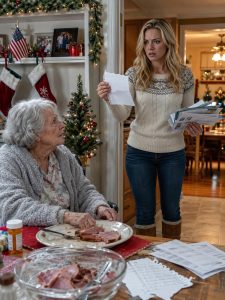
Just a handwritten note on torn notebook paper, sitting beside a plate of dried ham.
“Used your $8,500 loan for the family cruise. Take care of Grandma while we’re gone.”
They thought I would cry.
They thought I would forgive them.
They forgot one thing.
I had learned how to keep receipts.

PART 1 — THE NOTE ON THE KITCHEN TABLE
“You really left Grandma here like trash on Christmas?”
My voice sounded calm when I said it.
Too calm.
That was how I knew something inside me had finally died.
I didn’t knock when I came home. Why would I? It was my parents’ house, the same two-story place on Maple Ridge Road with the sagging porch, the cracked driveway, and the fake wreath Mom hung every December to make the neighbors think we were a warm, happy family.
I had helped pay the mortgage more times than I could count.
I had bought the new water heater.
I had covered Dad’s “temporary” bank overdrafts.
I had paid for Jacob’s “emergency car repair” that turned out to be a weekend trip to Nashville.
So no, I didn’t knock.
I pushed open the front door with a wrapped scarf in one hand and a grocery bag in the other, expecting noise.
Christmas noise.
Mom shouting from the kitchen.
Dad arguing with the TV.
Emily taking selfies by the tree.
Jacob complaining that the ham was dry.
Grandma laughing from her recliner, wrapped in the purple blanket she crocheted before her hands got stiff.
But the house was silent.
Not peaceful.
Empty.
The Christmas tree blinked in the living room like it was embarrassed to be there. Half the lights were out. The angel on top leaned sideways. The carpet still had old pine needles from last year’s fake garland.
“Hello?” I called.
My voice bounced down the hallway.
Then I heard it.
A fork scraping against a plate.
Slow.
Weak.
From the kitchen.
My stomach tightened before I even turned the corner.
Grandma sat alone at the kitchen table in her purple sweater, the one with a missing button near the collar. Her thin white hair was pinned back messily. A paper plate sat in front of her with cold stuffing, dried-out ham, and a spoonful of cranberry sauce that had formed a skin.
She looked up at me with tired eyes.
“Hi, sweetheart.”
I stared at her.
“Where is everybody?”
She didn’t answer.
That was the first warning.
Grandma reached across the table with trembling fingers and slid a folded piece of notebook paper toward me.
My name was written across the front.
Not “Merry Christmas.”
Not “We’ll be back soon.”
Just my name.
I opened it.
The words were short.
Almost lazy.
Spent your $8,500 loan on a family cruise. Sorry. Take care of Grandma while we’re gone. Love, Mom.
For a second, I couldn’t understand English.
The words were there, but my brain refused them.
My $8,500 loan.
The money I had saved for dental surgery.
The money I earned working night shifts, taking weekend Uber rides, designing cheap logos for people who paid late, skipping lunches, skipping sleep, telling myself the pain in my jaw would be fixed soon.
Gone.
Not borrowed.
Not delayed.
Gone.
On a cruise.
I looked at Grandma.
“They left yesterday,” she said softly.
My fingers tightened around the note.
“They left you here?”
She looked down at her plate.
“With leftovers.”
I laughed once.
Not because it was funny.
Because if I didn’t laugh, I might have broken something.
“They took my surgery money,” I said. “They left you alone on Christmas. And they wrote a note like they were asking me to water the plants?”
Grandma’s mouth trembled, but she didn’t cry.
She had outlived too much to waste tears on cowards.
“I told them I didn’t want to stay alone,” she whispered. “Your mother said you’d come. She said you never say no.”
That hit harder than the note.
Because she was right.
I never said no.
When Mom called in November, her voice had been soft and syrupy.
“Sweetheart, your dad and I just need a short-term loan. We’ll pay you back by February. It’s for family. You understand.”
I asked how much.
She said $8,500.
I almost said no.
I should have said no.
But then she said the sentence she always used when she wanted to put a leash around my throat.
“After everything we’ve done for you, this is the least you can do.”
Everything they’d done for me.
Like kicking me out at seventeen because I refused to lie for Jacob after he stole Grandma’s pain pills.
Like missing my college graduation because Emily needed help moving into her boyfriend’s apartment.
Like forgetting my birthday three years in a row.
Like calling me selfish every time I didn’t answer their texts fast enough.
But when they needed money, suddenly I was family.
I sat down across from Grandma.
The chair was cold.
The kitchen smelled like old grease and refrigerator air.
“Did they at least leave your medication organized?” I asked.
Grandma looked away.
That was answer enough.
I stood up and opened the cabinet beside the sink.
Empty pill bottles.
A blood pressure cuff with dead batteries.
A stack of unpaid pharmacy receipts shoved behind a box of instant oatmeal.
My chest went tight.
“Grandma.”
“I didn’t want to bother you,” she said.
“You’re not bothering me.”
She looked at me then, really looked at me, and for the first time that night, I saw the shame in her face.
Not because she had done anything wrong.
Because they had made her feel like needing help was a crime.
I pulled out my phone and opened the family group chat.
Nothing.
No Merry Christmas.
No update.
No “we landed safely.”
No “thank you.”
The last message was from Mom three weeks earlier.
Don’t forget to transfer the loan to Dad’s account. Cruise prices jump tomorrow.
Cruise.
I read it again.
Cruise.
They hadn’t even hidden it.
They had just trusted me to be too obedient to notice.
Grandma pushed her plate away.
“I saved something,” she said.
I looked up.
“What?”
She reached into the pocket of her sweater and pulled out a second note.
This one was different.
A folded receipt.
A bank receipt.
Cash withdrawal.
Two thousand dollars.
From Grandma’s pension account.
The withdrawal date was two days before Christmas.
My face went still.
“Who took this?”
Grandma swallowed.
“Your father said he needed it for bills.”
I already knew there were no bills.
At least none he planned to pay.
Something cold moved through me then.
Not rage.
Rage is hot.
This was cleaner.
Sharper.
Like ice forming over a wound.
“Grandma,” I said slowly, “how long have they been taking from you?”
She didn’t answer right away.
Then she looked toward the hallway, where the family photos hung crooked on the wall.
Mom smiling at church.
Dad holding a barbecue trophy.
Jacob in his high school football jersey.
Emily in a graduation cap none of us had been invited to watch her wear.
And me.
A small photo at the bottom.
Half hidden behind the thermostat.
“Since your grandpa died,” she said.
The room changed.
The Christmas tree kept blinking in the living room.
The fridge hummed.
Somewhere outside, a car drove past, tires crunching over frozen snow.
I sat very still.
“Show me everything,” I said.
Grandma’s eyes lifted.
“Sweetheart…”
“No.” I folded the note and placed it beside the bank receipt. “No more sweetheart. No more excuses. No more ‘that’s just how they are.’ They left you here to rot while they drank champagne with my money.”
Grandma stared at me for a long moment.
Then something in her face hardened too.
She pushed herself up slowly from the chair.
Her hip made her wince, but she didn’t stop.
“Then come with me,” she said.
“Where?”
“The garage.”
I followed her through the laundry room and into the cold garage where Dad kept broken tools, fishing rods, and secrets.
Grandma pointed to an old gray filing cabinet under a tarp.
“Your grandfather kept copies.”
My pulse changed.
“Copies of what?”
Grandma looked me straight in the eyes.
“Everything.”
And that was when Christmas stopped being a tragedy.
It became an investigation.
PART 2 — THE RECEIPTS IN THE GARAGE
“They called me a leech while drinking champagne paid for with my blood money.”
That was the sentence that turned my pain into a plan.
I found out the next morning.
Emily had posted on Instagram.
She must have forgotten I could still see her stories from my design account.
There they were.
My mother.
My father.
Jacob.
Emily.
All four of them on the deck of the Majestic Aurora, a luxury Caribbean cruise ship with glass railings, white towels, blue water, and waiters carrying drinks with fruit stabbed on tiny swords.
Mom wore oversized sunglasses and a floppy hat.
Dad had a cigar in his mouth.
Emily posed in a robe with champagne.
Jacob grinned like he had never stolen anything in his life.
The caption read:
Finally, peace away from all the leeches and negativity.
Leeches.
I stared at that word for a long time.
Grandma was asleep in the recliner behind me, wrapped in her blanket, her pill organizer newly filled beside her.
The house was quiet.
Too quiet.
I looked at Emily’s photo again.
Then I laughed.
Hard.
Ugly.
Once.
“They used my money,” I whispered, “and called me the leech.”
That was the moment I stopped feeling guilty.
By noon, Grandma and I were in the garage again.
The filing cabinet was a museum of betrayal.
Old bank statements.
Mortgage records.
Copies of checks.
Pension letters.
Property tax notices.
A copy of Grandpa’s will.
A second copy of Grandpa’s will.
That made me pause.
“Grandma,” I said, holding both papers, “why are there two wills?”
She looked over from a cardboard box full of Christmas ornaments.
Her expression went flat.
“One is the real one.”
My heart kicked.
“And the other?”
“The one your mother showed everyone after he died.”
The garage seemed to tilt.
I opened the first will.
Grandpa’s real signature was at the bottom. It left the house in trust for Grandma for life. After she passed, the house was to be sold and divided between the children.
But there was another clause.
A clause I read twice.
A separate emergency care fund of $42,000 shall remain for medical, housing, and personal support expenses of my wife, Margaret Elaine Carter, and shall not be withdrawn for any other purpose.
I looked at Grandma.
“Where is this fund?”
Her lips pressed together.
“Your mother said legal fees ate it.”
I opened the second will.
The fake one.
Same structure.
Different clause.
No care fund.
No restrictions.
Just a vague line about “family discretion.”
My hands went numb.
“They forged this.”
Grandma didn’t speak.
She didn’t have to.
I took photos of both.
Then I called a lawyer.
Not a family friend.
Not someone from Mom’s church.
A real elder abuse attorney two counties over named Natalie Brooks.
Her assistant answered first.
I said, “My family stole my surgery money, abandoned my disabled grandmother on Christmas, and I think they forged my grandfather’s will.”
There was silence.
Then the assistant said, “I’m transferring you directly.”
Natalie’s voice was calm and low.
“Start from the beginning,” she said.
So I did.
For forty-seven minutes, I told her everything.
The loan.
The cruise.
The note.
The pension withdrawal.
The missing medication.
The two wills.
The Instagram caption.
Grandma sat beside me the whole time, hands folded, face pale but firm.
When I finished, Natalie said, “Do not confront them yet.”
I almost laughed.
“They’re on a boat.”
“Good,” she said. “Then they can’t walk into the house and destroy evidence. Photograph everything. Scan everything. Get Grandma’s permission in writing for you to review her accounts. Contact the bank. Ask for login history. And install cameras immediately.”
“Cameras?”
“If they come back angry, you’ll want more than your word.”
So I bought three cheap indoor cameras from Walmart.
One for the kitchen.
One for the living room.
One for the front porch.
Grandma watched me climb a chair to install the kitchen camera above the cabinets.
“I feel like we’re in one of those crime shows,” she said.
“We are,” I said. “Except the criminals have matching cruise bracelets.”
For the next three days, I barely slept.
I built a spreadsheet.
Every transaction.
Every withdrawal.
Every payment labeled “urgent.”
Every Venmo request from Emily for “rent” that matched Sephora purchases.
Every cash withdrawal near Dad’s favorite casino.
Every bank login from Mom’s iPad.
Every transfer from Grandma’s pension account into Dad’s checking account.
Every promise to pay me back.
Every lie.
Natalie helped us request bank records.
Grandma signed authorization forms with a hand that shook only once.
The bank manager was a woman named Denise who knew Grandma from church.
When she saw the statements, her polite smile disappeared.
“Margaret,” she said carefully, “did you authorize these online transfers?”
Grandma looked at me.
Then back at Denise.
“No.”
Denise closed the folder.
“I’m going to escalate this.”
By day four, we had enough to scare them.
By day five, we had enough to destroy them.
Then the porch camera caught someone.
Kelly.
Jacob’s wife.
She arrived after dark, hood up, face red from crying.
I opened the door before she could knock twice.
“I shouldn’t be here,” she whispered.
“Then why are you?”
She looked past me at Grandma, who sat in the living room with a blanket over her knees.
Kelly broke.
“I didn’t want to go on the cruise,” she said. “I told Jacob it was wrong. I told him leaving Grandma like that was wrong.”
I said nothing.
She wiped her face.
“He said you’d fix it. He said you always fix everything. And if you didn’t, Mom said Grandma could ‘learn to appreciate what people do for her.’”
Grandma flinched.
My hand tightened on the doorknob.
Kelly looked at me, desperate.
“They planned it. All of them. Your mom said you trusted them too much to call the police. Emily laughed and said you’d probably apologize for being upset.”
The camera above the porch caught every word.
I asked softly, “Will you repeat that with consent to record?”
Kelly stared at me.
Then she nodded.
“Yes,” she whispered. “I’m tired of lying for them.”
That recording became the match.
The cruise ended four days later.
They came home sunburned, bloated, loud, and smiling.
Emily walked in first, dragging a designer suitcase across the floor.
“Ugh, I need real food,” she said. “Ship food gets old.”
Mom stepped in behind her, sunglasses still on indoors.
She looked around the kitchen and frowned.
“Did you even clean?”
Dad came in with a duty-free liquor bag.
Jacob dropped onto the couch without looking at Grandma.
“Still alive?” he muttered.
The old me would have frozen.
The old me would have swallowed it.
The old me would have tried to keep peace.
But the old me was gone.
I was sitting at the kitchen table with my laptop open.
Grandma sat beside me.
Natalie was on speakerphone, muted.
Three cameras were recording.
And on the table in front of me were two notes.
The one they left for me.
And the one Grandpa left for Grandma.
I looked at all of them.
“Sit down,” I said.
Mom laughed.
“Excuse me?”
I clicked the first file open.
“I said sit down.”
And for once in their lives, they heard something in my voice that made them obey.
PART 3 — THE EMAIL THEY THOUGHT I WOULDN’T SEND
“You have forty-eight hours to return every stolen dollar, or I send this to the police, the bank, Grandma’s attorney, and every local news station within one hundred miles.”
Nobody moved.
Nobody breathed.
Even Dad stopped chewing the mint he stole from the cruise lounge.
Mom stared at the laptop like it had just pulled a gun.
Emily sat with her arms crossed, trying to look bored, but her face had gone pale under her spray tan.
Jacob leaned back in his chair and smirked.
“You’re being dramatic.”
I clicked play.
The first file opened.
A spreadsheet.
Clean.
Organized.
Brutal.
Date.
Amount.
Account.
Recipient.
Notes.
Grandma’s pension transfers.
Dad’s casino-adjacent withdrawals.
Mom’s online login records.
Emily’s “emergency” payments.
Jacob’s cash app requests.
My $8,500 “loan.”
The room went quiet in a way I had never heard before.
Not peaceful.
Cornered.
Mom’s voice sharpened.
“Where did you get that?”
“From the bank,” I said. “With Grandma’s permission.”
Dad stood.
“You had no right digging through private family finances.”
I looked at him.
“You had no right stealing from an elderly woman with a bad hip and blood pressure medication she couldn’t afford because you emptied her account.”
Grandma inhaled beside me.
Dad pointed at me.
“You watch your mouth.”
“No,” I said. “You watch the screen.”
I clicked the next file.
Screenshots.
Mom texting Emily.
He won’t notice the cruise deposit missing. He trusts us too much.
Emily replying:
He’s such a softie. Plus, who leaves Grandma alone on Christmas anyway? LOL.
Emily’s mouth fell open.
“That’s private.”
“So was my money.”
Jacob leaned forward.
“You’re seriously going to ruin your own family over some cash?”
I almost smiled.
“Some cash?”
I opened the photo of the note.
The one Mom wrote.
Then I opened Emily’s Instagram story.
Champagne.
Bathrobes.
Blue ocean.
Leeches and negativity.
Emily’s eyes widened.
“You stalked my Instagram?”
“You posted stolen money with a caption.”
Dad slammed his hand on the table.
Grandma jumped.
I didn’t.
The kitchen camera blinked red above us.
Dad noticed it.
“What the hell is that?”
“A camera,” I said.
His face changed.
That tiny flicker of fear was almost beautiful.
Mom looked up.
“You recorded us?”
“Only in the common areas of a house Grandma legally occupies,” I said. “Natalie explained the rules.”
Mom’s eyes narrowed.
“Who is Natalie?”
That was when I unmuted the phone.
A woman’s calm voice filled the kitchen.
“Natalie Brooks. I represent Margaret Carter in matters concerning elder financial abuse, unauthorized account access, and potential probate fraud.”
Mom’s face drained.
Jacob shot up.
“You got a lawyer?”
“No,” Grandma said.
Her voice was small but steady.
“I did.”
Everyone turned to her.
For years, they had treated Grandma like furniture.
Something old.
Something soft.
Something they could move, ignore, or sit beside when they wanted to look decent at Thanksgiving.
But now she sat at the table like a judge.
Her hands trembled, but her eyes did not.
“I trusted you,” she said.
Mom opened her mouth.
Grandma raised one finger.
“No. You talked enough.”
Mom shut it.
Grandma looked at Dad.
“You took my pension.”
Dad’s jaw worked.
“It was for bills.”
Grandma looked at Emily.
“You asked me for medicine money, then bought makeup.”
Emily looked down.
Grandma looked at Jacob.
“You stole pills from me once, and your parents threw him out for telling the truth.”
Jacob’s face turned red.
“That was years ago.”
“And you are still the same boy,” Grandma said.
That landed like a slap.
Then I opened the final folder.
“Before you decide whether to keep lying,” I said, “there’s one more thing.”
I clicked play.
Kelly’s voice came through the laptop speakers.
Shaky.
Clear.
I didn’t want to go. I told Jacob it was wrong. He said if you didn’t give the money, they’d just leave Grandma and deal with it later. Your mom said you always cave. Emily laughed. I’m sorry. I’m so sorry. I can’t lie anymore.
Jacob lunged toward the laptop.
I shut it and pulled it back.
“You recorded my wife?” he shouted.
“She consented.”
“She’s lying.”
“No,” I said. “She’s finally telling the truth.”
Mom stood, trembling with rage.
“You ungrateful little snake.”
There it was.
The real mother.
Not the church smile.
Not the Thanksgiving apron.
Not the sweet voice she used when asking me for money.
The woman underneath.
Cold.
Proud.
Furious that her victim had learned paperwork.
“You think you’re better than us?” she hissed.
I looked at her for a long second.
“No,” I said. “I think I’m finished being useful to people who hate me.”
Dad laughed bitterly.
“You’ll regret this.”
I turned the laptop around.
An email draft filled the screen.
Subject line:
Formal Report: Elder Financial Abuse, Unauthorized Account Access, Misappropriation of Funds, Possible Probate Fraud
Attached files:
Bank records.
Screenshots.
The note.
The cruise posts.
The two wills.
Kelly’s recording.
Camera footage.
A timeline.
A signed statement from Grandma.
Recipients:
Adult Protective Services.
County Sheriff’s Department.
Grandma’s attorney.
Bank fraud department.
Social Security fraud division.
Two local news stations.
The county ombudsman.
Mom stopped breathing.
Emily whispered, “You wouldn’t.”
I looked at her.
“You left Grandma alone with cold ham on Christmas and called me a leech.”
Her eyes filled with tears.
I felt nothing.
“You have forty-eight hours,” I said. “Return my $8,500. Return Grandma’s stolen pension money. Sign written repayment agreements for the rest. Cooperate with Natalie. Or I send it.”
Jacob scoffed.
“You’re bluffing.”
Grandma stood.
Slowly.
Painfully.
But she stood.
She placed both palms on the table and looked at all of them.
“I raised three children in this house,” she said. “I cooked for you. Cleaned for you. Prayed for you. Changed your diapers. Paid your bills when you failed. And when I got old, when I needed help walking to the bathroom, you left me with frozen beans and moldy pie while you sailed away on stolen money.”
No one spoke.
Grandma’s voice lowered.
“You are lucky he is the one handling this.”
Mom swallowed.
Dad looked away.
Jacob stared at the floor.
Emily cried harder.
Then Grandma said the sentence that ended the family.
“Because if it were just me, I would have called the police before you ever got off that ship.”
Dad grabbed his liquor bag and stormed out.
Mom followed, muttering about betrayal.
Emily tried to hug Grandma.
Grandma stepped back.
Jacob looked at me with pure hatred.
“You’re not family anymore.”
I smiled.
“No,” I said. “I’m finally free.”
They didn’t pay.
Not in forty-eight hours.
Not in twenty-four.
They sent texts.
Mom: You’re being emotional.
Dad: We can talk like adults.
Emily: Please take down the screenshots. My boss saw them.
Jacob: You ruined Christmas over money.
So I sent the email.
At 6:13 p.m., Adult Protective Services replied.
A case has been opened.
By morning, the story had teeth.
A local reporter called Natalie.
The article went live that afternoon.
Family Accused of Stealing Disabled Grandmother’s Pension, Abandoning Her on Christmas Cruise
They didn’t use our full names at first.
They didn’t need to.
Emily’s Instagram screenshots did the work.
The champagne photo spread fast.
Her caption became a meme.
“Leeches and negativity” appeared under every post she made.
Her marketing firm put her on leave by Friday.
She called me screaming.
“Do you know what you’ve done?”
I said, “Yes. I returned the favor.”
Mom showed up at the house that night.
No makeup.
Hair messy.
Eyes red.
For one second, I almost saw my mother.
Then she opened her mouth.
“You need to stop this before you destroy us.”
I leaned against the porch railing.
“You brought a check?”
She pulled an envelope from her purse and slapped it into my hand.
A cashier’s check.
$8,500.
My surgery money.
“No interest?” I asked.
Her face twisted.
“You’re lucky you’re getting anything.”
I handed the check back.
She blinked.
“What are you doing?”
“Natalie said all repayments go through the attorney’s trust account now. Clean records.”
Mom’s lips parted.
“You think I’m a criminal?”
“No,” I said. “I know you are.”
She slapped me.
Hard.
The porch camera caught it perfectly.
For a second, the whole street went quiet.
Then Grandma’s voice came from behind me.
“Carla, get off my porch.”
Mom turned.
Grandma stood in the doorway holding her cane like a weapon.
“You chose a boat over blood,” Grandma said. “Now live with the ocean.”
Mom left.
The next morning, Natalie filed for an emergency protective order over Grandma’s finances.
The bank froze disputed access.
Dad’s card stopped working at a gas station.
Jacob’s paycheck became eligible for garnishment.
Emily’s employer requested a statement.
Kelly filed for separation.
That one hit Jacob hardest.
He showed up three days later unshaven, furious, pacing in the driveway.
“You turned my wife against me.”
“No,” I said. “You showed her who you are.”
He stepped closer.
I didn’t move.
The porch camera was still recording.
A police cruiser slowed at the end of the street.
Natalie had told me to call non-emergency if he came by.
I had.
Jacob noticed the cruiser and stopped.
I handed him a legal letter.
“Pay your share.”
He ripped it in half.
I handed him another copy.
“I printed six.”
His face went purple.
“You think you won?”
I looked past him at the house.
At Grandma in the window.
At the porch light Grandpa installed with his own hands.
At the driveway where I had stood at seventeen with garbage bags full of my clothes because I told the truth.
“Yes,” I said.
And for the first time, I meant it.
PART 4 — THE FAMILY I BUILT AFTER THEY LOST EVERYTHING
“They destroyed their own name trying to bury mine.”
That is what I told Grandma three months later at a small-town diner with checkerboard floors, cracked red booths, and coffee so bad it tasted like old tires.
She laughed so hard she nearly dropped a French fry into her milkshake.
It was the first real laugh I had heard from her in years.
Not polite.
Not careful.
Real.
The legal mess didn’t disappear overnight.
People like my family never fall in one dramatic explosion.
They collapse piece by piece.
First came the money.
Mom and Dad returned the $8,500 through Natalie’s office because they had no choice.
Emily paid $3,100 in four humiliating installments after her boss suspended her and her landlord threatened late fees.
Jacob paid $2,700 after his wages were garnished and his own boss found out why.
The total came to just over $14,300 with interest and fees.
I used part of it for my dental surgery.
When I woke up afterward, sore and swollen but finally free of that constant pain, Grandma sat beside my hospital bed holding my hand.
“You should have had this done months ago,” she whispered.
“I know.”
Her face crumpled.
“I’m sorry.”
I squeezed her fingers.
“You didn’t do it.”
She looked at me with wet eyes.
“But I let them take too much.”
“No,” I said. “They took too much. There’s a difference.”
The rest of the money went where it should have gone all along.
A proper lift chair for Grandma.
A part-time home nurse.
Medication delivery.
A locked interest-bearing account in Grandma’s name with access restricted to her and me.
Natalie helped rewrite every document.
Power of attorney.
Medical directive.
Bank authorization.
Property records.
The real will went back into the official file.
The fake one went into evidence.
When Grandma signed the new paperwork, her hand shook.
Not from fear this time.
From relief.
“They took everything from me,” she said.
I shook my head.
“They tried.”
She looked up.
I smiled.
“But they didn’t take you.”
After the article spread, my family tried to rewrite the story.
Of course they did.
Mom told relatives I had manipulated Grandma because she was “confused.”
That lie died when Grandma stood up in church one Sunday and told the entire women’s Bible group exactly what happened.
By Monday, Mom stopped attending.
Dad told people it was a “private financial misunderstanding.”
That lie died when the bank opened its internal fraud investigation.
Emily posted inspirational quotes about forgiveness.
That lie died when someone commented, “Forgiveness usually comes after repayment, not champagne.”
She deleted the post.
Then her account.
Then came Jacob.
He made a video about “toxic siblings” and “family betrayal.”
Kelly reposted it with one sentence:
Tell them why I left.
He deleted the video within twenty minutes.
Kelly moved into a small apartment across town with the kids.
I helped her carry boxes one Saturday morning.
She looked embarrassed when I showed up.
“You don’t have to do this,” she said.
“I know.”
She looked down.
“I should have said something sooner.”
I lifted a box labeled KITCHEN.
“Yes,” I said. “You should have.”
Her face fell.
Then I added, “But you said it when it counted.”
She cried then.
Quietly.
Not like my family cried.
Not to manipulate.
Just because she was tired.
I understood that kind of tired.
Months passed.
The house on Maple Ridge Road went up for review after Natalie found old documents proving Grandma’s life tenancy had been ignored.
Mom and Dad had been treating the house like theirs.
It wasn’t.
Not fully.
Not legally.
Not anymore.
They had used Grandma’s name when it helped them, erased it when it didn’t, and called it family.
The court didn’t call it family.
The court called it exploitation.
Mom lost control over Grandma’s accounts.
Dad’s access was permanently revoked.
Jacob was ordered to repay additional unauthorized withdrawals.
Emily lost two brand partnerships she had been bragging about since Thanksgiving.
The boutique marketing firm let her go “due to reputational concerns.”
That phrase made Grandma smile for three straight days.
“Reputational concerns,” she repeated one morning over toast. “That’s a fancy way to say people found out you’re awful.”
I laughed.
Peace came slowly.
Not as fireworks.
As small ordinary things.
Grandma sleeping through the night.
Me turning off my phone without panic.
Buying groceries without checking my account six times.
Eating dinner without waiting for someone to ask for money.
Moving into a quiet two-bedroom apartment downtown.
One room for me.
One room for Grandma.
She decorated hers with framed photos, crocheted blankets, and a little wooden cross from Grandpa’s old toolbox.
She called it “the fort.”
I called it home.
One night, a week after we moved in, she knocked on my bedroom door.
I was sitting on the floor building a cheap bookshelf.
“Can I ask you something?” she said.
“Always.”
She sat carefully on the edge of the bed.
“When you saw that note on Christmas,” she asked, “why didn’t you leave?”
I turned the screwdriver in my hand.
For a moment, I was back in that kitchen.
Cold ham.
Blinking Christmas lights.
Grandma’s tired eyes.
Mom’s note.
The old me might have left.
The old me might have gone home, cried, blocked everyone, and let them get away with it because fighting felt too expensive.
But something about seeing Grandma alone had changed the shape of my fear.
“I stayed,” I said, “because I remembered who I was before they trained me to feel guilty for having boundaries.”
Grandma nodded slowly.
Then she reached for my hand.
“I’m proud of you.”
That sentence broke something open in me.
Not pain.
Not anger.
Something softer.
Something I thought my family had killed.
I had wanted those words from my mother my whole life.
I had worked for them.
Paid for them.
Begged silently for them.
And they came from the one person who had deserved protection all along.
So here is what happened to my family.
Mom lost her perfect church-lady reputation.
Dad lost access to money he never earned.
Emily lost her job, her online image, and the fantasy that cruelty looks cute with champagne.
Jacob lost his wife, his control, and a chunk of every paycheck.
And me?
I lost a family that only loved me when my bank account was useful.
Which means I didn’t lose much.
I gained sleep.
I gained peace.
I gained a home where nobody leaves cruel notes on Christmas.
I gained the right to say no without explaining myself.
And Grandma gained something too.
Her name back.
Her money back.
Her dignity back.
Last Christmas, we didn’t go to their house.
We made dinner in our apartment.
A small ham.
Mashed potatoes.
Green beans.
Store-bought pie because neither of us wanted to pretend we could bake.
Kelly came with the kids.
Natalie dropped by with cookies.
Denise from the bank sent a card.
Grandma sat at the head of the table in her lift chair, wearing her purple sweater, smiling like a queen who had survived the war and kept the crown.
Before we ate, she raised her glass of sparkling cider.
“To receipts,” she said.
Everyone laughed.
Then she looked at me.
“And to the people who stay.”
I smiled.
Outside, snow fell softly over the parking lot.
Inside, the apartment was warm.
No shouting.
No guilt.
No one asking for money.
No one calling me selfish.
For the first time in my life, Christmas didn’t feel like a test.
It felt like mine.
And if you’re wondering whether my family ever apologized, the answer is simple.
They apologized to the judge.
They apologized to the bank.
They apologized to their bosses, their church friends, and every relative who stopped inviting them to dinner.
But they never truly apologized to me.
That’s okay.
I didn’t need their apology to heal.
I needed the truth.
And once I had it, I did what they never expected.
I used it.